
Duchy of the Archipelago
When Constantinople fell to the knights of the Fourth Crusade in 1204, the Byzantine Empire shattered into pieces, and ambitious men reached for the fragments. One of them was a Venetian nobleman named Marco Sanudo. In 1207 he borrowed eight galleys from the Venetian Arsenal, sailed into the Aegean without asking anyone's permission, and carved out a private kingdom among the scattered islands of the Cyclades. He called himself Duke of the Archipelago, ruled it from Naxos, and his successors held it for more than three and a half centuries.
A Freelance Conquest
Sanudo was the nephew of Enrico Dandolo, the blind old Doge who had steered the Fourth Crusade to Constantinople, and he had inherited the family appetite for empire. His expedition was nobody's official policy. He anchored at the harbour of Potamides, in the southwest of Naxos near modern Pyrgaki, and seized most of the island fast. But the Naxiotes did not surrender. They fell back inland to the mountain fortress of Apalyros and held out for five or six weeks, helped by the Genoese, Venice's bitter commercial rivals. When the fortress finally fell, the island was Sanudo's. By 1210 he and his companions had taken Melos and most of the rest of the Cyclades, and the Duchy of the Archipelago was born - centered on Naxos and Paros, embracing nearly all the islands except Mykonos and Tinos.
Fifty-Six Fiefs
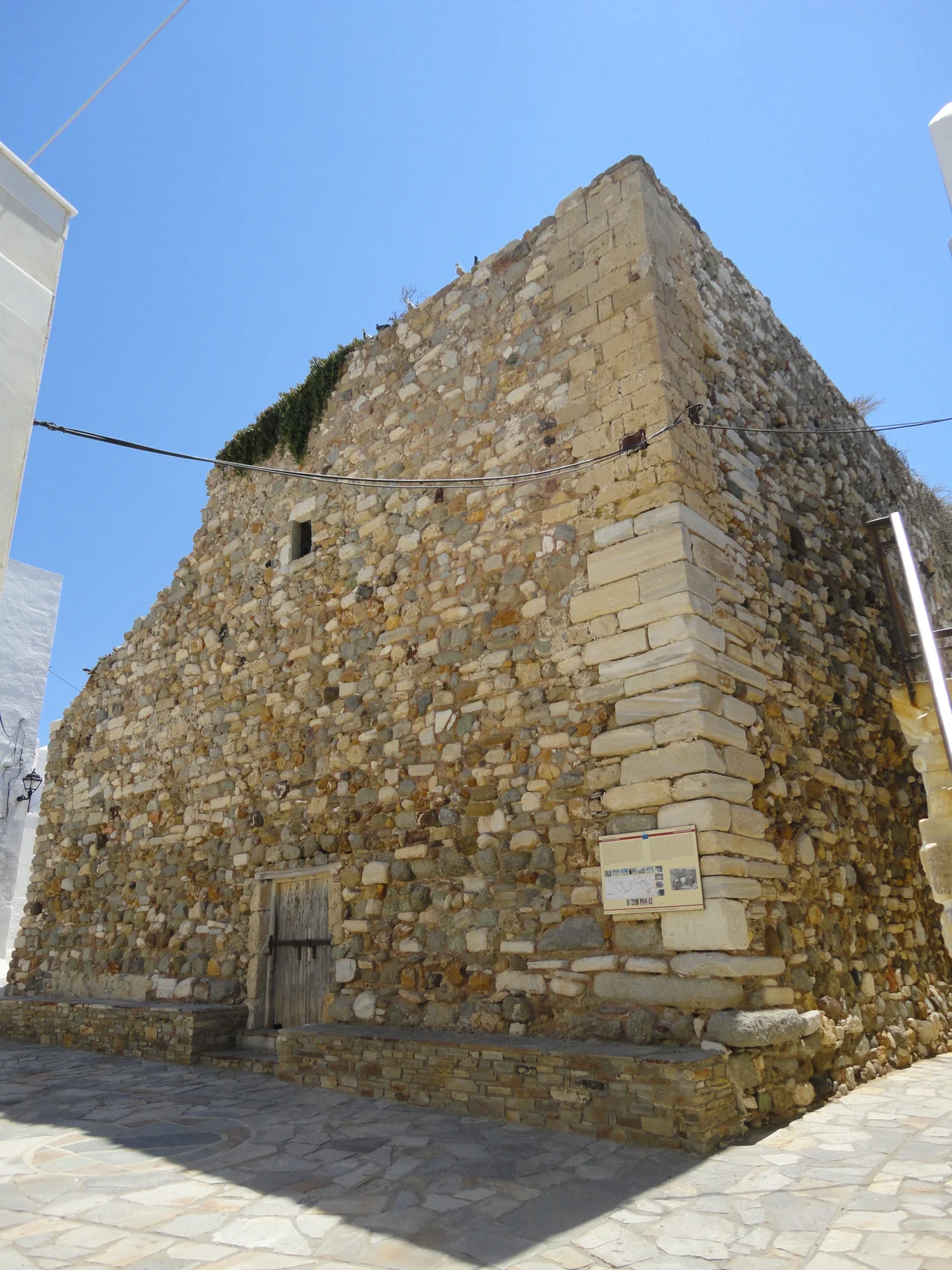
Sanudo governed like a feudal lord transplanted from western Europe. He rebuilt a strong fortress on the old acropolis of Naxos and split the island into fifty-six provinces, parceling them out as fiefs to the captains who had sailed with him. Each held his land in near-independence and paid his own way. For the Greek islanders, the change was less jarring than it might sound: they had lived under the Byzantine pronoia, a landowner system not so different in practice, and most submitted peacefully. Sanudo and his heirs were shrewd about it. Rather than crush the population, they courted it, even granting fiefs to local Byzantine notables to tie them to the new dynasty. The conqueror ruled for twenty years, from 1207 to 1227.
Two Churches, One Island
The Venetians brought the Catholic Church with them, and Sanudo established a Latin archbishopric on Naxos. But the rulers were a thin layer of often-absentee landlords atop a Greek Orthodox majority that stayed Orthodox. Sanudo himself, unlike some who came after him, did not try to force conversions; later dukes leaned harder, restricting Orthodox clergy and barring Orthodox Christians from positions of power. The islands mattered to Venice for cold strategic reasons - they commanded the trade routes to Anatolia and the eastern Mediterranean. The Venetians mined Naxos for marble and for corundum, the abrasive emery stone, and shipped it home. The legacy of that long rule is still audible: Catholic villages survive on islands like Syros and Tinos, and Cycladic surnames such as Venieris, Ragousis and Dellaportas carry their Italo-Venetian origins to this day.
The Long Decline
Twenty-one dukes of two dynasties, Sanudo and then Crispo, ruled the Archipelago across the centuries, shifting their nominal allegiance from the Latin emperors to the princes of Achaea, to the Angevins of Naples, and finally to Venice itself. The state was never secure. A revived Byzantine fleet under the admiral Licario stripped away most of the islands in the late thirteenth century before fading again. The Catalan Company raided in 1317. In 1383 the Crispo family overthrew Sanudo's heirs, and under them order and farming decayed while piracy flourished. The end came under the Ottomans: Duke Giacomo IV was deposed in 1566, already a tributary of Sultan Selim II. The sultan's chosen successor was Joseph Nasi, a Portuguese-born Sephardic Jew who had fled the Inquisition and risen to become a confidant of the Ottoman court - the last real Duke of the Archipelago, ruling islands he is said never to have visited.
From the Air
The Duchy was governed from Naxos, the largest island of the Cyclades, centered near Chora at roughly 37.10 N, 25.37 E. From altitude the Cyclades scatter across the central Aegean like a handful of stones - Naxos and Paros side by side at the group's heart, with the smaller islands the Sanudos once held radiating outward. The Kastro, Sanudo's hilltop fortress, still crowns the old town of Naxos. Nearest airport is Naxos Island National (LGNX), about 3 km south of Chora. Recommended viewing altitude 4,000-8,000 ft to take in the island cluster; summer visibility is superb, but the meltemi wind that funnels through the Cyclades can make the crossing brisk and turbulent.
Nearby Stories
- Apollon Theater, Syros 1.6 km away
- Panagia Tourliani 8.5 km away
- Keros 15 km away
- Ikaria 21 km away
- Archaeological Museum of Sifnos 30 km away
- Kimolos 39 km away
- Astypalaia 49 km away
- Cave of the Apocalypse 49 km away