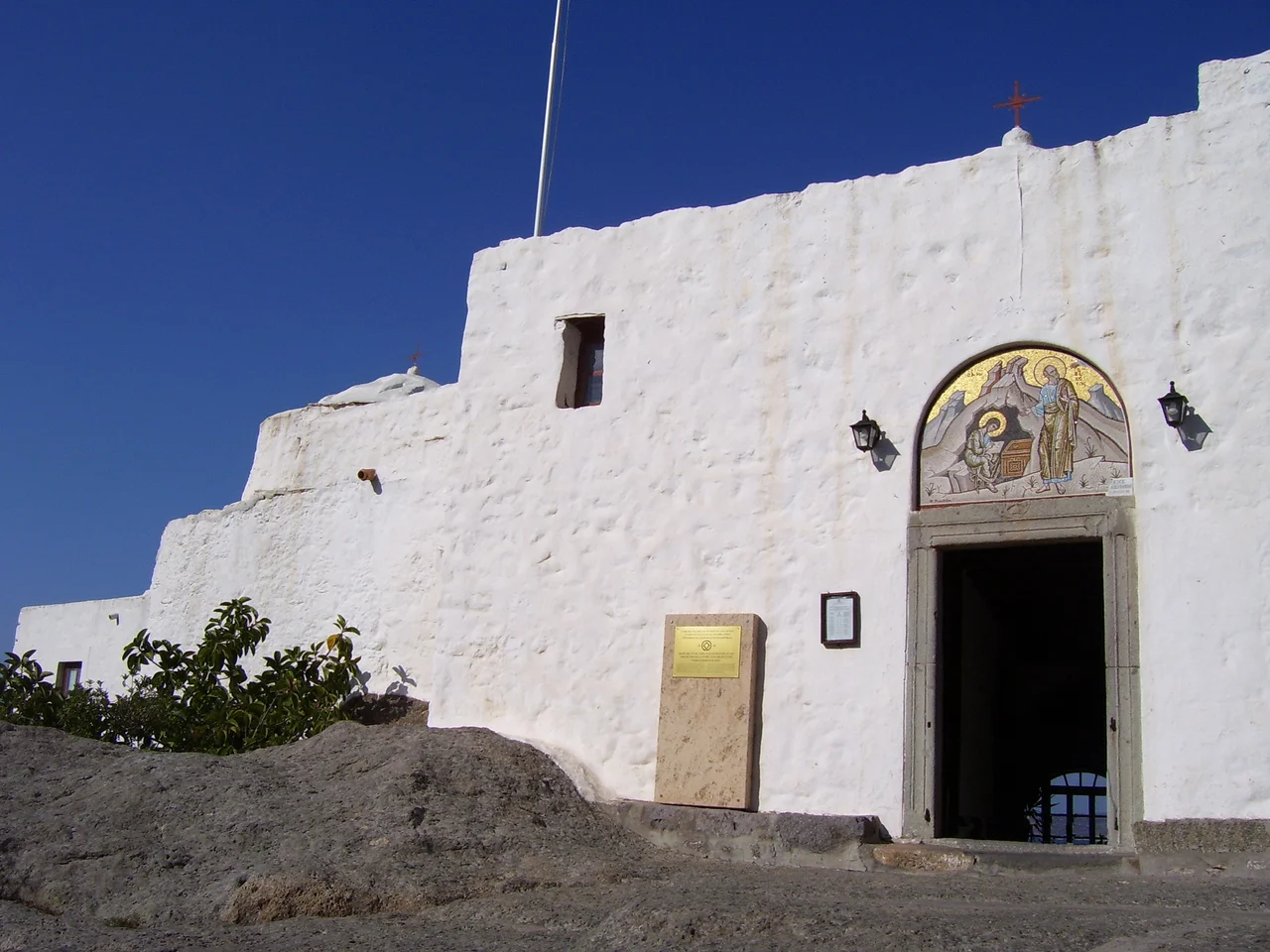

Cave of the Apocalypse
Halfway up the mountain, between the port of Skala and the white town of Chora, the road passes a small grotto cut into the rock. By Christian tradition, this is where the world was shown its own ending. Here, the faithful hold, John of Patmos heard a voice and wrote down the visions that became the Book of Revelation - the fire, the seven seals, the new Jerusalem descending from heaven. Whatever one believes, few caves on Earth have launched more imagination, dread, and art.
A Prisoner on a Rock
The story begins with exile. In the 1st century, Rome regarded the early Christians with suspicion - a strange and troublesome cult - and prophecy of any kind was treated as a threat to imperial power. According to Christian tradition, during the reign of the emperor Domitian, John was banished to Patmos, a small and rocky island, to serve out his sentence. He was not alone. Others were sent here too, including, by tradition, his faithful scribe Prochorus. The cave became their refuge from the harsh conditions of the island. It is worth pausing on that fact: the most influential vision of cosmic justice in Western literature is said to have come not from a throne or a temple, but from a banished man sheltering in a hole in the rock.
The Three Clefts
Step inside and the cave is small, dim, and intimate. The most striking feature is a fissure in the rock that splits into three thin openings. Christian tradition reads them as a symbol of the Holy Trinity, and holds that through them John heard the voice that told him to write down what he saw and send it to the seven churches. Pilgrims today may touch these three clefts. The cave preserves other relics of the tradition: a hollow in the wall said to be where the elderly John rested, with a worn grip in the stone to help him rise; a natural ledge where his scroll is said to have lain; and a lectern, built at human height, that tradition assigns to Prochorus. Portraits and sculptures of the apostle line the walls. It is a place of silence and prayer, still open to all who come.
From Vision to Monument
What was once a place of banishment became a destination of pilgrimage. The grotto was enshrined as a Greek Orthodox church and remains one to this day. Around its entrance once stood a chapel dedicated to St. Anne, the mother of Alexios Komnenos - the Byzantine emperor who, in 1088, gave the island to the monk Christodoulos. The monastery Christodoulos founded crowns the island's summit, and together with the cave it forms a single sacred landscape. In 1999, UNESCO recognized that landscape as a World Heritage Site, naming the cave one of the most sacred sites of Christianity. The island that Rome chose as a punishment is now visited precisely because of what happened during that punishment.
Why Here, Why This
Geography shaped the vision as much as faith did. Patmos is a small volcanic island near the western edge of the Dodecanese, off the coast of Asia Minor - remote enough to serve as a prison, close enough to remain connected to the early churches John addressed. The cave sits along a steep road that climbs from the sea toward Chora, and the path beyond it once led to a temple of Artemis, a reminder that this rock was held holy long before Revelation was written. To stand at the cave's mouth and look out over the Aegean is to understand why a man might imagine, here, both the end of one world and the dawn of another.
From the Air
The Cave of the Apocalypse lies at 37.31°N, 26.54°E, partway up the slope between Skala and Chora on Patmos, in the eastern Aegean's Dodecanese. Patmos has no airport; the nearest fields are Samos (LGSM) to the north and Leros (LGLE) to the south, with ferries serving the island. From altitude, look for the small, irregular island crowned by the dark fortified mass of the Monastery of Saint John the Theologian, with the cave on the hillside below it. Clear skies are typical in summer.
Nearby Stories
- Temple of Athena Polias (Priene) 21 km away
- Panagia Hozoviotissa Monastery 30 km away
- Bodrum Castle 33 km away
- Kouros of Apollonas 46 km away
- Bodrum 48 km away
- Battle of Corycus 54 km away
- Astypalaia 59 km away
- Mastichochoria 70 km away