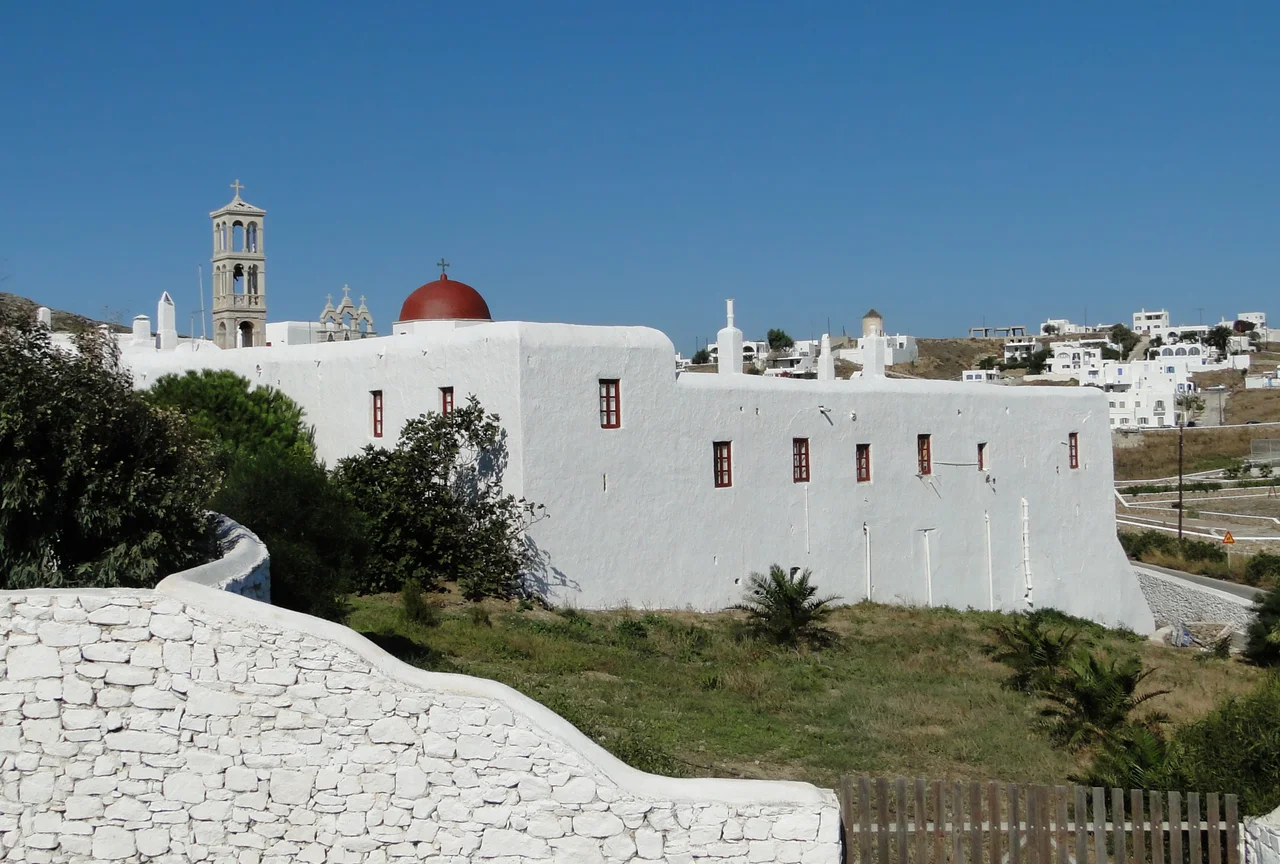

Panagia Tourliani
Most visitors to Mykonos never leave the coast, never climb away from the beaches and the bars into the island's quiet interior. Seven kilometres inland from the white maze of Chora, in the village of Ano Mera, a tall marble spire rises above a courtyard most tourists miss entirely. This is Panagia Tourliani, the patron monastery of the whole island, the spiritual centre of a place better known for its nightlife. Behind its plain whitewashed walls waits an interior so ornate it seems to belong to another country altogether.
Refuge and a Miraculous Icon
Two stories explain how the monastery came to be. By one tradition, it was founded by fugitive monks from Paros who sought asylum on Mykonos and took refuge in a small church high on the island, where a nun named Tourli served, giving the place her name. By another, the name comes from the sea district of Tourlos, just outside Mykonos Town, where a miraculous icon of the Virgin Mary was found floating in the water. That icon, still venerated here, is held by tradition to be the work of Luke the Evangelist himself. Whichever story is true, the monastery was formally founded in 1542, on the site of an older church, and dedicated to the Dormition of the Theotokos.
Florentine Gold in a Cycladic Village
Between 1757 and 1767 the hieromonk Ignatios Basoula renovated the monastery into the form it keeps today. Its church is a three-aisled, cruciform Byzantine structure, domed, topped by a soaring marble spire that announces it from across the valley. But the true astonishment is inside. In 1775, Florentine artists designed and built an imposing altarpiece of gilded, wood-carved Baroque, an iconostasis stretching ten and a fifth metres across all three aisles of the church. Its icons were painted by an iconographer named Ioannis from Corfu. The effect, this lavish Italian Baroque gleaming in a stone church on a windswept Greek island, is unexpected and overwhelming, a piece of Florence carried across the sea and set down among the rocks of the Cyclades.
The Island's Feast
The monastery is woven into the rhythm of the island's year. On the 15th of August the village fills for a great festival, and on the 23rd, the Apodosis of the Dormition, comes the main feast of the monastery itself. Every first Sunday of Lent, the icon of Panagia Tourliani is carried in solemn litany down into Chora, to one of the town's three parish churches, where it stays until the Saturday of Lazarus before returning home. These are not performances for tourists but living devotions, the same procession walking the same road it has walked for centuries, in a place where islanders once had to build a church on their land before they could build a house.
More Than a Church
Panagia Tourliani has always done more than worship. A small museum operates within its walls, displaying icons, gold-embroidered epitaphs, and the monastery's first bells. At the start of the 20th century the monastery turned its buildings to mercy, serving first as a nursing home and then as an orphanage for the island's children. Later it gave away plots of its own land, freely, so that a kindergarten, a primary school, a public square, and a spiritual centre could be built for Ano Mera. For a community of monks who first arrived as refugees, it is a fitting legacy: a place of asylum that spent the centuries afterward offering shelter to others.
From the Air
The Panagia Tourliani monastery stands at approximately 37.45°N, 25.39°E in the village of Ano Mera, in the interior of Mykonos about 7 km east of Chora (Mykonos Town). From the air, look for the village clustered in the island's central valley, away from the coastline; the monastery's tall marble spire is its most distinctive feature. Mykonos Island National Airport (LGMK) lies a short distance to the west, between Ano Mera and the main town. The surrounding terrain is the dry, rocky granite typical of the island. Visibility is generally excellent in the dry summer months.
Nearby Stories
- Andros 5.1 km away
- Chalandriani 5.7 km away
- Kouros of Apollonas 11 km away
- Ikaria 15 km away
- Archaeological Museum of Sifnos 38 km away
- Emporio, Chios 44 km away
- Archaeological Museum of Andros 49 km away
- Astypalaia 83 km away