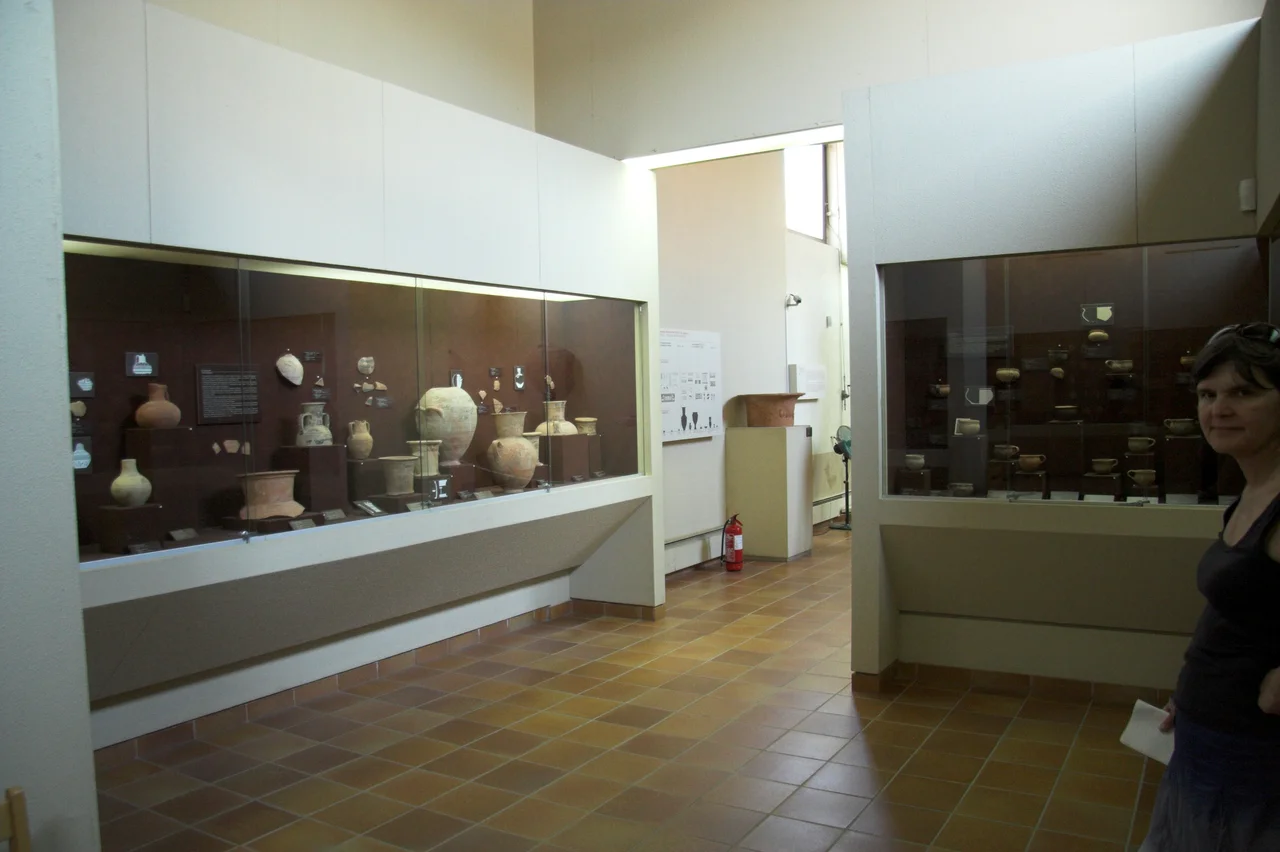

Archaeological Museum of Andros
The star of the Archaeological Museum of Andros is a marble figure that no longer exists in its original form. The Hermes of Andros — a Roman copy, dating to the 1st century BCE or early 1st century CE, of a work from the school of Praxiteles — was found at Palaiopolis, the ancient capital on the island's western coast. The original Greek bronze it copies is lost. What survives is the copy, and the copy is extraordinary: a slender, graceful messenger-god caught in a moment of stillness, the kind of fluid ease that the Praxitelean style made its signature. That this object ended up in a small island museum, rather than in Athens or the British Museum, is a piece of luck that rewards those willing to make the trip to Chora.
A Foundation and Its Building
The Archaeological Museum of Andros opened in 1981, established with support from the Basil and Elise Goulandris Foundation — one of the major Greek shipping families whose philanthropy shaped cultural infrastructure across the country. The building itself was designed by Stamo Papadaki, a Greek-American architect who worked primarily in the United States and brought a modernist sensibility to the commission. The result is a structure that sits comfortably in Chora without mimicking its neoclassical neighbors, providing appropriate gallery space for a collection that runs from the Bronze Age through late antiquity. The museum's existence reflects the broader pattern of Andros: island wealth, generated by the merchant marine, returning to the island in cultural form.
Three Thousand Years on Four Floors
The collection opens with Mycenaean pottery from Palaiopolis, dated to 1200–1150 BCE — evidence of Bronze Age settlement at the site long before the Classical city flourished. Geometric pottery follows: skyphoi and kotylai from Zagora, a fortified settlement on the southwestern coast of Andros occupied from around the 10th to the 7th century BCE, with pieces dated as precisely as 750–690 BCE. Then come the archaic sculptures — including two kouros figures, the young male standing type that Greek sculptors used as a kind of benchmark for anatomical mastery across the 6th century. One is in Parian marble with Naxian influence; another was imported directly from Naxos. The progression through the galleries is a compressed version of Greek artistic development: from geometric abstraction toward the naturalism that would eventually produce the Hermes.
The Hermes of Andros
The museum's most celebrated object was found at Palaiopolis and dates to the 1st century BCE or early 1st century CE — a Roman copy of a work attributed to the school of Praxiteles, the 4th-century BCE Athenian sculptor best known for introducing a new sensuousness into marble carving. The Hermes of Andros is the messenger god in a characteristic pose: weight shifted, one hip raised, the body in a gentle S-curve called the contrapposto that Praxiteles helped popularize. The marble is smooth to a degree that still impresses. Without the original to compare it against, we cannot know exactly what the copyist changed or simplified — Roman copies of Greek bronzes always involve some translation — but what remains is a figure of considerable elegance. Pausanias, writing in the 2nd century CE, described seeing works attributed to Praxiteles in various locations across Greece. Whether he saw the original that this copies, we cannot say.
Beyond the Hermes: Byzantine Rooms and the Long Story
The museum does not stop with the Roman period. A room of Byzantine collection completes the chronological arc, taking the story of objects made on and around Andros from the ancient world into the medieval one. A funerary relief from the 1st century BCE — onto which a cross was added at some later date, a quiet record of religious transition — captures that overlap between worlds. Small terracotta female figurines from the 5th century BCE, found at Kallivari near Gavrio, demonstrate how widely across the island ancient ritual life was distributed. The museum is compact; an attentive visit takes two hours rather than five. But the density of what it holds, relative to its size, makes it one of the more rewarding small archaeological museums in the Cyclades — a place where the distance between ancient Palaiopolis and the ferry port you arrived through feels genuinely compressed.
From the Air
The Archaeological Museum of Andros sits at approximately 37.84°N, 24.94°E, in Chora (Andros town), at the end of the island's eastern promontory. The promontory is clearly visible from the air: a narrow arm of land extending into the Aegean with the sea on three sides. The nearest major airport is LGMK (Mykonos National Airport), approximately 35 km to the southeast. There is no commercial airport on Andros. Approach from the south gives the best view of Chora's layout on the promontory. The ruined Venetian castle on its islet at the tip of the headland serves as a visual landmark for identifying the town from altitude.
Nearby Stories
- Gyaros 6 km away
- Ftelia 18 km away
- Rhamnous 22 km away
- Massacre of the First Sapper Battalion 23 km away
- Agios Georgios (island) 33 km away
- Battle of Mykonos 48 km away
- Psara 50 km away
- Aegean Sea 60 km away