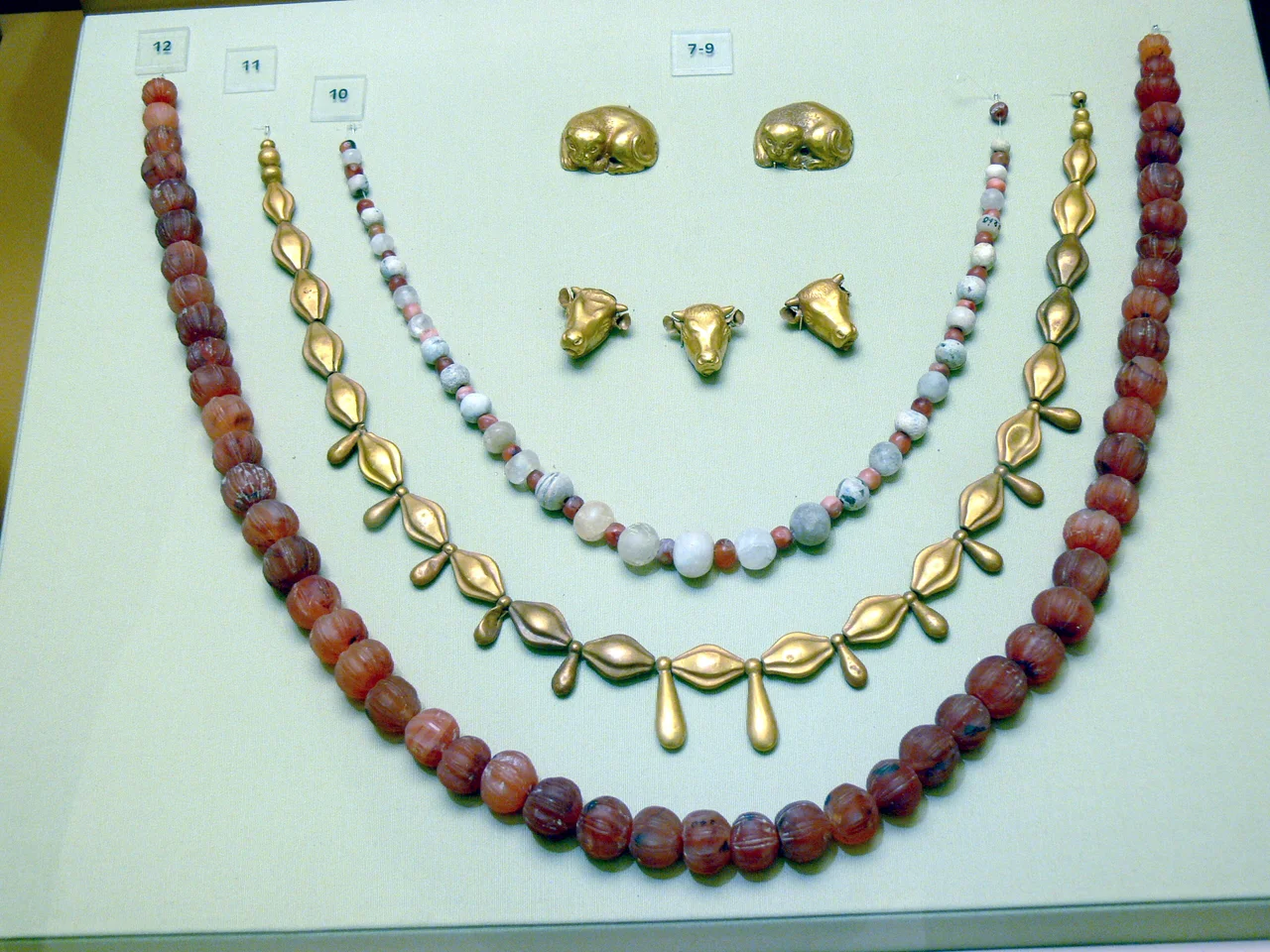

Heraklion Archaeological Museum
The Phaistos Disc sits in a glass case in Room III, smaller than you expect. About sixteen centimeters across, fired clay, both sides stamped with 241 spiraling symbols - little heads with feathered crowns, fish, ships, eight-petaled flowers, a gauntleted arm. No one has ever read it. The signs do not match any known script. They were pressed into the wet clay with hand-cut stamps, which would make this the earliest known example of movable type, predating Gutenberg by three thousand years - if we knew what it said. Some scholars think it is a hymn. Some think it is a forgery. Most think it is genuine and unreadable. It has been sitting here since 1908, and every year someone announces a new decipherment, and every year the disc keeps its secrets.
A Building Made to Survive
The museum holds the largest collection of Minoan art in the world, but the building itself is also a story. Three earthquakes in the 1920s and 1930s nearly destroyed the original 1912 home, and the director Spyridon Marinatos - who would later become famous for excavating the buried Bronze Age city of Akrotiri on Santorini - convinced the government that Crete needed something stronger. He hired Patroklos Karantinos, a Bauhaus-trained Greek modernist. Between 1937 and 1940 Karantinos built a quietly radical structure: clean concrete lines, skylit galleries, polychrome marble walls echoing the Minoan painted plaster, and an antiseismic frame designed to survive whatever the Aegean threw at it. It survived the Luftwaffe's bombing of Heraklion in 1941. The collection survived inside it. In May 2025, when a magnitude 6.2 quake hit, four exhibits toppled - but the building held.
The Bull Leapers
Hung in the Hall of Frescoes upstairs is the image that has come to define Minoan civilization for the modern world: three slender figures and a charging bull, painted on plaster around 1500 BC and pieced back together from fragments scraped off the floor of Knossos. A girl grasps the bull's horns. A young man arches over the animal's back in mid-vault. Another girl waits with arms outstretched to catch him. The athletes' skin colors follow Egyptian convention - women painted white, men reddish-brown - but the action is uniquely Cretan. Nobody knows for certain whether the leap was real, ritual, athletic, religious, or all four. The fresco itself is a reconstruction; only fragments survived. The duplicate now hangs at Knossos, while the original lives here. Stand close and you can see where the modern restorers filled in the gaps. The ancient pieces are darker, more lustrous, alive.
Goddesses and Serpents
In Room IV, two faience figurines stand under spotlights - the Minoan snake goddesses, found in a stone-lined pit beneath the floor of a temple repository at Knossos. Each holds writhing snakes. Each wears the elaborate flounced skirt and exposed bodice that Minoan women - or at least Minoan goddesses - wore in fresco after fresco. The smaller figure, about twenty-nine centimeters tall, has a wildcat perched on her crown. The larger holds her serpents with tense, theatrical poise. Whether they represent priestesses, household goddesses, or something else, no one can say with certainty. They are the most photographed objects on Crete, and yet they remain enigmatic - as so much of Minoan religion does, since the Linear A script in which the Minoans recorded their world has never been read.
Linear A, Linear B
Two scripts dominate the museum's tablets and inscribed cups. Linear B, deciphered by Michael Ventris in 1952, turned out to be an early form of Greek used by the Mycenaean rulers who took over Knossos around 1450 BC. Most of it is bookkeeping - inventories of sheep, jars of oil, taxes, soldiers' rations. The earlier Linear A, used by the Minoans themselves, is older and undeciphered. We can read the sounds of some signs, since they reappear in Linear B, but the underlying language is unknown. A cup in Room IV bears Linear A inscriptions. So does a stone libation table. The Minoans wrote their thoughts down. We can hold their writing in our hands. We just cannot hear what they were saying.
From Neolithic to Roman
The museum spans 5,500 years of Cretan history - from a Neolithic fertility figurine in Room I, through the Kamares-ware pottery of the first palaces, through the Mycenaean takeover, through the Dorian iron age, to Greco-Roman sculptures in Room XX. The Hagia Triada sarcophagus, painted on plaster around 1370 BC, shows a funeral procession with libations and double-axe altars in such detail that scholars still mine it for clues to Minoan religion. The Harvester Vase, a black steatite rhyton from Hagia Triada, depicts a procession of singing farmworkers carrying winnowing forks - one of the most warmly observed scenes in all of ancient art. After 2006, most of the museum closed for seven years of renovation. It reopened in May 2013, brighter and clearer, and the queue outside has rarely been short since.
From the Air
Located in central Heraklion at 35.3392°N, 25.1375°E, on the north coast of Crete near the harbor. Cruising 6,000-10,000 ft above the city offers views of the Venetian fortress and the sea. Nearest airports: Heraklion Nikos Kazantzakis Airport (LGIR) just east of the city; new Kastelli airport (under construction) 40 km southeast. Summer thermals can be strong over Crete; winter winds funnel between the island's mountain ranges.
Nearby Stories
- Battle of Rethymno 9.8 km away
- Archaeological Museum of Agios Nikolaos 26 km away
- Battle of Cape Spada 80 km away
- Santorini: The Volcano That May Have Destroyed Atlantis 84 km away
- 1956 Amorgos Earthquake 112 km away
- Battle of Derna (1805) 322 km away
- Siege of Derna 352 km away
- Battle of Sidi Barrani 395 km away