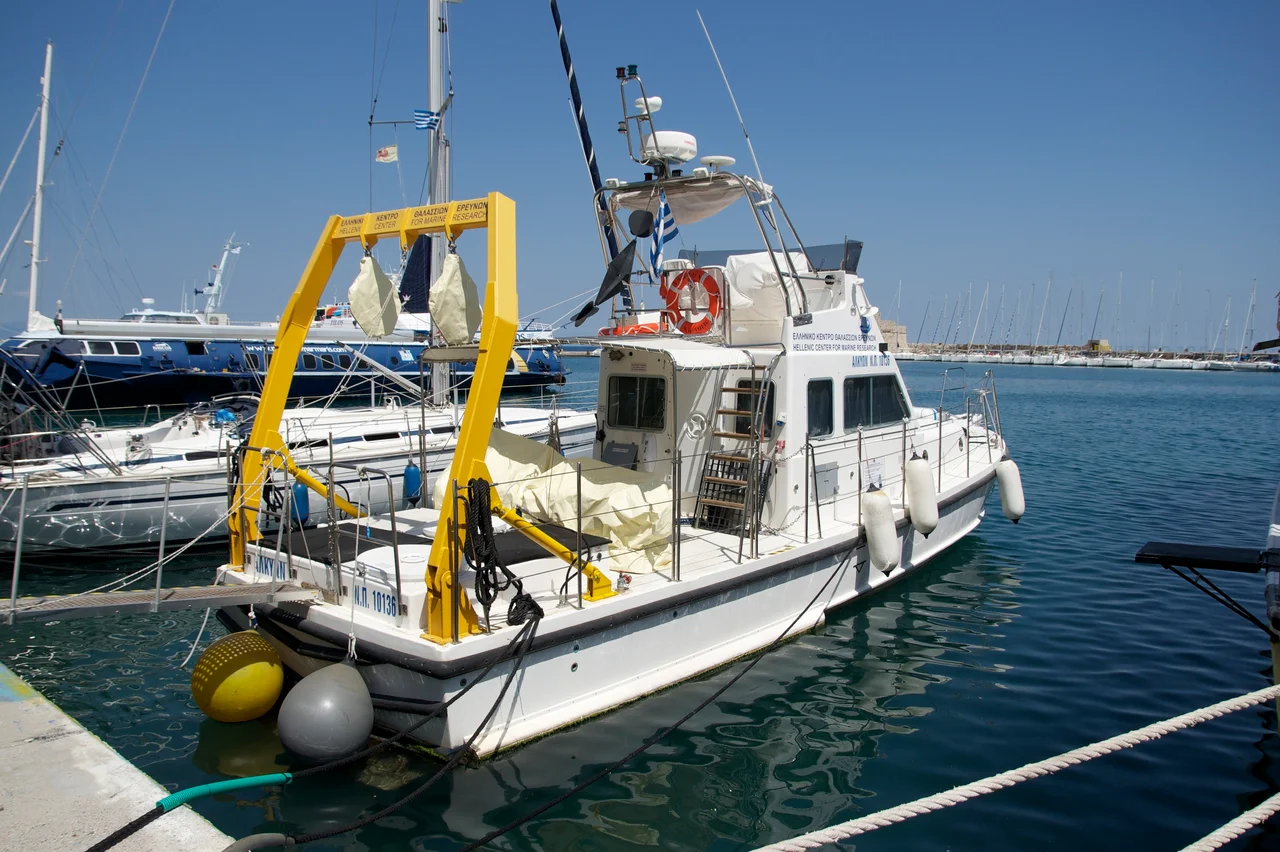

Hellenic Centre for Marine Research
In 1912, the Greek government asked a professor in Rome — Decio Vinciguerra, director of the Ichthyological Station — how to build a marine research institute. With his advice, the Marine Hydrobiological Station opened in 1914 near Athens. More than a century of mergers, renamings, expansions, and wars later, that small beginning has grown into the Hellenic Centre for Marine Research: three research vessels, a crewed submersible, multiple Remotely Operated Vehicles, and a network of laboratories and aquaria stretching from the Attic coast to Crete and Rhodes.
A Century of Becoming
The institution arrived in its current form through a long sequence of transformations. The original Marine Hydrobiological Station, established in 1914 in Palaio Faliro near Athens, came under the Ministry of Agriculture in 1948 and was renamed the Laboratory of Fisheries Studies. Meanwhile, in 1945, a separate Hellenic Hydrobiological Institute was founded in Piraeus — incorporating the Hydrobiological Station of Rhodes, which the Italians had set up during their occupation of the Dodecanese. In 1965, these two institutions merged to form the Institute of Oceanographic and Fisheries Research. By 1985 it had become the National Centre for Marine Research, a public sector organisation under what is now the Ministry of Development. The current name — Hellenic Centre for Marine Research, HCMR — arrived in 2003, consolidating several institutes into a single organisation focused on the full range of marine science. Its headquarters sit in Anavyssos on the Attic coast, with facilities in Heraklion and Rhodes.
Below the Surface: The Fleet
The HCMR operates three research vessels and a suite of underwater tools that extend its reach far below what any ship can see from the surface. Its crewed submersible, THETIS, cost €2,069,000 and is deployed from the research vessel AEGAEO. THETIS carries two robotic arms capable of lifting objects up to 100 kg, and communicates with the ship through a dedicated intercom system. Alongside THETIS, the Centre operates several Remotely Operated Vehicles for unmanned underwater exploration. Together, these assets allow Greek scientists to study seafloor geology, deep-water ecology, and marine habitats that would otherwise remain inaccessible. The research vessel Philia, a fisheries vessel built in 1986, is based in Heraklion and serves Cretan waters. The fleet connects the HCMR's land-based laboratories to the full expanse of Greek seas.
The Largest Tank Farm in the Mediterranean
On the Attic coast at Anavyssos, the HCMR operates HCMR-Aqualabs-Cages — a facility it describes as the largest of its kind for marine experimental tanks in the Mediterranean. The infrastructure combines inland tank installations, net-pen cages in the sea, and analytical laboratories. Scientists here study the reproduction, development, nutrition, pathology, and husbandry of Mediterranean fish species: European seabass, gilt-head bream, and sharpsnout seabream among native species, and non-native species including greater amberjack, meagre, and Atlantic wreckfish. The research feeds directly into sustainable aquaculture practices and fisheries management across the region. A second urban facility sits in the Agios Kosmas area of Elliniko, Athens — a two-storey building housing the Institute of Marine Biological Resources and the Institute of Aquaculture, with both indoor and outdoor tanks.
Public Faces: Aquaria and a Whale
The HCMR has two public-facing institutions that bring its science to general audiences. Cretaquarium, located in Gournes near Heraklion, is the largest public aquarium in Greece: 61 tanks holding a combined 1,800,000 litres of seawater. Beyond displaying marine life, Cretaquarium conducts research by camera-monitoring its animals to study behaviour and life cycles, and it rehabilitates injured or sick sea creatures before returning them to the wild. The Hydrobiological Station of Rhodes — one of the HCMR's oldest institutions — doubles as a research centre, aquarium, and museum on the island of Rhodes. Among its exhibits is the embalmed body of a Cuvier's beaked whale; another exhibit is a 2,000-year-old skeleton of a Mediterranean monk seal, found in a grave at an archaeological site at the port of Rhodes. The monk seal is among the most endangered marine mammals in the world. Finding one in an ancient tomb is a reminder of how long humans and these animals have shared the same waters.
Publishing the Sea
The HCMR publishes its scientific output through several channels, including the peer-reviewed journal Mediterranean Marine Science, issued three times annually and covering aquatic science, oceanography, environmental engineering, ecology, evolution, behaviour, and systematics. The Centre also publishes Monographs on Marine Sciences for in-depth treatment of specific topics, and occasional special publications including two ebooks: the State of the Hellenic Marine Environment (2005) and the State of Hellenic Fisheries (2007). These publications feed into national and European policy on fisheries, conservation, and the health of Greek seas — a body of water that has been fished, traded across, and battled over for millennia, and that the HCMR is tasked with understanding well enough to protect.
From the Air
The HCMR headquarters at Anavyssos lies at approximately 37.73°N, 23.90°E, on the eastern Attic coast roughly 40 km south of central Athens. From the air at 5,000–8,000 ft, the coastal research facilities are visible along the shoreline south of Athens. The Saronic Gulf extends to the west. Nearest major airport: LGAV (Athens International Airport, Eleftherios Venizelos), approximately 30 km north-northeast. The Cretaquarium facility is near Heraklion, Crete (nearest airport: LGIR, Heraklion International N. Kazantzakis).
Nearby Stories
- Museum of the Center for the Acropolis Studies 0.1 km away
- HMHS Britannic 2.3 km away
- Franchthi Cave 6.7 km away
- Great Sand Beach 8.4 km away
- Kythnos 15 km away
- Sanctuary of Apollo Maleatas 16 km away
- Loutraki 20 km away
- Hydra: The Island That Refused the Car 25 km away