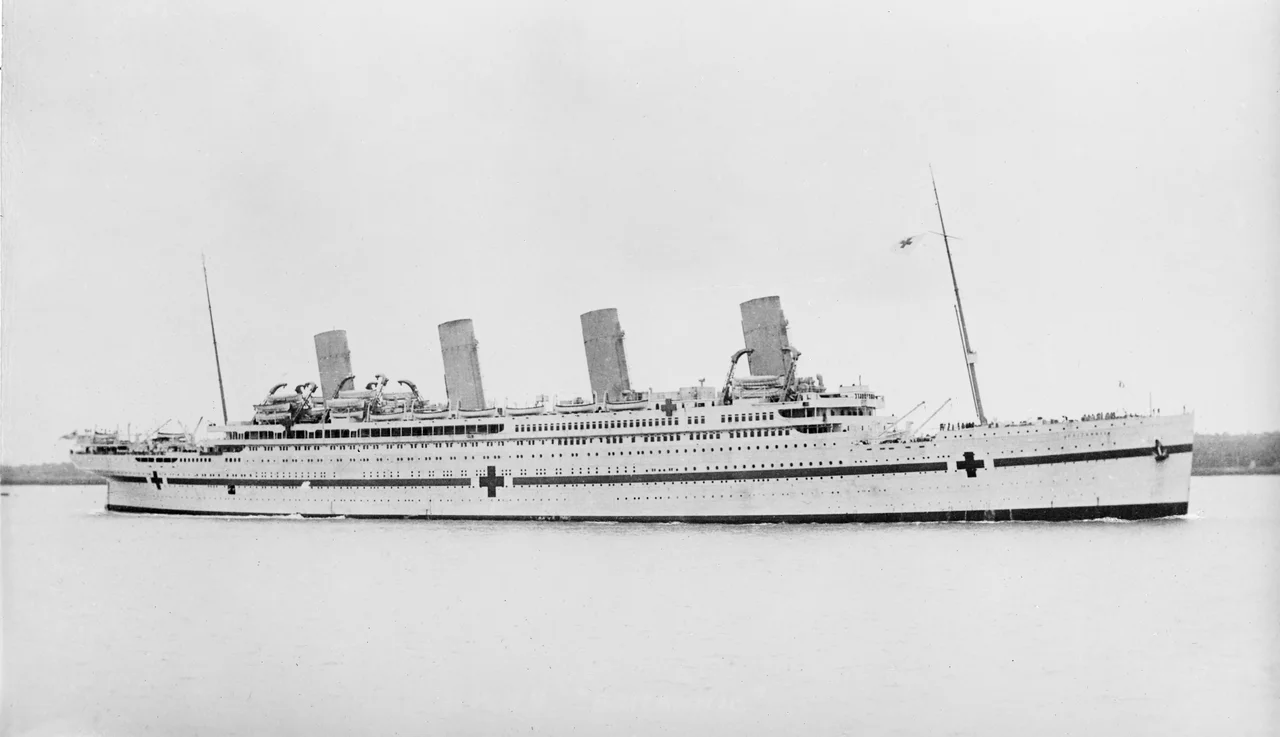

HMHS Britannic
She never carried a paying passenger. The ship launched in Belfast on 26 February 1914, designed to be the finest and safest of the three Olympic-class liners — more spacious than Titanic, with better lifeboats, stronger bulkheads, wider gantry davits. By the time she was complete, Europe was at war, and she was requisitioned before she could enter commercial service. Repainted white with red crosses and a green stripe, renamed His Majesty's Hospital Ship Britannic, she spent just over a year carrying wounded soldiers out of the Dardanelles theatre. In the early morning of 21 November 1916, in the Kea Channel between Cape Sounion and the island of Kea, she struck a mine laid by a German submarine. Fifty-five minutes later, she was gone. Of the 1,066 people aboard — nurses, doctors, orderlies, officers, and crew — thirty died. The 1,036 who survived owed their lives, in part, to each other.
Built for Peace, Requisitioned for War
The Olympic-class programme began in 1907 with a simple ambition: to build the three largest, most luxurious liners afloat. Olympic came first, then Titanic. Britannic, the youngest, was still under construction when the Titanic sank in April 1912. The disaster forced a redesign. Britannic's beam was widened to 94 feet, accommodating a double hull along the engine and boiler rooms. Six of the fifteen watertight bulkheads were extended higher — up to B Deck. She was fitted with 48 lifeboats, enough for well over 3,600 people, far exceeding the ship's maximum capacity. Eight sets of towering gantry davits — each capable of launching six boats at once, even on a listing ship — were planned; five were installed before she entered war service. On paper, no ship in the world was better prepared to keep her people alive.
But the war moved faster than the shipyard. When Germany declared war in August 1914, the Admiralty froze Britannic at Belfast. She sat there, fitted out but unlaunched into service, until November 1915, when she was finally requisitioned as a hospital ship. The ship's luxurious first-class spaces — the dining room, the reception rooms — became operating theatres. The cabins of B Deck housed the doctors. Her gleaming interiors, never seen by a tourist, became wards for the broken bodies coming back from Gallipoli.
Six Voyages
Between late 1915 and November 1916, Britannic made six voyages to the eastern Mediterranean, running between Southampton and the Greek island of Lemnos (the staging point for Dardanelles operations), stopping at Naples to take on coal. Life aboard followed a strict routine. Patients woke at six o'clock; breakfast came at half past six; the captain inspected the ship; lunch at 12:30; tea at 4:30; lights out at 8:30. The medical staff moved constantly between meals. Aboard a hospital ship at war, there was always more to do.
The fifth voyage was marred by a quarantine after a food-borne illness swept through the crew at Moudros. Still, the ship completed it and returned home. On 12 November 1916, she departed Southampton for the sixth time, heading again for Lemnos. She was carrying no patients. The ship was outbound — empty of the wounded, full of the staff who would care for the next intake. There were 1,066 people aboard.
The Morning of 21 November
A storm had slowed the ship at Naples. Captain Charles Bartlett pushed on through a break in the weather. By the small hours of 21 November, the seas had calmed. Britannic rounded Cape Matapan and entered the Kea Channel at full speed, steaming northeast toward Lemnos. At 8:12 in the morning, the ship struck a mine.
The explosion was on the starboard side, between holds two and three. It was violent enough to damage the watertight bulkhead between hold one and the forepeak, and to tear open the boiler-man's tunnel connecting the forward crew quarters with boiler room six. Four watertight compartments began filling immediately. The antenna wires snapped, leaving the ship able to broadcast distress signals but unable to receive replies. Bartlett ordered the doors closed, the lifeboats prepared, and the engines kept running so he could steer toward Kea and attempt to beach her.
What he could not yet know was that the nurses, working against the summer heat, had opened portholes along the forward lower decks to ventilate the wards. As the bow dipped, those portholes submerged. Water entered through them, bypassing the bulkhead that should have guaranteed the ship's survival. More than six compartments were now flooding. Britannic could not float.
The Thirty Who Did Not Come Home
By 8:50, thirty-five lifeboats had been launched and most of those aboard were in them. Bartlett, thinking the flooding had slowed, ordered the engines restarted in one last attempt to reach the shallows near Kea. The forward motion forced more water in. By 9:00 he knew the ship was lost. He gave the final order to abandon ship — two long blasts of the whistle — and then, as water reached the bridge, he and his assistant walked off the deck into the sea and swam to a collapsible boat. From there they continued directing the rescue.
Britannic capsized to starboard. Her funnels fell one after another. Because her hull was longer than the water was deep, her bow struck the seabed while her stern still rose above the surface. She slipped completely beneath the waves at 9:07 — fifty-five minutes after the explosion.
Thirty people died. Two of the deaths came when lifeboats were drawn back into the still-turning propellers, which had not yet stopped when the first boats were lowered. Among those lost was Captain John Cropper of the Royal Army Medical Corps. Others were not recovered and are commemorated on the Mikra Memorial in Thessaloniki and on memorials in London. Only five of the thirty were buried; the rest were taken by the sea.
The first rescuers on scene were fishermen from Kea, who came in a traditional boat called a caique and pulled survivors from the water. Royal Navy vessels arrived within two hours. In all, 1,036 people survived. The surviving nurses and doctors, many still in their ward clothes, set up an impromptu medical station on the bare quayside at Korissia on Kea, fashioning dressings from aprons and pieces of life-belts, using the stone pier as their operating room.
What Lies Below
Britannic rests today on the seabed of the Kea Channel at about 400 feet, lying on her starboard side. Jacques Cousteau located and explored her in 1975 and returned the following year to enter the wreck. Robert Ballard visited in 1995. In 1996, maritime historian Simon Mills — who has written extensively about the ship — bought the wreck and became its owner. Subsequent expeditions have penetrated the interior, photographing telegraphs, a helm, and the telemotor on the captain's bridge. Divers in 2003 confirmed that a number of watertight doors were open at the time of sinking, corroborating the German submarine records that indicated a single mine, with flooding compounded by the open portholes and unsealed doors.
In 2025, a Greek government team led by Simon Mills recovered artefacts from the wreck, including the ship's lookout bell. Britannic is the largest intact passenger ship on the seabed in the world. She is also, in a sense, the most complete memorial to the thirty people who did not survive that November morning — and to the thousand and more who did, and who carried what happened in the Kea Channel with them for the rest of their lives.
From the Air
The wreck of HMHS Britannic lies at approximately 37.701°N, 24.284°E in the Kea Channel, in open Aegean water between the southern tip of Attica (Cape Sounion) and the island of Kea. The site is at sea and has no surface feature; at cruising altitude it appears as open water. The nearest airport is Athens International (LGAV), approximately 65 km to the northwest. Flying from LGAV toward the Cyclades, the Kea Channel passes beneath the track at roughly 20 minutes after departure. Cape Sounion, visible from altitude on clear days, marks the northern boundary of the channel. The island of Kea (also called Tzia) lies to the southeast. The wreck depth is approximately 120 metres.
Nearby Stories
- Hellenic Centre for Marine Research 3.2 km away
- Church of Saint John the Theologian, Kythnos 3.2 km away
- Greek Islands 4.9 km away
- Karystos 5.4 km away
- Pallene (Attica) 7.3 km away
- Archdiocese of Naxos, Tinos, Andros and Mykonos 23 km away
- Temple of the Delians 27 km away
- Hydra: Fire Ships and Stone Mansions 40 km away