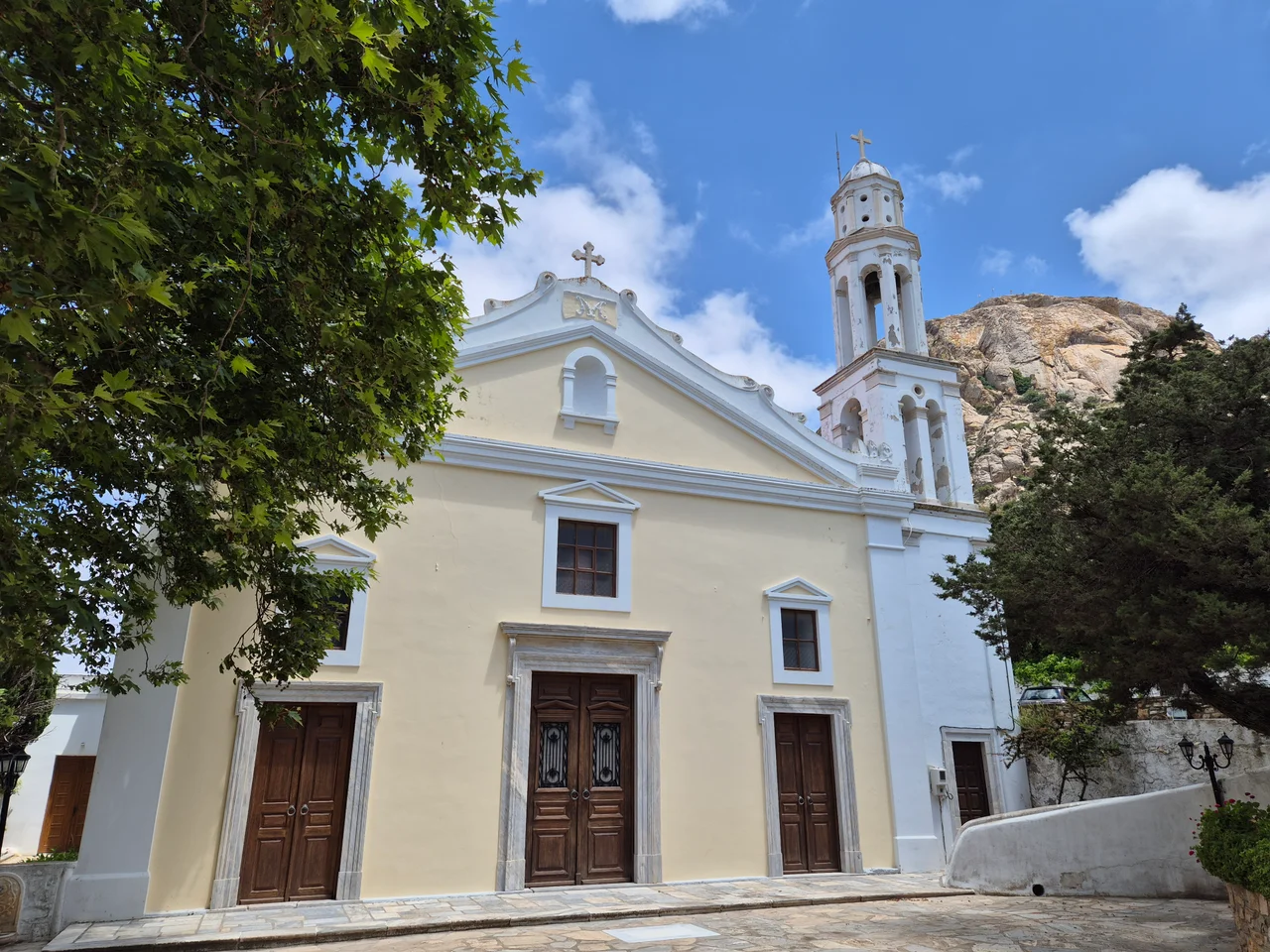

Archdiocese of Naxos, Tinos, Andros and Mykonos
In a corner of Greece where almost everyone is Orthodox and the great pilgrimage church belongs to the Virgin of the Eastern tradition, a Latin cathedral stands in the village of Xinara on Tinos, its bishop serving an archdiocese that has existed, in one form or another, since the thirteenth century. Catholic Christianity has been a minority faith in these islands for most of that time. It has also been remarkably durable.
A Venetian Inheritance
The Diocese of Naxos was erected in the thirteenth century, a product of the Latin conquest that followed the Fourth Crusade and the subsequent division of Byzantine territories among Western powers. Venice and its allies carved the Cyclades into feudal lordships; the Catholic Church followed wherever Venetian influence extended. Naxos became the seat of a Latin duchy, and the islands of Andros, Tinos, and Mykonos fell under varying degrees of Venetian control across the following centuries.
The diocese was elevated to a Metropolitan Archdiocese in 1522, after the Ottoman conquest of Rhodes displaced the Knights Hospitaller and reshuffled ecclesiastical geography across the eastern Mediterranean. The Cyclades remained a zone of contested sovereignty — Catholic lords, Orthodox populations, and Ottoman overlordship existing in uneasy proximity — but the Latin Church maintained its institutional presence through it all.
Under Barbarossa's Shadow
In 1537, Naxos, Andros, Paros, and Santorini fell to the Ottoman naval commander Hayreddin Barbarossa. The conquest was swift and thorough. Pope Paul III assembled a Holy League in response — the Papacy, Spain, the Republic of Venice, and the Knights of Malta — but the alliance was defeated at the Battle of Preveza in 1538. Ottoman dominance over the Aegean was confirmed for generations.
The Catholic community in the islands did not disappear. It contracted, adapted, and survived. The Latin hierarchy continued; bishops were appointed, died, and were replaced across the centuries of Ottoman rule. The very length of the bishops' list — stretching from Giorgio in 1252 through the present day — is itself evidence of institutional persistence in the face of conditions that might reasonably have ended the archdiocese several times over.
Consolidation and Modern Life
On June 3, 1919, the Archdiocese of Naxos merged with the Roman Catholic Archdiocese of Tinos and Mykonos — which had itself absorbed the suppressed Diocese of Andros in 1824 — to form the present Archdiocese of Naxos, Tinos, Andros and Mykonos. The unified name made official what geography had long suggested: these islands form a single cultural and historical zone, their Catholic communities linked by shared Venetian origins and shared experience of minority existence in an Orthodox country.
The ecclesiastical territory today covers most of the Aegean islands in Greece. The cathedral of Our Lady of the Rosary in Xinara, Tinos, is the archiepiscopal see; a co-cathedral of the Presentation of the Lord serves Naxos town. The suffragan dioceses include Chios, Crete, Santorini, and Syros.
The Poor Man's House
In 1964, the archdiocese brought together its various parish charitable funds and brotherhoods into a single organization, naming it To spíti tou ftochoú — 'The Poor Man's House.' The organization provided donations and loans, supported education, and helped the disabled, widows, and orphans. In the 1980s it was renamed Caritas Naxos-Tinos, expanded its mandate, and became a member of Caritas Hellas in 1981. By 1994 it was registered as an NGO.
The transformation from medieval bishopric to modern charity reflects something the long list of archbishops in this diocese suggests only obliquely: institutions that survive across centuries do so by finding new ways to matter. The Catholic community of the Cyclades has been a small minority for most of its history. It has also been, in its way, persistent — maintaining its cathedral, its charitable work, and its connection to an eight-hundred-year thread of Latin Christianity in the islands of the Aegean.
From the Air
The Archdiocese of Naxos, Tinos, Andros and Mykonos covers islands centered around 37.58°N, 25.16°E, with the cathedral see in Xinara village on Tinos. The nearest major airport for Tinos is LGMK (Mykonos National Airport), approximately 25 km to the southeast; ferries connect Tinos to Mykonos, Rafina, and Piraeus. From the air, Tinos is the large island to the northwest of Mykonos, distinguishable by the prominent hill above the town and the white church visible on the slope. Recommended viewing altitude: 8,000–12,000 feet to appreciate the scatter of Cycladic islands across the Aegean.
Nearby Stories
- Serifos 16 km away
- Archaeological Museum of Andros 18 km away
- Loutra, Kythnos 19 km away
- Panagia Ekatontapiliani 20 km away
- Karystos 30 km away
- Ikaria 45 km away
- Amorgos 51 km away
- Emporio, Chios 54 km away