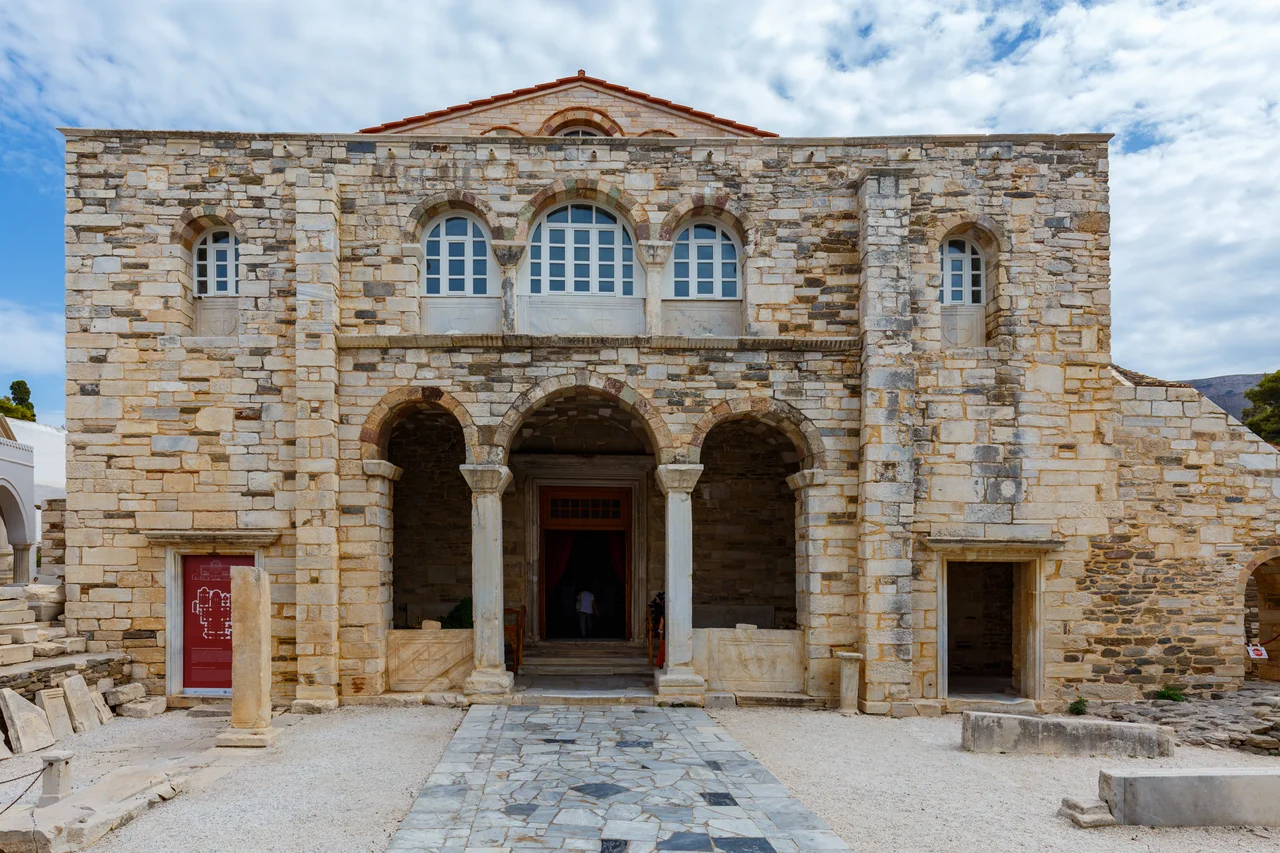

Panagia Ekatontapiliani
The name invites a puzzle before you even walk through the door. Panagia Ekatontapiliani — "Our Lady of the Hundred Gates" — stands in the heart of Parikia on the island of Paros, and it does not have one hundred gates. Nobody is quite sure why it earned the name. One theory holds that it is a corruption of "Katapoliani," meaning the church of the lower town, which matches its position by the sea at the base of the settlement. Another tradition insists that ninety-nine of the hundred gates have been found over the centuries, and when the hundredth is discovered, Constantinople will be Greek again. Whether linguistic quirk or prophetic riddle, the name has outlasted empires. What is certain is that the complex itself dates to 326 AD, and that its oldest stones predate even the moment in 391 AD when Christianity became the official religion of the Roman Empire. This is not a church built in the flush of imperial triumph. It was here first.
Saint Helena's Shore
The foundation story belongs to Saint Helena, mother of Emperor Constantine the Great. According to tradition, she stopped at Paros while sailing to the Holy Land on pilgrimage sometime around 326 AD, and she prayed at a small chapel on the site, vowing to build a great church here if her journey proved successful. It did. The church followed. Constantine himself is said to have completed what his mother began. Whether or not the sequence unfolded exactly this way — and tradition and archaeology do not always align — the story gives the Ekatontapiliani a direct lineage to the foundational figures of Christian history. Helena was later canonized, and her feast day is celebrated in Greece with particular intensity. On Paros, the connection feels tangible. Pilgrims have been making their way to this church for seventeen centuries.
What the Complex Contains
The Ekatontapiliani is not a single church but a complex of three: a main chapel dedicated to the Assumption of the Virgin, flanked by the smaller chapel of Saint Nicholas and the chapel of Agia Theoktisti. The centerpiece retains the form of an early Byzantine basilica — a large, elongated hall leading to a sanctuary, its interior whitewashed and austere in the Cycladic tradition, its proportions speaking of age rather than ornament. The baptistery, dating to the early Christian period, contains a cruciform font — one of the oldest surviving examples of its kind in the Aegean. Early Christian worshippers were baptized by full immersion; the cross-shaped pool made that immersion both practical and symbolically legible. Standing beside it, the weight of what ordinary faith looked like in the fourth century becomes unusually concrete.
Pilgrimage in the Aegean
Among the Marian pilgrimage churches of the Aegean, the Ekatontapiliani ranks second only to the celebrated church of the Megalochare on nearby Tinos island — the church that houses the famous icon of the Virgin Mary, discovered in 1823. That ranking reflects genuine religious standing, not tourist promotion. The Feast of the Assumption on August 15th draws thousands of pilgrims to Parikia each year, filling the harbor with ferries and the church with candlelight and chant. Paros is often described in travel writing as a party island, a windsurfing destination, a place for the summer crowds. But the Ekatontapiliani has been drawing people across the Aegean for reasons that have nothing to do with any of that — and it was doing so long before the first tourist arrived.
Layers of Stone and Time
The church has been damaged and rebuilt more than once across its seventeen centuries. An earthquake in 1773 caused significant structural damage, and subsequent restoration work has sometimes obscured the earliest layers. Archaeologists and art historians have worked to distinguish the original Byzantine fabric from later interventions, particularly from the extensive restorations carried out in the twentieth century under the direction of architect Anastasios Orlandos. What survives — original masonry, the ancient baptistery, sections of early floor — represents a continuity of sacred use that is almost impossible to find elsewhere in the Cyclades. The village of Parikia has grown up around the complex over the centuries. Streets curve to accommodate it. The Ekatontapiliani is not a monument preserved in isolation; it is a living building at the center of a living town.
From the Air
Panagia Ekatontapiliani sits at 37.0849°N, 25.1520°E in Parikia, the main port town on the western coast of Paros. Flying into the area, the island of Paros is recognizable as a roughly oval landmass in the central Cyclades, with Parikia's harbor visible on the west side. The nearest airport is Paros National Airport (LGPA), approximately 12 km southeast of Parikia. Approach from the north or west offers views down the island's spine. Visibility across the Cyclades is typically excellent in summer; in winter and spring, Aegean low pressure systems can bring cloud cover quickly. The church complex is not individually visible from altitude but lies within the dense white-walled cluster of Parikia's old town, immediately east of the ferry quay.
Nearby Stories
- Panagia Gremniotissa 13 km away
- Milos 17 km away
- Panagia Kanala 18 km away
- Delos 18 km away
- Serifos 19 km away
- Amorgos 27 km away
- 1956 Amorgos Earthquake 27 km away
- Ikaria 57 km away