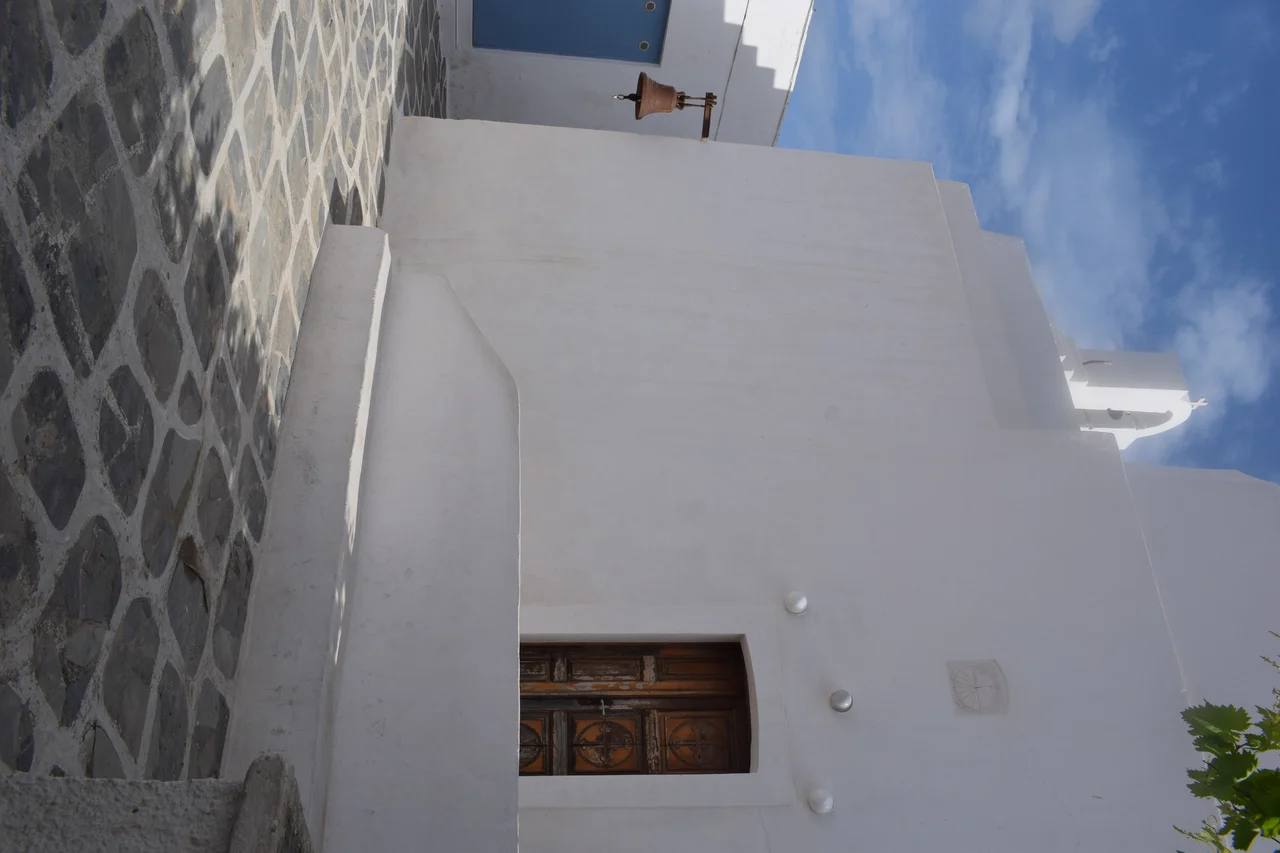

Church of Saint John the Theologian, Kythnos
Above the south entrance of the Church of Saint John the Theologian, mounted on the exterior wall, is a sundial. It is a detail easy to overlook — churches across the Cyclades carry centuries of small additions — but it is the kind of specific, practical object that grounds a sacred building in daily life. Someone needed to know the time, or wanted the hour marked in stone, and the sundial went up. The church it adorns stands in the neighborhood of Panochori, near Mazarakis Square in Chora, the hilltop capital of Kythnos, and it has been classified as a Greek historical monument. Its Byzantine form — a single-room cruciform plan under a cupola — is characteristic of Kythnos church architecture, repeated across the island's many chapels and churches. What distinguishes this one is its interior: frescoes commissioned in 1846, icons by a local artist named Dimitrios Halkiotis, and a carved wooden altar screen whose craftsmanship speaks of a community that invested in this building over generations.
The Architecture of Devotion
The church follows the cruciform plan under a dome that defines so much of Aegean Orthodox religious architecture — a form developed in the Byzantine period and continued with modest regional variations through the centuries of Venetian and Ottoman rule. The cupola admits a shaft of light to the center of the interior; the arms of the cross create four focused spaces around it. Inside, the wooden carved altar screen separates the nave from the sanctuary in the manner of Eastern Orthodox tradition, its craftsmanship suggesting skilled local woodworking. Frescoes cover the walls, painted when the church was renovated in 1846 at the expense of a priest and teacher named Georgios Aisopidis. That the renovation was funded by an individual — his name attached to the work in the historical record — gives the church a human scale that large institutional buildings often lack. This is a neighborhood church, in the most literal sense: it belongs to Panochori, and Panochori belongs to it.
Icons from Two Worlds
The church holds two icons by the artist Dimitrios Halkiotis that stand apart from the conventional devotional imagery. One depicts the Apocalypse of Saint John — John the Evangelist, to whom the church is dedicated, shown in a state of profound contemplation. The second is more unusual: it represents the Virgin Mary holding the Christ child, surrounded by Elizabeth, the young John, Saint Anne, and Mary — all depicted as children, all standing rather than seated on a throne. The departure from convention is deliberate and striking. Orthodox iconography has rules about posture and hierarchy; saints typically appear enthroned or formally positioned. Halkiotis chose movement instead of stasis. The icon is noted for its vivid colors, which suggests that even within a traditional form the painter was reaching for something particular. The church was also enriched with vessels of Russian ecclesiastical art, funded by a local priest named Meletios Vayanellis who was living in Kyiv at the time — a reminder that even small Cycladic communities maintained surprising connections to the wider Orthodox world.
Kythnos and Its Chora
Kythnos is one of the quieter Cycladic islands, lacking the summer crowds that descend on Mykonos or Santorini. Its capital, Chora, sits on a ridge above the island's center — a typical Cycladic hilltop settlement, designed for visibility over the surrounding landscape and defensibility against pirate raids that were a persistent feature of Aegean life for centuries. The Church of Saint John the Theologian in Panochori represents one node in a dense network of Orthodox places of worship that covers the island; Kythnos is known for having an unusually high number of churches relative to its population. Most are small, plain on the outside, and contain within them the accumulated donations and commissions of generations of islanders — painted walls, carved screens, icons brought from distant Orthodox communities. The church near Mazarakis Square is classified as a historical monument by the Greek state, which places it within a legal framework of protection, but its real preservation has come from the ongoing devotion of the community it serves.
From the Air
The Church of Saint John the Theologian sits at approximately 37.4124°N, 24.4316°E in Chora on Kythnos, a small Cycladic island northwest of Syros in the western Cyclades. Kythnos is accessible by ferry from Piraeus (approximately 3 hours by conventional ferry) or Lavrio; there is no airport on the island. The nearest major airport is Athens International Airport Eleftherios Venizelos (LGAV), approximately 70 km to the northwest. Flying over the area, Kythnos appears as a long, narrow island — about 99 square kilometers — with Chora visible as a white cluster near the island's center when flying at lower altitudes. The island lies between Kea to the north and Serifos to the south. In summer, visibility across the western Cyclades is typically excellent, with the meltemi wind creating clear but turbulent conditions at altitude.
Nearby Stories
- MS Express Samina 12 km away
- Hellenic Centre for Marine Research 13 km away
- HMHS Britannic 16 km away
- Greek Cruiser Elli (1912) 26 km away
- Sifnos 29 km away
- Hydra: Fire Ships and Stone Mansions 38 km away
- Greek Islands 43 km away
- SS Slamat 66 km away