
Sifnos
The island once sent a gold-gilded egg to Delphi instead of the solid gold one it had always sent before. According to the Greek historian Pausanias, Apollo punished the deception by destroying Sifnos's gold and silver mines in an earthquake. By the 6th century BC the island had been one of the most prosperous places in Greece; the Treasury of the Siphnians at Delphi was reputed to be among the most opulent buildings at that shrine. Then came the earthquake, and the golden age ended. What Sifnos has done since — how it rebuilt its identity around pottery, cuisine, hiking trails, and an atmosphere of unhurried beauty — is the real story of the island.
Gold, Silver, and a Cautionary Egg
The ancient mines of Sifnos are the island's most dramatic historical footnote. The silver mines at Ag. Sostis are thought to be among the earliest workings known in Greece, and in the island's Archaic heyday the wealth they produced funded a treasury at Delphi that Pausanias described as extraordinarily lavish. Its foundations can still be seen at Delphi today. Then, in the legend Pausanias records, the islanders grew greedy — or perhaps overconfident — and substituted a gilded egg for the solid gold one they had been sending as tribute. Apollo noticed. The earthquake came, the mines flooded or collapsed, and Sifnos slipped back into the ordinary rhythms of Cycladic island life. By Hellenistic times the golden age had passed. What it left behind are ruins of ancient mines that appear on some maps, a Mycenaean citadel on the hill of Aghios Andreas south of Apollonia, and a reputation for a past so glorious it became a moral warning.
The Island That Fed Greece
Sifnos has long had a reputation for excellent cuisine, and it is no accident. Nikolaos Tselementes was born in the village of Exampela on Sifnos in 1878. He trained in Vienna and worked in embassies and restaurants across Europe and the United States before returning to Greece, where he published the cookbook that would define Greek domestic cooking for generations. His book — the first comprehensive cookbook in Greek — went through more than fifteen official reprints and became so foundational that in modern Greek, 'tselementes' has become a common noun meaning any cookbook. The traditional Sunday chickpea soup, slow-cooked in the island's wood-fired ovens, is one of Sifnos's most celebrated dishes — a dish that predates Tselementes and runs deeper than any cookbook. The island's ceramic cooking pots, made by local potters, are part of what makes the food taste the way it does.
Pottery and Paths
Two things distinguish Sifnos from most Cycladic islands. The first is its pottery tradition, which has survived as a working craft rather than a heritage performance. In Cheronisos, the fishing village in the island's barren north, a potter specialises in trick pots — fill one with wine, pour until it seems empty, set it down, pick it up again, and more wine comes out. Working potteries in Plati Yalos and Vathi sell directly to visitors. Shops in Apollonia and Kamares carry work at a range of prices. The second distinction is the trail network: more than 100 km of professionally designed and marked paths, one of the largest in the Aegean, connecting towns, beaches, and ancient sites. Red and white waymarkers guide walkers through terrain that rewards the effort, though in summer the heat and the lack of shade demand early starts and water.
Two Islands in One
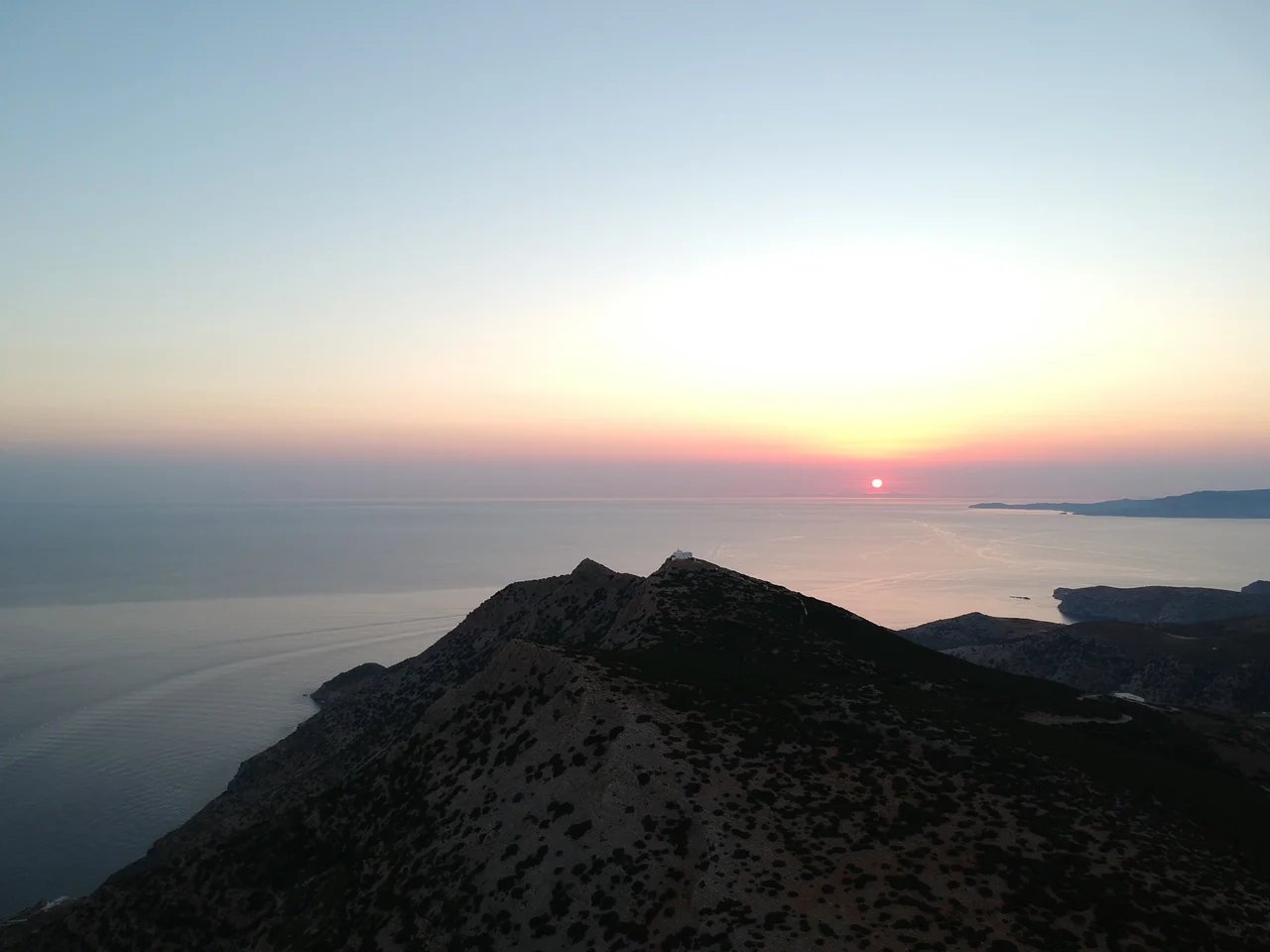
The island divides itself naturally. The western half — where the ferry arrives at Kamares — is bare, rocky, and open to the wind. The eastern half is greener, more terraced, more sheltered. Apollonia, the island capital, sits at the centre of a cluster of villages on a hillside — it merges into Artemonas above it and connects by bus to Kastro, the medieval fortified town on the coast. Kastro is almost perfectly preserved: a maze of whitewashed lanes, Roman sarcophagi built into walls, ancient columns incorporated into house facades, and a small Archaeological Museum. South of Kastro, the Panagia Chrysopigi monastery stands on its rock spur in the sea, formal patron of Sifnos since 1964. The Bay of Vathi offers what many visitors consider the island's finest beach: a long crescent of fine sand on an enclosed, calm bay, with good tavernas at the water's edge.
Getting There, Slowing Down
Sifnos has no airport. That is not a flaw but a fact with consequences: you arrive by sea, and the pace of arrival sets the pace of the visit. Daily or near-daily fast boats and conventional ferries connect with Piraeus during high season — about five hours by ferry, roughly half that by catamaran. If you want to fly, you land at Athens (LGAV) and take the ferry from Piraeus. Once on the island, the bus system is frequent and reliable enough to make a car optional. The island is small enough to walk, given time and water and a tolerance for hills. Most visitors settle into this rhythm quickly. The whitewash, the marble lanes, the smell of slow-cooked food, the sea visible from almost everywhere — Sifnos is an island that asks you to stay longer than you planned.
From the Air
Sifnos is centred at approximately 36.97°N, 24.72°E in the Western Cyclades, roughly 130 km southeast of Athens. The island runs roughly north-south, about 13 km long. The nearest major airport is LGAV (Athens International Eleftherios Venizelos); there is no airport on Sifnos. Milos airport (LXMM) is the nearest island airfield and is sometimes used as a starting point for the short ferry crossing to Kamares. From the air at 10,000 feet, Sifnos is recognisable by the contrast between its bare western coast — facing the ferry route from Piraeus — and the greener, more terraced eastern hillsides. Kamares bay on the west is the main port. Kastro, on the east coast, shows as a compact white settlement on a headland. At around 5,000 feet in good visibility, individual villages are distinguishable and the trail network's terrace lines are visible on the hillsides.
Nearby Stories
- Ios 2.4 km away
- Italian submarine Jantina (1932) 9.6 km away
- Temple of Sangri 11 km away
- SS Heraklion 19 km away
- Syros 23 km away
- Milos 33 km away
- Agios Georgios (island) 38 km away
- Monemvasia 107 km away