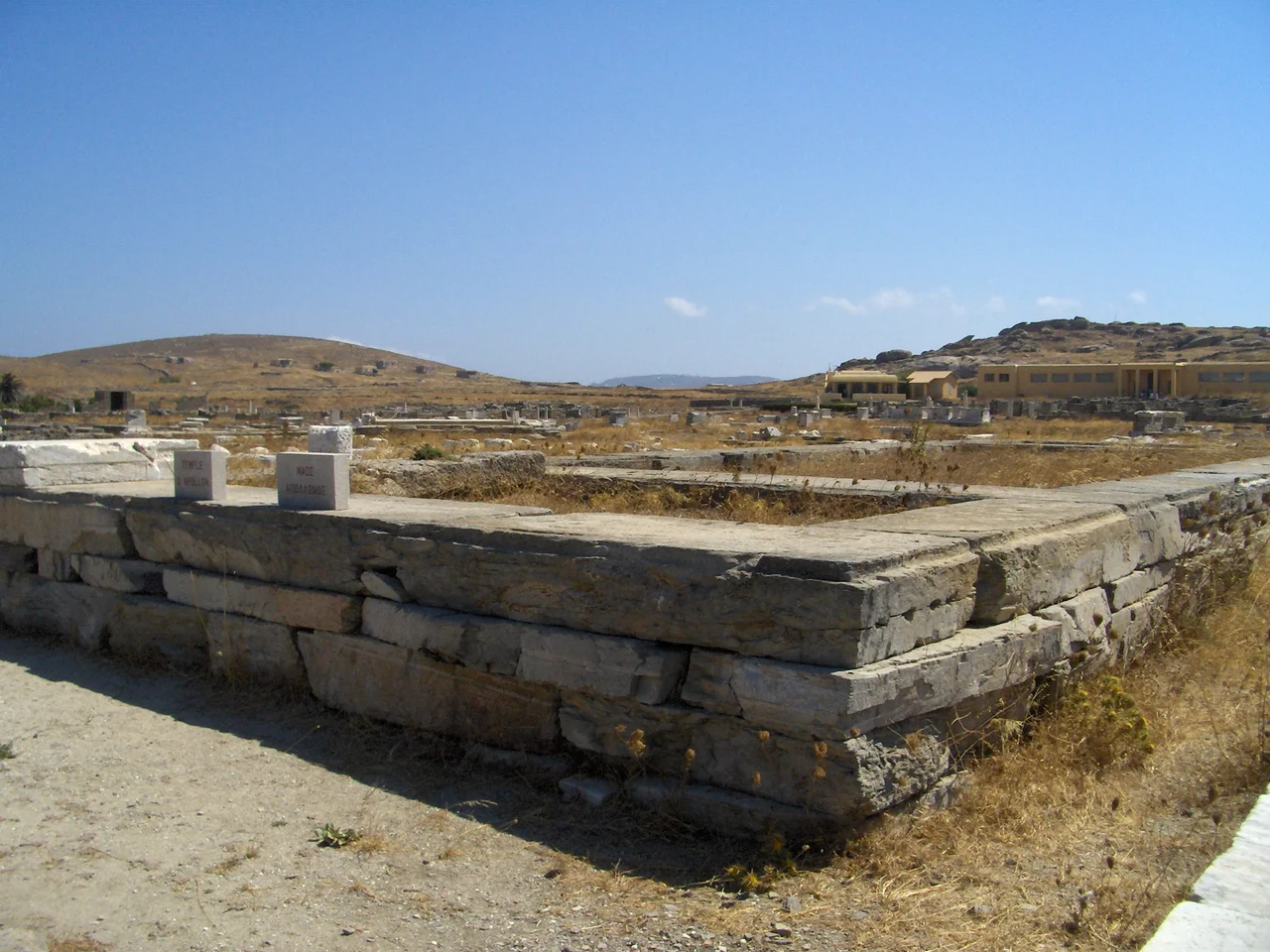

Temple of the Delians
No one was allowed to be born or to die on Delos. Pregnant women and the dying were ferried across to the smaller island of Rheneia, four stadia away, so that nothing as ordinary as birth or death could pollute the holy ground where Apollo himself was supposed to have been born. Every dog was banned. Every grave was eventually exhumed and moved off the island. The Temple of the Delians, the largest of three temples to Apollo at the heart of this purified sanctuary, was begun in 476 BC and never quite finished. Construction stopped, started, stopped again. The columns were never properly fluted. Today the columns lie on their sides like cylinders of cake, their unfinished surfaces preserving the exact moment in the Greek building process when the masons stopped working.
Apollo's Birthplace
The myth, as Strabo retold it, is that Leto, mother of Apollo and Artemis, wandered the Aegean searching for somewhere to give birth. Hera, the jealous wife of Zeus, had cursed her so that no land would receive her. Delos, then a floating rocky outcrop tossed by the waves, agreed to anchor itself if Leto would honor it. Four pillars rose from the bedrock to fix the island in place. Leto gave birth to Artemis first, then to Apollo. From that moment Delos was sacred, and the small island became one of the great Panhellenic sanctuaries, ranking with Olympia and Delphi. The neighboring Cyclades sent annual delegations of envoys, sacrificial animals, and choirs of girls to celebrate the great festival of Apollo. The Cyclades themselves take their name from circling around Delos.
The Delian League's Treasury
After the Persian wars, the Greek city-states formed a defensive alliance against Persia. The treasury was kept on Delos, which gave the league its name: the Delian League. Construction of the great temple began in 476 BC, funded by league contributions, as a Doric peripteral temple with six columns on each end and thirteen along each side, on a foundation roughly 30 by 13 meters. Then in 454 BC the treasury was moved to Athens, ostensibly for safekeeping, in practice because Athens was now treating its allies as subjects. Pericles used the funds to build the Parthenon. Construction at Delos paused. It resumed only after Delos won a brief period of independence in 314 BC, but the finishing touches were never completed. Decorative carvings and the column fluting remained unfinished forever.
Unfinished Columns, A Window into Process
Because work stopped, the temple's columns preserve something most finished temples have lost: the Greek construction process itself. A column shaft was assembled from round stone drums, stacked one on top of another. While the drums were on the ground, masons would carve the fluting, the vertical channels that give Greek columns their characteristic ribbed look, but only at the very top and bottom of each drum, just enough to mark the alignment so the next drum could be set in correct register. Once the column was assembled and standing, scaffolds were built and masons worked their way up the shaft, completing the flutes between the marker grooves. At the Temple of the Delians, this final step was never done. The drums show smooth surfaces between the carved guides, frozen at exactly the moment the project ran out of money or political will.
The Sack of 88 BC
Delos remained a religious sanctuary and a major commercial port through the Roman period. After Rome destroyed Corinth in 146 BC, much of that city's trade shifted to Delos, and the sanctuary's wealth grew. Then in 88 BC, during the First Mithridatic War, the Pontic king Mithridates VI sent his general Menophanes to attack the island. Pausanias preserved the story. Menophanes raided the unfortified, unarmed sanctuary, killed the foreigners and Delians living there, plundered the temple offerings, and took women and children as captives. He sacked the place to ruin. According to the Greeks, the god took his revenge: as Menophanes sailed away, surviving merchants attacked his ship and sank it. Mithridates himself was eventually driven to suicide as Roman armies pursued him. The temple stood, but Delos never recovered its earlier prominence. Strabo described it a few decades later as desolate.
Foundations on the Sacred Ground
Today the Temple of the Delians is foundations and stylobate, with the unfinished column drums tumbled across the site like the wreckage of an interrupted thought. Visitors arrive by ferry from Mykonos, a 30-minute crossing, and walk through what amounts to a complete ancient sanctuary city. The Sacred Way passes the famous Terrace of the Lions, marble guardians the Naxians dedicated around 600 BC. The Sacred Lake, where the divine swans were said to have circled, is now drained, marked by a lone palm tree. The Colossus of the Naxians, a giant statue of Apollo, lies in fragments in the courtyard adjacent to the temple. The whole island is an open-air archaeological site, a UNESCO World Heritage Site, and you cannot stay overnight. The old prohibition on dying on Delos has become the modern prohibition on sleeping there. Every visitor must leave before dark.
From the Air
Located at 37.40 N, 25.27 E on Delos, a small uninhabited island in the central Cyclades, 1 km west of Mykonos. The sanctuary covers most of the western and central island. Mount Kynthos, the only significant elevation at 113 meters, lies just southeast. Nearest airports: Mykonos Island National (LGMK) 5 km east, Paros (LGPA) 30 km west, Naxos (LGNX) 35 km south. Best viewed from a southern approach below 800 meters AGL on a clear day. The bare, golden-brown island is unmistakable, with the temple foundations and the Terrace of the Lions visible against the surrounding ruins. Mykonos's white-washed buildings provide a striking contrast just across the strait.
Nearby Stories
- Panagia Ekatontapiliani 1.5 km away
- Panagia Kanala 15 km away
- Andros 30 km away
- HMHS Britannic 30 km away
- Kimolos 33 km away
- Amorgos 34 km away
- Ikaria 51 km away
- Emporio, Chios 71 km away