
Temple of Aphaia
Her name means "the one who vanished." Aphaia was a goddess worshipped at exactly one place on Earth - this hilltop on the eastern flank of Aegina, 160 meters above the Saronic Gulf. The Cretans told a story about a nymph named Britomartis who fled the advances of King Minos, leapt from a fisherman's boat, ran into a grove on Aegina, and disappeared. The locals said she became Aphaia, and they built her a temple here, and they kept worshipping her long after the rest of Greece had moved on to better-known names. From the columns that still stand, you can see Athens across the water on a clear day. The Athenians could see this hilltop too, which mattered.
The Goddess Who Belonged Here
Cult activity on this hilltop reaches back to the 14th century BC. Excavators have found an unusual concentration of female figurines from the Late Bronze Age, including kourotrophoi - mother-and-child statuettes that imply a fertility cult older than any Greek pantheon. Whoever the worshippers of those figurines thought she was, the people who eventually called her Aphaia kept the site sacred for nearly three thousand years. The Greeks elsewhere tried to map her onto familiar names. Pausanias, writing in the 2nd century AD, identifies her with Athena and with Artemis and with the Cretan Britomartis, three goddesses at once. The Aeginetans seem to have shrugged at this and continued worshipping their own goddess, the one who disappeared into the grove.
Two Temples, One Hill
The temple visible today is not the first. Around 510 BC fire destroyed an earlier Doric temple on this same spot - smaller, with painted limestone elements that the rebuilders carefully buried in the new terrace fill, where they preserved beautifully. That accident of construction means archaeologists have a near-complete record of both buildings, one stacked above the other. The replacement temple, finished around 500 BC, is what visitors see now: hexastyle Doric, six columns by twelve, all but three of the outer columns carved from a single block of stone. The marble roof tiles and antefixes were luxurious choices for a small island temple. Aegina was wealthy then, having grown rich on Mediterranean trade, and the islanders meant to show it.
The Pediments That Aren't Here Anymore
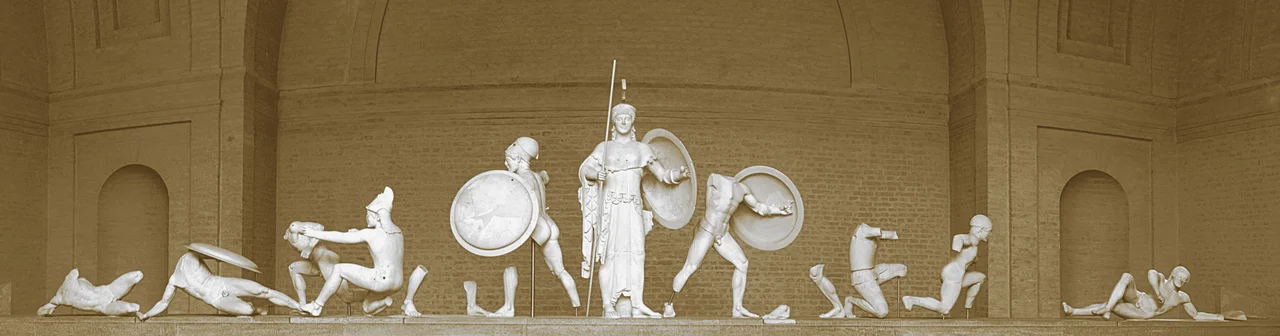
In 1811, two young men on the Grand Tour climbed this hill: Charles Robert Cockerell, an English architect, and the Baltic German Otto Magnus von Stackelberg. They found the fallen pediment sculptures lying in the rubble - two complete sets, the east and west, depicting Aegina's local heroes fighting in the Trojan Wars alongside Heracles and Agamemnon. With the help of Carl Haller von Hallerstein, who was protege of Crown Prince Ludwig of Bavaria, they sold the marbles to Ludwig the following year. The pediments left Aegina and went to Munich, where the Danish sculptor Bertel Thorvaldsen restored them, and where they still sit in the Glyptothek. They influenced an entire generation of Neoclassical architecture in the city. The temple lost its sculptures, but the painted traces preserved on those marbles became one of the most important sources for understanding how brightly Greek temples were once decorated.
Two Trojan Wars in Stone
The pediments told a deliberate story about Aegina's pedigree. The myth ran like this: Zeus seduced the nymph Aegina, who bore Aiakos, the first king of the island. Aiakos fathered Telamon and Peleus. Telamon was the father of Ajax. Peleus was the father of Achilles. The west pediment showed the Trojan War of Homer - Ajax in the thick of it. The east pediment showed an earlier Trojan War, the one Heracles fought against King Laomedon, with Telamon at his side. Athena stood at the center of both compositions. The message was clear: every great Greek hero of legend had Aeginetan blood. The east pediment was actually replaced once during construction, possibly after lightning damage during the Persian Wars, in a more dynamic Classical style than the slightly older west pediment. Walking the temple today, you read the change in artistic technique across a few decades carved into one building.
Standing Among the Pines
Twenty-five of the original thirty-two outer columns still stand, restored carefully in stages between the 1950s and the work of German archaeologist Dieter Ohly's team from 1966 to 1979. The hilltop is quiet most days. Pine trees line the approach, and the breeze off the Saronic Gulf carries the smell of resin and salt. Athens lies thirty kilometers north across the water, the Acropolis sometimes visible in clear light. From this vantage you understand what J. M. W. Turner saw when he painted this temple in the early 19th century - not the Athens of textbooks but a quieter, older Greece, where a goddess of fertility could keep her sanctuary on a single island for thirty centuries while empires rose and fell around her.
From the Air
Temple of Aphaia sits at 37.7543 N, 23.5333 E on a 160-meter pine-covered ridge near the northeast tip of Aegina island in the Saronic Gulf. From cruise altitude, the island appears as a roughly triangular shape 30 km southwest of Athens. Best viewed at 3,000-5,000 feet on approaches into Athens International (LGAV/ATH); the Acropolis lies on bearing 010 at 30 km distance. Hellenic Air Force Tatoi (LGTT) and Eleusis (LGEL) lie north and northwest. Visibility into the eastern Saronic Gulf is reliably excellent in summer; afternoon sea breezes can bring scattered cumulus.
Nearby Stories
- Megara 4.3 km away
- Berbati Valley 4.4 km away
- The Dokos Shipwreck 11 km away
- Mines of Laurion 12 km away
- Sicyon 12 km away
- Hellenic Geodetic Reference System 1987 12 km away
- Villa of Herodes Atticus 15 km away
- Kythnos 46 km away