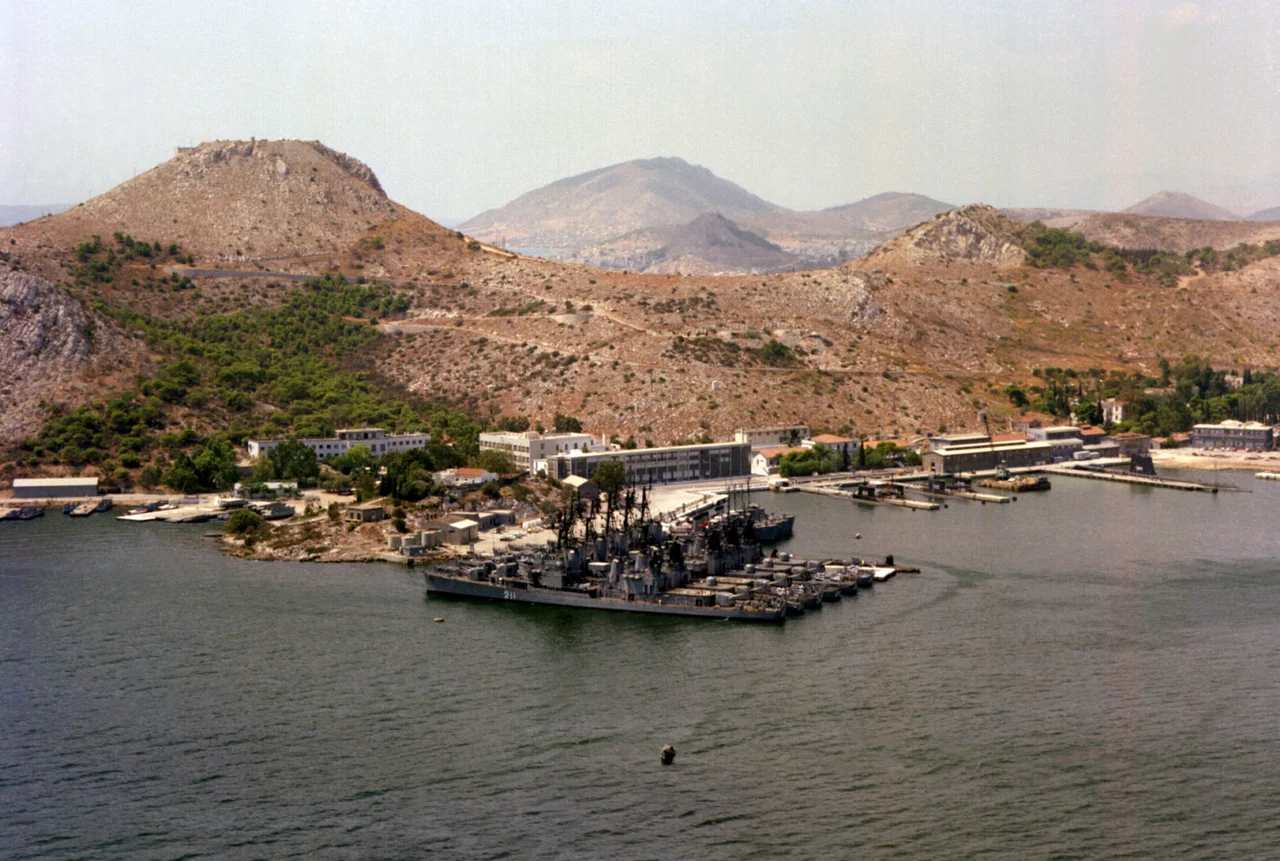

Salamis Naval Base
Photography is strictly prohibited. Access to the seafront is restricted to naval personnel only. These warnings appear in accounts of the Salamis Naval Base, and they underscore something the base shares with the island itself: the sense that consequential things happen here, away from ordinary view. The strait just outside the perimeter is where the Greek fleet destroyed the Persian armada in 480 BC, the battle that arguably saved Western civilization. Today that same narrow channel is the home port of the Hellenic Navy's most powerful warships, submarines, and amphibious forces. The geography that made Salamis decisive in antiquity makes it indispensable now.
From Poros to Arapi
The first organized Greek naval base after independence was founded on the island of Poros, following the 1821 revolution. It served as the Royal Hellenic Navy's main base until 1881. That year, on April 16, a Royal Decree ordered a new facility to be constructed at a location on northeastern Salamis Island then known as Arapi — near Cape Arapis. The Municipality of Salamis donated most of the roughly 300 hectares required, calculating, correctly, that a naval base would bring employment, infrastructure, and business to the island. Construction began immediately, and one of the first permanent structures completed was the church of Saint Nikolaos, finished in 1882. Naval activities were transferred gradually from Poros and from a temporary arrangement at the Phaneromeni Monastery, which had briefly hosted the navy between 1878 and 1881.
War, Occupation, and Ruin
The base proved its worth across a generation of conflicts. The Balkan Wars, the First World War, the Second World War — each drew the facility into intensive use. In 1936, a suburban light railway connected Piraeus with Perama, terminating inside the base at Amphiali, running until 1977. Then came the German occupation. The Luftwaffe sank ships in the strait in 1941, including the decommissioned battleships Lemnos and Kilkis, blocking the channel. German forces occupied and used the base for submarine operations. When they retreated in 1944, they left the installations severely damaged. Cleanup and reconstruction began in November 1944. It took years to restore what a few months of occupation had destroyed, but the base never went out of service entirely — it was too important to abandon.
The Principal Base of the Hellenic Navy
Today the Salamis Naval Base is the largest naval installation in Greece. Most Hellenic Navy ships are homeported here, along with administrative, training, and support services. Around 10,000 naval and civilian personnel work within its perimeter. The base encompasses frigates, fast boats, gunboats, mine sweepers, amphibious forces, submarines, and an underwater demolition command — essentially the full fighting capability of the Greek fleet, concentrated in this one compound on the northeastern tip of Salamis. A heliport at Amphiali, designated LGAM, serves the base's aviation needs. The Forward Operating Naval Base at Syros, in the Cyclades, reports to Salamis command.
Island Economy, Shared Life
The base does not exist apart from the island community — it is deeply woven into it. The naval hospital served the island's civilian population for decades, providing healthcare where none otherwise existed. Vocational training programs for young islanders have run through the base. When fires or emergencies struck Salamis, naval firefighting and ambulance units reinforced local emergency services. Subcontracting for ship maintenance flows out to businesses in Perama, Keratsini, and Drapetsona, spreading employment well beyond the base perimeter. The strait that once defined the most celebrated naval battle in history now defines the livelihoods of thousands of ordinary people.
From the Air
The Salamis Naval Base occupies the northeastern tip of Salamis Island at approximately 37.977°N, 23.536°E — the narrowest point of the historic Strait of Salamis. Flying west from LGAV (Athens International Eleftherios Venizelos) at 3,000–5,000 feet, the strait appears between the industrial port of Perama on the mainland and the northeastern shore of Salamis Island. The base's docks, jetties, and dry-dock facilities are visible along the Cape Arapis shoreline. Piraeus is prominent to the northeast; the Athenian urban sprawl fills the horizon beyond. Photography of the base is prohibited by Greek military regulation.
Nearby Stories
- Hellenic Geodetic Reference System 1987 3.4 km away
- Mount Helicon 4.2 km away
- Siege of Thebes (292–291 BC) 4.8 km away
- Archaeological Museum of Aegina 6.3 km away
- Berbati Valley 10 km away
- Theatre of Thorikos 14 km away
- Sicyon 15 km away
- Euboea 22 km away