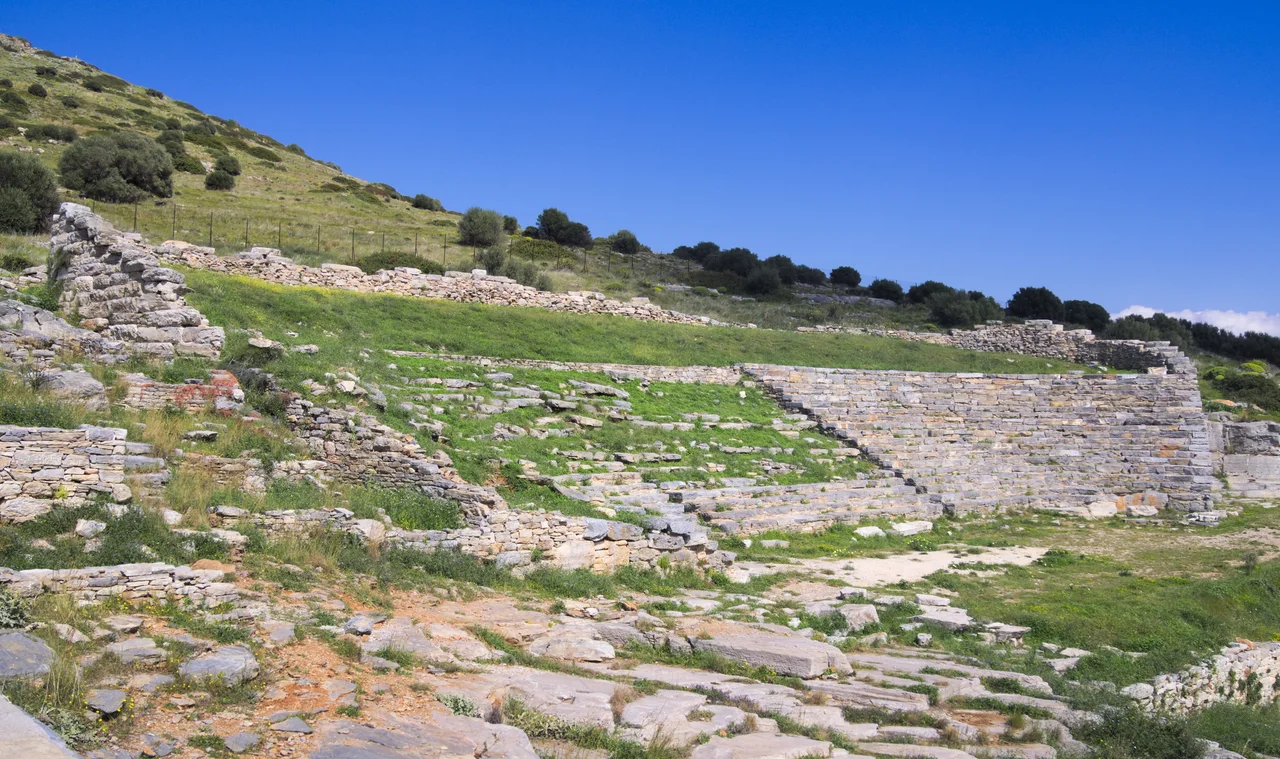

Theatre of Thorikos
The shape is wrong, and that is the point. Every Greek theatre you have ever seen in photographs — Epidaurus, Delphi, Dodona — follows the same geometry: a perfect semicircle of tiered seats curving around a circular orchestra pit. The Theatre of Thorikos does not do this. Its seating rows run straight through the middle and bend only at the ends, creating an elongated form that opens toward the southwest with an oval orchestra approximately 16 by 30 meters. It looks like a theatre designed by someone who had not yet decided what a theatre was. That is essentially correct. Thorikos was built around 525–480 BCE, making it the oldest known stone theatre in the world, constructed before the conventions of Greek theatrical architecture had solidified into their canonical form.
A Stage Built Among the Mines
Thorikos was an ancient deme — a local administrative community — on the southern tip of the Attica peninsula, just north of what is now Lavrio and not far from the silver mines of Laurion. The theatre sits on the southern slope of a hill called Velatoúri, carved from local limestone quarried nearby. Its setting is industrial as much as cultural: the same landscape that produced the silver that built Athens' fleet contained this, one of the earliest civic gathering spaces in the ancient world.
The theatre was not designed for drama alone. It functioned as a meeting place where citizens of Thorikos gathered for civic purposes — assemblies, religious festivals, public business. The distinction between theatre and civic forum was, at this early stage, not yet firmly drawn.
How It Grew
The theatre was built in phases across roughly two centuries. In the first phase of construction, there were approximately 19 to 21 straight rows of stone benches, divided by two vertical staircases into three sections of unequal width. The middle section's benches run at a slight diagonal — another sign of pragmatic construction rather than geometric idealism.
In the mid-5th century BCE, curved sections were added to both ends of the original straight gallery. In the 4th century BCE, further curved rows were added at the rear, probably including some wooden benches. Two entrances on the north side gave access from outside to the upper seating area; a raised walkway led from the slope on the west. At its largest, the theatre could hold between 2,000 and 3,200 spectators — a substantial audience for a community built in the shadow of the mining works.
The World's Oldest, Largely Forgotten
Despite holding the distinction of being the oldest known stone theatre in the world, the Theatre of Thorikos is not a famous destination. It lies outside the major archaeological tourism circuit of southern Attica, which tends to begin and end with the Temple of Poseidon at Cape Sounion. The site is largely unrestored; the benches sit as they were found, weathered and worn, in a working archaeological landscape rather than a curated monument.
American scholars from the School of Classical Studies at Athens reported on the theatre as early as 1885–1886. Belgian teams excavated and documented the site extensively through the 1960s onward, publishing detailed analyses of its geometry and construction phases. The theatre has been the subject of continuing scholarly interest precisely because its irregular form illuminates the process by which Greek theatrical conventions were invented, not received whole.
From the Air
The Theatre of Thorikos is located at 37.738°N, 24.054°E, on the hill of Velatoúri above the modern town of Lavrio, on the southeastern tip of the Attica peninsula. From the air, the elongated seating rows are discernible on the hillside. The nearest major airport is Athens International Eleftherios Venizelos (LGAV), approximately 40 km to the north-northwest. The site sits roughly 8 km north of Cape Sounion — approach from Sounion along the coastal road heading north, or from Athens along the eastern Attic coast. Recommended viewing altitude: 1,500–2,500 feet AGL. The surrounding landscape retains evidence of the ancient mining works, including spoil heaps and processing areas.
Nearby Stories
- Salamis Naval Base 1.9 km away
- Battle of Andros (1790) 5 km away
- Temple of Aphaia 5.8 km away
- Hydra: The Island That Refused the Car 13 km away
- Gyaros 14 km away
- Saint Ephraim Monastery, Nea Makri 16 km away
- Kythnos 30 km away
- Archaeological Museum of Sifnos 53 km away