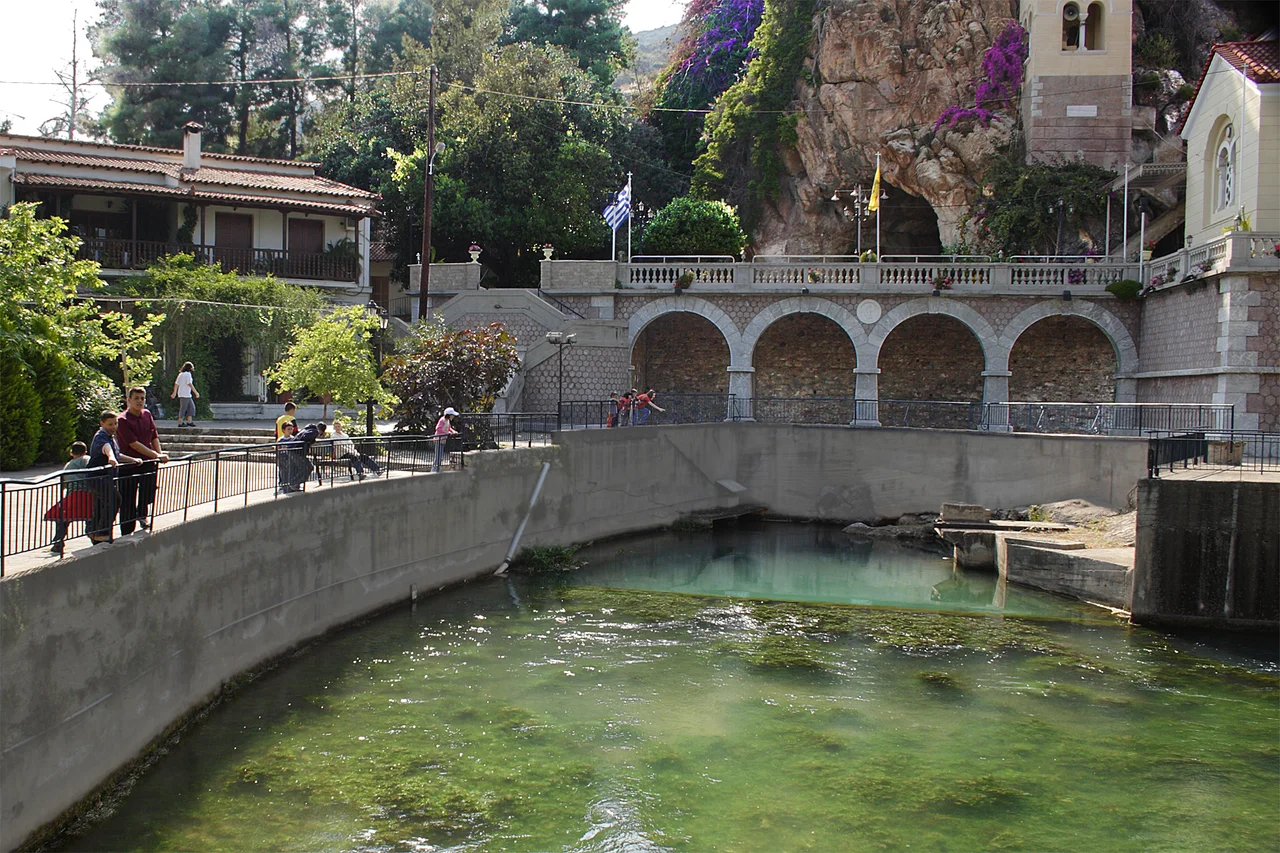

Kefalari (Argolis)
The name gives it away, if you know the Greek. Kefalari — from the words for 'lift' and 'head' — traces back to the moment Heracles buried the main head of the Lernaean Hydra beneath a mountain here, and the earth cracked open with such force that a great spring burst through. Mythology or not, the spring is real: a powerful karst torrent that emerges where the limestone mountains of the Peloponnese give way to the Plain of Argos, feeding the ancient river Erasinos toward the sea. The village that grew up around it has been sacred ground for thousands of years, its allegiances shifting from Hera to the Virgin Mary without the water ever slowing.
Water from the Underworld
Kefalari's spring is not a modest trickle. Vast subterranean waterways carry rainfall from highland basins as far away as Lake Stymphalia — where Heracles famously drove off the Stymphalian Birds in another of his labors — through kilometers of limestone before they burst into daylight here. A 1986 hydrogeological study by researchers from Athens and Graz confirmed what ancient Greeks had long suspected: the water that feeds Kefalari originates in the closed basins of Arcadia and Corinthia, traveling unseen through geological faults before rising at the edge of the fertile plain. The spring's flow is generous in winter and spring, then falls silent in the driest summer months — a rhythm the ancient inhabitants surely watched with some anxiety, since the water sustained the entire city of Argos, 6 kilometers away. Until 1983, it still supplied Argos with drinking water.
From Hera to the Virgin
Kefalari was almost certainly a religious site before it was a village. Ancient Greeks would have worshipped here at shrines to Hera and the water-nymphs, drawn by the spring's seemingly miraculous abundance. About 60 meters above the karst outlet, a cave opens in the cliff face. It would have been considered the place where Heracles interred the Hydra's severed head, the source of the water's power. When Christianity transformed the Peloponnese, the worship did not disappear — it redirected. The cave was consecrated to the Blessed Virgin Mary. The spring itself became known as the Zoodochos Pigi, 'the life-giving fountain,' a title for Mary that echoes the ancient reverence for water as divine gift. A church with foundations dating to the Roman imperial era was rebuilt at its commanding hillside position in 1835, and the combined site — cave, spring, and church — became a center of pilgrimage under the name Panagia Kefalariotissa.
Centuries of Conquest
The village's history mirrors the turbulent ownership of the Peloponnese itself. Byzantine from 337 AD until the Fourth Crusade brought French and Italian Crusaders storming south in 1204, Kefalari passed into Frankish hands and then back to Byzantine control in the 15th century, only to fall to Ottoman conquest in 1460. Under both Venetian and Ottoman governance through the 16th and 17th centuries, the village prospered modestly, its residents farming and weaving. Then, in the aftermath of a disastrous revolt around 1770 — when reprisals by Ottoman forces devastated the Peloponnese — Kefalari was abandoned, its people fleeing to the mountains of Arcadia and eastern Argolis. The village remained empty until the late 1880s, when descendants of displaced families and new arrivals gradually rebuilt a small community centered on animal husbandry, farming, and tapestry.
The Pyramid in the Field
Kefalari holds one more curiosity that confounds easy explanation. About 2 kilometers west of the village stands the Pyramid of Kefalari, one of only two ancient pyramidal stone constructions known in Greece — and both happen to be in Argolis. These are not monumental structures on the scale of Egypt; their exact purpose and date remain debated among archaeologists. But their existence here, in a valley already dense with myth and worship, adds another layer to a place that has always attracted human devotion. Today Kefalari is a village of around 800 residents. The spring's outlet is framed by old stone walls and shaded by rows of Oriental plane trees. On the Thursday after Orthodox Easter, the village fills for a large fair — a gathering that, beneath its modern surface, continues a rhythm of seasonal pilgrimage begun before history was written down.
From the Air
Kefalari sits at approximately 37.60°N, 22.69°E, at the point where the Argolid limestone mountains meet the flat Plain of Argos — a clear visual boundary visible from altitude. The Plain of Argos itself is a broad agricultural expanse easily identifiable from cruising height; Kefalari lies at its southwestern edge. The nearest major airport is LGAV (Athens International Eleftherios Venizelos), approximately 120 km northeast. Flying in from the Argolic Gulf, the spring and village are nestled at the foot of the hills, with the whitewashed chapel visible above the tree line on the cliff face. Best viewing altitude is 1,500–3,000 feet AGL in clear conditions, which are typical of this region from spring through autumn.
Nearby Stories
- Kastanitsa 2.3 km away
- Heroon at Nemea 3.4 km away
- Psari, Trikolonoi, Arcadia 4.2 km away
- Siege of Gardiki-Arcadia 8 km away
- Cleitor 12 km away
- Troezen 15 km away
- Cave of Euripides 24 km away
- SS Heraklion 94 km away