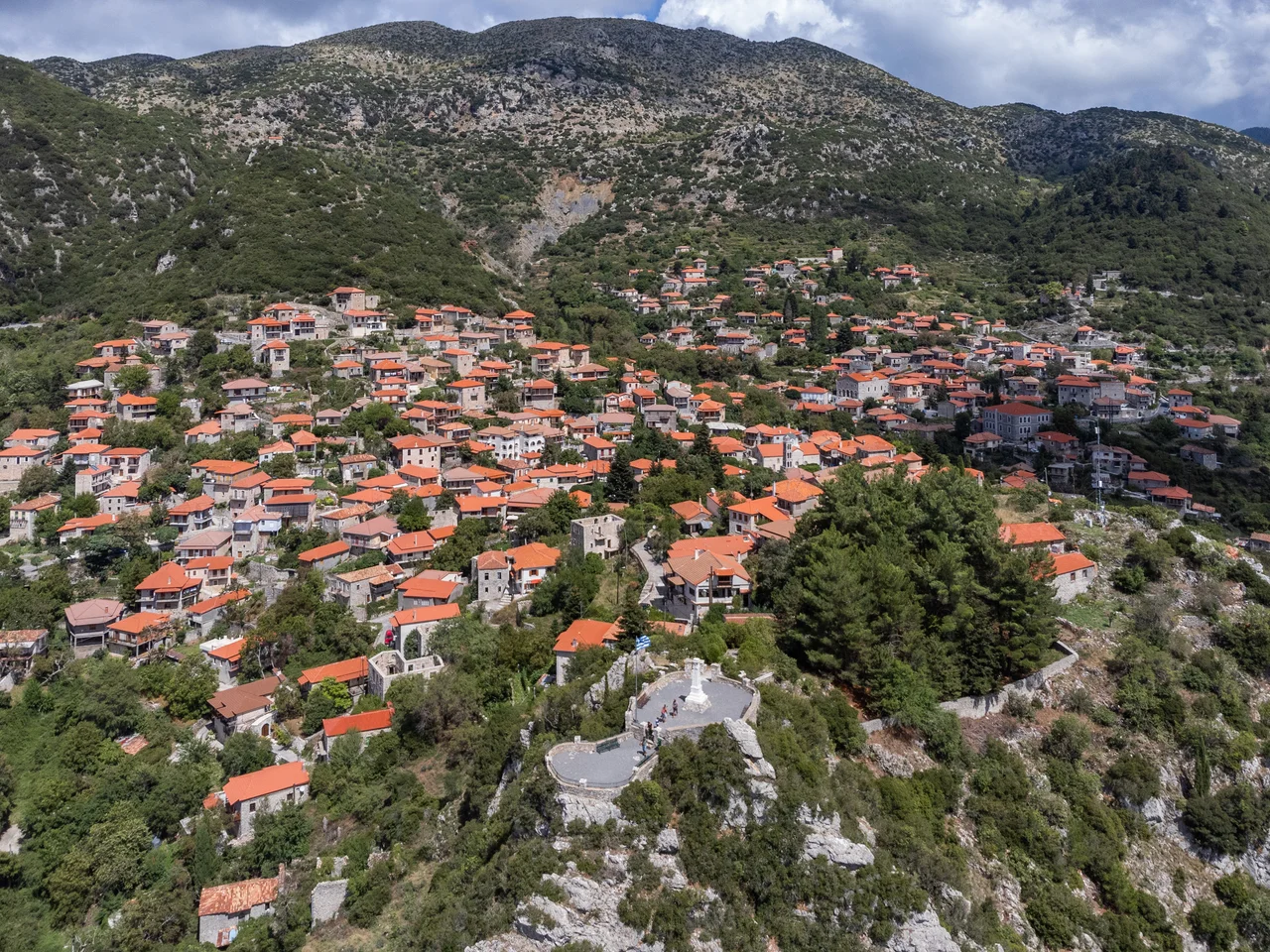

Stemnitsa
For three weeks in the spring of 1821, Greece had a government — and it met in Stemnitsa. From the end of May to mid-June of that year, the newly liberated Peloponnese convened its provisional assembly, the Peloponissiaki Gerousia, at the monastery of Zoodochos Pigi on the edge of this mountain town. The delegates who gathered there were deciding the shape of a nation that did not yet exist. They chose Stemnitsa partly because of its relative safety: tucked into the western edge of the Mainalo mountains above the gorge of the river Lousios, at over a thousand meters elevation, the town had survived centuries of Ottoman occupation by being difficult to reach and worth knowing.
A Woodland Haven Above the Gorge
The name Stemnitsa has Slavic roots, meaning "woodland," and the Slavic settlers who gave it that name arrived in the 7th and 8th centuries, long before the town became what it is today. The site itself is older still — Stemnitsa has been identified with the ancient Arcadian city of Hypsous, and its position above the Lousios gorge made it a natural stronghold across every era.
After the fall of Constantinople in 1453 and the Ottoman occupation of the Peloponnese, Stemnitsa's remoteness became its protection. Greek culture and Orthodox religion found refuge here when they were suppressed elsewhere. Churches from this period survive: the church of Bafero was built in 1185 and that of Zoodochos in 1433. Ottoman taxation documents from 1512–1515 record around 120 families in the town; a later Venetian census, the Grimani report, shows Stemnitsa as the most populous village in all of Gortynia, with 925 people.
Silver, Gold, and the Art of the Bell
Stemnitsa built its identity around its craftsmen. The town was known across the Peloponnese for its gold- and silversmiths and for the other skilled trades that clustered around them — the coppersmiths, the shoemakers, the candlemakers whose work is commemorated in the folklore museum. The museum itself, housed in a traditional building near the square, contains Byzantine icons, old costumes, copperware, guns, and jewelry: the full material culture of a working mountain town.
The tradition did not die. Since the 1970s, a publicly funded school of gold and silver smithing has operated in Stemnitsa, training craftspeople in the techniques that made the town famous. Students still learn to work precious metals in workshops that connect directly to that centuries-old lineage. The school draws students from across Greece and has kept the craft alive in the place where it developed its distinctive character.
The Monastery at the Cliff's Edge
Seven kilometers from Stemnitsa, the road descends into the ravine of the Lousios until it reaches the monastery of St. John the Baptist — the Prodromos — built around 1167, its walls pressed against the face of a vertical cliff above the river. During the Ottoman period, the monastery served as a center of faith and clandestine education for Greeks who had no other access to learning. Below the monastery, roughly 200 yards down the gorge, the Lousios runs cold and fast. Nearby, excavations have uncovered an ancient hospital dedicated to Asclepius, the god of medicine, suggesting that the gorge was a place of healing long before the monks arrived.
The library of Stemnitsa itself once held around 5,000 volumes — a remarkable collection for a mountain village — until the upheaval of the Greek War of Independence in 1821. What remained became a monument, located next to the town square.
A Town of Remarkable People
Stemnitsa has produced an improbable number of notable figures for a place of its size. Gennaios Kolokotronis, son of the great revolutionary general Theodoros Kolokotronis, was born here in 1803 and later served as Prime Minister of Greece. Antonis Samaras, a more recent Prime Minister and President of the New Democracy party, also claims Stemnitsa as his ancestral home.
Georgios Roilos, born in 1867, became a professor at the University of Athens and one of the first painters to bring Impressionism to Greek art. His most famous student was Giorgio de Chirico, the founder of Metaphysical painting — an aesthetic lineage that traces back, improbably, to this stone town in Arcadia. Elias Gyftopoulos became Ford Professor Emeritus of Nuclear Engineering at MIT. Dimitrios Thanopoulos won a silver medal in Greco-Roman wrestling at the 1984 Olympics. What the mountain produced, it sent into the world.
From the Air
Stemnitsa lies at 37.555°N, 22.081°E on the western edge of the Mainalo mountains in Arcadia, at approximately 1,050 meters elevation. Approaching from the south at 6,000–8,000 feet, the town is visible as a dense cluster of stone-tiled rooftops above the deep ravine of the Lousios river. The gorge itself — running roughly north–south — is a useful navigation landmark, with vertical limestone walls dropping to the river below. The nearest major airport is LGKL (Kalamata International), approximately 75 km to the southwest. Mountain wave turbulence is possible above the Mainalo ridge in northwest winds; afternoons in summer can bring cumulus buildups over the higher terrain.
Nearby Stories
- Battle of Meligalas 5 km away
- Battle of Picotin 13 km away
- Kastanitsa 13 km away
- Phlius 14 km away
- Cleitor 16 km away
- Pyramid of Hellinikon 16 km away
- Agios Andreas, Katakolo 19 km away
- Strofades 39 km away