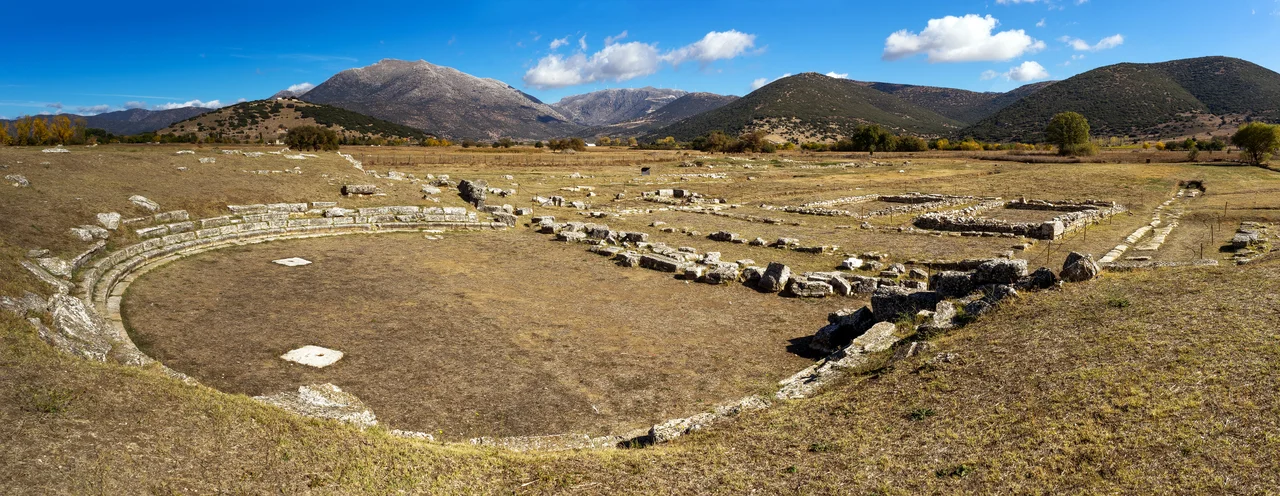

Mantinea
Diotima of Mantinea taught Socrates what he knew about love. The philosopher himself says so in Plato's Symposium — though whether she was real or a device, scholars still argue. What is not argued is that Mantinea, the city she supposedly called home, sat at the center of the Greek world's most turbulent centuries, hosting three decisive battles on the same plain and surviving destruction twice. Not many cities can say that.
The Plain That History Kept Choosing
The Arcadian plateau around modern Tripoli is broad and bowl-shaped, ringed by mountains — Lyrkeia to the north, Mainalo to the southwest — and flat enough that armies could maneuver freely. Ancient commanders understood its geometry. When Sparta and Athens fought for dominance of the Peloponnese in 418 BC, they chose this plain. The First Battle of Mantinea that year was the largest land battle of the Peloponnesian War. Sparta's tighter discipline held; the Athenian commander Laches was killed, and his army routed. Fifty-six years later, in 362 BC, the same ground hosted the Second Battle of Mantinea, in which Thebes — the briefly dominant power — won the fight but lost its greatest general. Epaminondas, architect of the Sacred Band and innovator of the oblique attack, died of his wounds on the field. His death, and the mutual exhaustion of all sides, left Greece without a clear hegemon. A vacuum that Macedon would soon fill.
A City Built, Dismembered, and Rebuilt
Mantinea itself coalesced around 500 BC through the amalgamation of several neighboring villages — a process the Greeks called synoecism, the gathering-together of peoples. Its patron god was Poseidon, and it filled the plain with temples. The fortifications were originally polygonal, the walls mud-brick over a rubble core.
Politics made enemies. Mantinea had sided with Athens during the Peloponnesian War, which Sparta neither forgot nor forgave. After the Peace of Antalcidas in 387 BC gave Sparta a diplomatic pretext to reassert control over its neighbors, Mantinea refused to dismantle its walls on Spartan orders. The Spartans responded in 385 BC by damming and redirecting the Ophis river, letting water undermine and collapse the mud-brick walls rather than storming them directly. The city was dismembered — broken back into its constituent villages. It would take the Spartan defeat at Leuctra in 371 BC and the rise of the Arcadian League before Mantinea reconstituted itself, this time with walls rebuilt in an almost oval plan, stronger than before.
A Democracy Worth Studying
Mantinea was no ordinary city. By 420 BC it was already a democracy — Thucydides notes that the Mantineans joined an Argive alliance partly because it was a fellow democracy, a remarkably self-aware political statement for the fifth century. Aristotle found its system unusual enough to describe specifically: officials were elected not by the whole citizen body directly, but by a standing committee the citizens had selected, something like a representative council filtering the democratic impulse. The assembly still met, probably once a year. There were *damiourgoi* for civil administration, *theoroi* for religious matters, and *polemarchoi* for military command. The Spartans forcibly suppressed this democracy in 385 BC when they dismembered the city. It revived briefly in the 360s, during Mantinea's membership in the Arcadian League, before the cycles of Greek politics swept on.
Hadrian's Temple, Pausanias's Tour, and the Marble That Survives
The Roman emperor Hadrian visited Mantinea in AD 130, restoring its ancient name — it had been renamed Antigoneia by the Macedonian king Antigonus III Doson after he sacked it in 223 BC. Hadrian also built a temple here dedicated to his lover Antinous, who had drowned in the Nile the previous year. The emperor grieved visibly and publicly; temples to Antinous appeared across the eastern empire, but Mantinea's connection to beauty and philosophy made it a fitting site.
A few decades later, the traveler and geographer Pausanias toured the plain and described what remained — temples, walls, the theater, the dam. From the 4th century BC survives the Mantineia Marble, now in the National Archaeological Museum of Athens: three relief panels — one depicting the mythological contest between Apollo and Marsyas (with a Scythian slave holding a knife, ready to perform the punishment), and two showing groups of Muses, one of whom plays a pandouris — an instrument researchers cite as evidence that lutes existed in ancient Greece. The plain today grows moschofilero grapes for a Protected Designation of Origin wine, blanc de gris. The vineyards and wheat fields spread where hoplites once formed their lines.
What the Mountains Still Hold
Mountains remain the valley's frame. The seat of the modern municipal unit Mantineia is Nestani, a village of fewer than five hundred people in 2011, sitting in the northeastern part of Arcadia. The valley below it has flooded more than once in the modern era — mid-twentieth-century floods formed temporary lakes before drainage was engineered. Forests cover the slopes. Rocks and grassland dominate the northeast. The ancient dam near the city was, Pausanias noted, one of the most sophisticated engineering works of the ancient world. The Ophis river that Sparta weaponized against the city's walls still flows through the plain, quieter now, past vineyards that produce a wine with the PDO name of the city that once stood here.
From the Air
Mantinea lies at approximately 37.62°N, 22.38°E on the broad Arcadian plateau northeast of Tripoli. From altitude, the plain is distinctive — flat, bowl-shaped, ringed by mountain ridges. The modern city of Tripoli (population ~28,000) is visible to the southwest. Approach from the south at 5,000–8,000 feet for the best view of the plateau's geometry. Nearest major airport: LGKL (Kalamata International), approximately 90 km to the southwest. The ancient theater of Mantineia is partially visible near the village of Nestani on low passes.
Nearby Stories
- Araklovon Castle 4.8 km away
- Pellana 6.6 km away
- Arkadiko Bridge 10 km away
- Siege of Corinth (1463) 11 km away
- Leonidio 11 km away
- Kyparissia 11 km away
- Pheneus 14 km away
- Santameri Castle 29 km away