
Sanctuary of Asclepius, Epidaurus
They came here because they had tried everything else. People from across the ancient Mediterranean world — from Asia Minor, from Egypt, from Rome — made the journey to Epidaurus when illness had defeated the physicians. They arrived at a sanctuary in a river valley, purified themselves according to the rituals, and then lay down in the abaton, a long colonnade that served as a sleeping hall, to wait. The hope was that Asclepius, the god of medicine, would appear to them in the night. Sometimes he would speak. Sometimes, according to the inscriptions preserved here, he would heal. The Sanctuary of Asclepius at Epidaurus was the most famous healing center of the ancient world — a rival, its sources claimed, of Olympia and Delphi — and the stone inscriptions recording miracles that were unearthed here in 1881 contain the names of real people, each one of them carrying a real illness, each one of them trusting that this particular valley held something the rest of the world did not.
The God and His Birthplace
The mythology of the sanctuary is inseparable from its location. According to Pausanias, the 2nd century AD geographer who described the sanctuary in detail, Asclepius was born here at Epidaurus — the son of Apollo and a mortal woman named Coronis. After his birth, the infant was exposed on a nearby hill, the one now called Kynortion, where a goat nursed him until he was found. That hill was sacred to Apollo Maleatas, and the older shrine atop it predates the sanctuary below. Asclepius grew into the greatest physician the ancient world knew, eventually so skilled at healing that he began raising the dead — at which point Zeus struck him down with a thunderbolt to prevent him from upsetting the natural order. After death, Asclepius became a god, and the place of his birth became the center of his cult. A procession was established in the 3rd century BC, initiated by a man named Isyllus, to celebrate Asclepius's birthday: it began at the hilltop shrine of his father Apollo and descended to the valley sanctuary. The two sites were always understood as a single sacred landscape.
The Temple and Its God
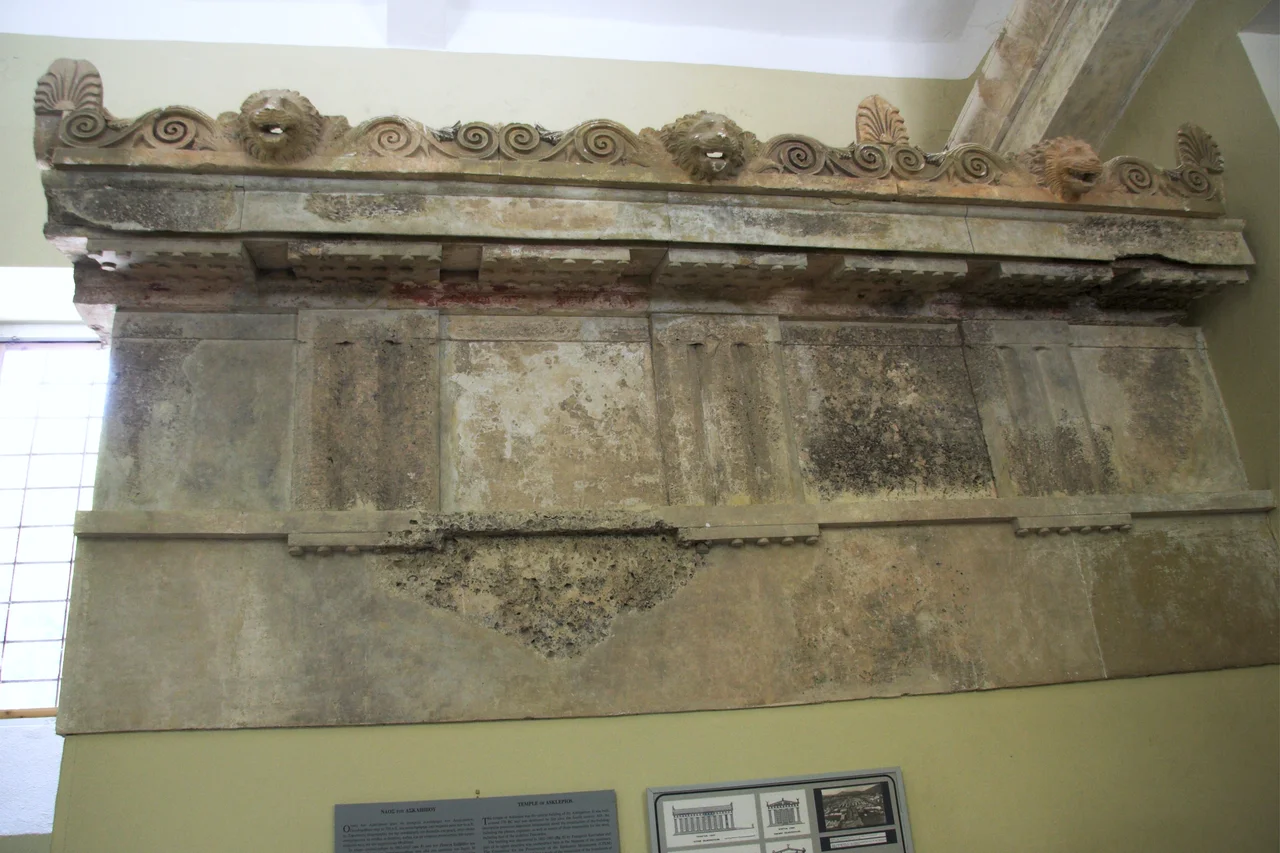
The Temple of Asclepius was built in the early 4th century BC. It was Doric in style — six columns across, eleven along the sides — and measured roughly 80 feet in length. An architect named Theodotus designed it; the project took nearly five years to complete. Inside stood the cult statue of the god, an extraordinary work in gold and ivory by the sculptor Thrasymedes of Paros: Asclepius seated on a throne, one hand resting on a staff, the other raised above the head of a serpent. A dog lay at his feet. Pausanias described the statue as half the size of the famous Zeus at Athens, which still would have made it a commanding presence. The temple's pedimental sculptures and decorative elements — the work of master craftsmen — were eventually transported to what is now the National Archaeological Museum in Athens. The temple itself survives only as foundations, though fragments of the upper structure are held in the on-site museum.
Sleep, Dreams, and the Abaton
The healing practice at Epidaurus centered on a ritual called incubation: sleeping within the sanctuary in the hope of receiving a divine vision. The abaton, a long roofed colonnade, was the place where this happened. People who came to Epidaurus seeking healing would undergo preliminary purification — the rules were strict; no birth and no death were permitted within the sanctuary precinct — and then lie down in the abaton to wait. The stone inscriptions unearthed by excavators in 1881 and 1903, sometimes called the miracle inscriptions, recorded the names of at least twenty individuals and described how each was healed. Some accounts describe the god appearing in a dream and prescribing a treatment; others describe more direct interventions. Aelian, a Roman writer of the 3rd century, preserved one account of a woman who came to Epidaurus suffering from an intestinal worm that no physician had been able to treat. The sanctuary attendants laid her down in the healing place, and — in the account that has survived — Asclepius himself arrived and performed a surgery that his attendants had begun but could not complete, restoring the woman to health. Whether or not these stories describe literal events, the people who wrote them down and the people who kept them on the sanctuary walls believed they did. Each inscription was a testament from someone who had been desperate and then, somehow, recovered.
Centuries of Use, and Ruin
The sanctuary endured for centuries, accumulating buildings and patrons and rituals. During the Achaean War in 146 BC the precinct was converted into a military stronghold; after the war, the Roman general Lucius Mummius visited and left dedications. In 87 BC, Sulla looted the sanctuary. Pirates sacked it before 67 BC. The first century BC left the site in ruins: the gymnasium abandoned, the water system non-functional, the hilltop shrine of Apollo Maleatas destroyed. A wealthy local benefactor, Euanthes son of Eunomus, is credited on surviving inscriptions with preventing total collapse. The sanctuary recovered under the empire. The Emperor Hadrian visited in 124 AD and introduced major reforms, including restructuring the Asclepieia Games. In the 160s and 170s AD, a Roman senator from Asia Minor, Sextus Julius Major Antoninus Pythodorus, funded an extensive renovation that restored both the valley sanctuary and the hilltop shrine. The Goths raided in 395 AD. The sanctuary was known as a Christian healing center as late as the mid-5th century — the site's healing associations outlasting the specific cult by several generations.
What the Excavations Found
Panagiotis Kavvadias began excavating at Epidaurus in 1881 on behalf of the Archaeological Society of Athens, initially looking for the famous theatre Pausanias had described. He found the theatre almost immediately — and then kept digging for nearly fifty years, until his death in July 1928. His excavations uncovered the Temple of Asclepius, the tholos (a mysterious circular building whose exact function remains debated), the stadium, the gymnasium, and the miracle inscriptions. Valerios Stais joined as field director in 1887 and supervised much of the systematic work. John Papadimitriou continued between 1948 and 1951, focusing especially on the hilltop sanctuary of Apollo Maleatas. The site was inscribed on the UNESCO World Heritage List in 1988, recognized for its architecture and its significance in the history of medicine. The Epidaurus Archaeological Museum, built within the sanctuary precinct, holds the sculptural fragments, the miracle inscriptions, and thousands of votive offerings left by people who came here sick and hoping, across seven hundred years, that the god would answer them.
From the Air
The Sanctuary of Asclepius at Epidaurus sits at approximately 37.599°N, 23.074°E in a river valley of the northeastern Peloponnese, roughly 30 kilometres south of Corinth and 100 kilometres southwest of Athens. From the air at 4,000 feet, the ancient theatre — a nearly perfect semicircle cut into the hillside — is the landmark that announces the site. The valley precinct spreads below it to the southeast, partially visible through pine trees. Mount Kynortion, with the older hilltop sanctuary of Apollo Maleatas, rises to the east. The nearest major airport is LGAV (Athens International Eleftherios Venizelos), approximately 100 kilometres to the northeast. The Argolic Gulf is about 10 kilometres to the southeast; the road from the coast threads through low hills to reach the sanctuary. On a clear day at altitude, the sacred geography of Epidaurus — hilltop shrine, valley sanctuary, theatre, and coast — is visible all at once.
Nearby Stories
- German Submarine U-133 (1941) 5.1 km away
- Battle of the Trench (1821) 5.4 km away
- Battle of Settepozzi 6.7 km away
- Stymphalus (Arcadia) 8.2 km away
- Kechries 11 km away
- Battle of Sellasia 13 km away
- Saronic Gulf 19 km away
- SS Heraklion 68 km away