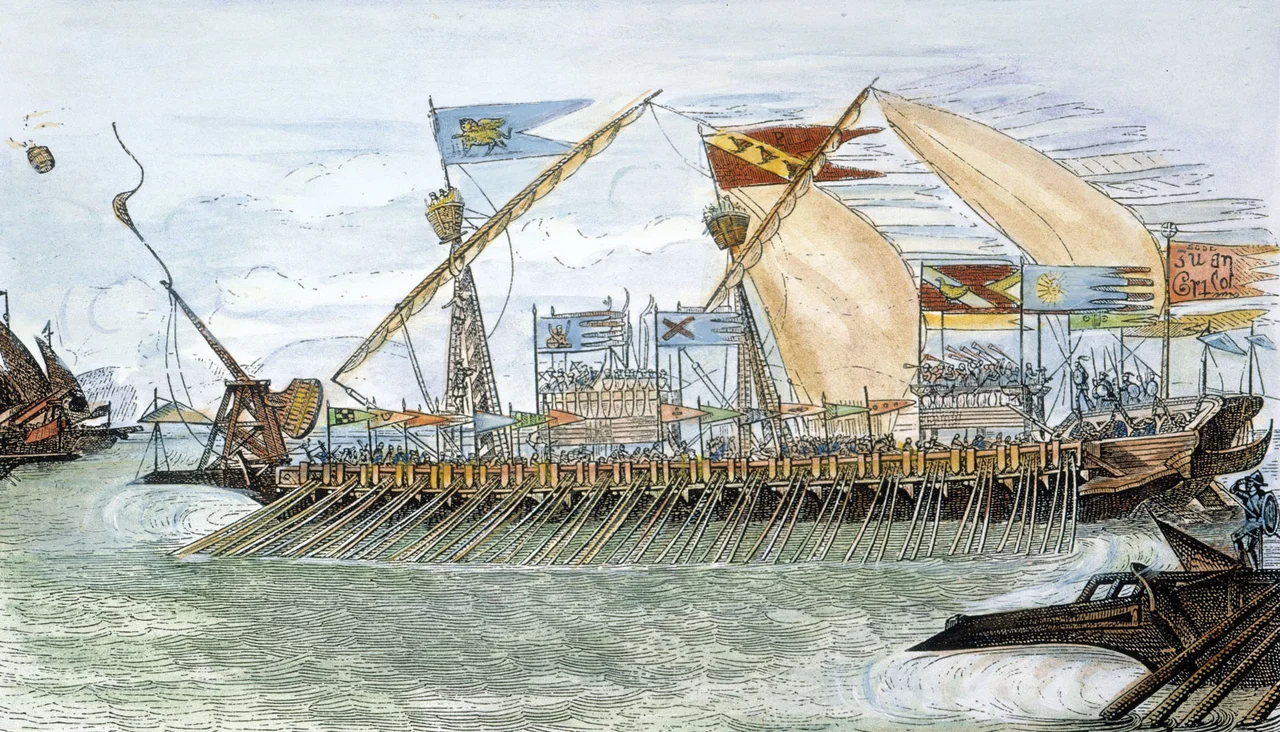

Battle of Settepozzi
When the signal to attack went up on the Genoese flagship, only fourteen of the forty-eight ships in the fleet moved. The other thirty-four held their oars in the water and watched. Two of the four admirals - Pietro Avvocato and Lanfranco Spinola - drove their ships at the Venetian line off the island the Italians called Settepozzi (today's Spetses, in the Saronic Gulf). The other two admirals fled. By sundown Avvocato was dead, four Genoese galleys were in Venetian hands, and Emperor Michael VIII Palaiologos in Constantinople had received the kind of news that ends alliances.
An Alliance Born of Necessity
The setup at Settepozzi was three years in the making. In 1261 Michael VIII, ruler of the rump Empire of Nicaea, was preparing to retake Constantinople from the Latins who had held it since the Fourth Crusade. He had soldiers. He did not have ships. The Venetians, who had installed the Latin emperor in 1204 and still profited handsomely from Constantinople's customs houses, had ships - more than anyone else. The only state that could match Venice at sea was Genoa, and Genoa had been at war with Venice since 1256 over a quarrel about a Levantine monastery. On 13 March 1261, in the Asian port of Nymphaeum, Michael and the Genoese envoys signed a treaty: Genoa would supply fifty galleys; in exchange, when Constantinople fell, Genoese merchants would inherit the Venetian privileges. A fortnight later a Nicaean general named Alexios Strategopoulos walked into the unguarded city with a small force, and the alliance suddenly mattered less than its architects had hoped.
Why the Ships Wouldn't Fight
Genoese galleys did not belong to Genoa. They belonged to merchant families who paid for their construction and outfitting and expected returns. An admiral who lost a ship had to answer to the family that had financed it. The historians Frederic Lane and Deno Geanakoplos have pointed to this as the structural reason Genoese fleets avoided pitched battle throughout the War of Saint Sabas: the captains had every commercial incentive not to risk their hulls. The Venetians, by contrast, fought in state-owned galleys with state-paid crews. When the two systems collided in the open sea, the institutional difference showed up as cowardice in the official chronicles. It may have been something more complicated than cowardice.
The Battle That Never Quite Happened
In the early summer of 1263, the Genoese fleet of 38 galleys and 10 lighter saette - some 6,000 men - was sailing south to the Byzantine fortress of Monemvasia at the tip of the Peloponnese. North of the island of Spetses they ran into a Venetian fleet of 32 galleys under Guiberto Dandolo, sailing the other way toward Negroponte. Two accounts survive. The Genoese Annales Ianuenses say the signal to attack was given but only fourteen ships answered it. The Venetian chronicler Martino da Canal says the Venetians attacked first while the Genoese were still arranging themselves into four ranks of ten. Both agree on the outcome: the two engaged Genoese flagships were boarded and their flags cut down, the surviving admirals fled, and Pietro Avvocato was among the dead. Canal's casualty figures - perhaps inflated - give the Genoese 600 dead or wounded and 400 captured against Venetian losses of 20 dead and 400 wounded.
Aftermath in Three Capitals
What happened at Settepozzi stopped being a local naval defeat the moment the dispatches reached Genoa, Venice, and Constantinople. In Genoa, a court of inquiry was convened - an unusual step - and the surviving admirals were condemned for their excesses and malfeasance in the areas of Romania. In Venice, the victory hardened resolve to keep fighting. In Constantinople, Michael VIII concluded he had paid for an unreliable navy. He dismissed sixty Genoese ships from his service immediately and reportedly upbraided the Genoese podesta in person. When in 1264 a Genoese plot was uncovered to surrender Constantinople to Manfred of Sicily, the emperor expelled the Genoese from the city outright. On 18 June 1265 Michael signed a separate treaty with Venice - it was never ratified by the Doge, but the message was clear. Three years later, with Charles of Anjou now pressing him from the west, the emperor formalised a five-year non-aggression pact with Venice while keeping his Genoese alliance. Salt-water defeats had become statecraft.
Spetses Today
Settepozzi - the seven-wells, in medieval Italian - is now Spetses, a small island in the Saronic Gulf about 90 km southwest of Athens. Cars are mostly banned in the old town; horse carts and small boats run the harbor. The pine-wooded hills slope down to the same indented coast where Genoese and Venetian galleys swept their oars into the morning of a long-forgotten battle. Nothing on the island marks where it happened, because no one knows exactly. The waters between Spetses and the Argolid coast - bright, narrow, shielded by the headlands - have a habit of holding their geography close, and their dead closer.
From the Air
37.25N, 23.10E. Spetses lies at the southern tip of the Argolid Peninsula in the Saronic Gulf, about 90 km southwest of Athens. From 4,000-5,000 ft you can see the island's pine-forested hills surrounded by a narrow channel separating it from the mainland; the medieval battle took place in the open water north and east of the island. The Argolid bay, Hydra island (12 km east), and the Peloponnese coast all sit within visual range. Athens International (LGAV) is 110 km northeast; Kalamata (LGKL) lies 105 km west. There is no airport on Spetses; the closest landings are by helicopter or by boat from Costa or Porto Cheli (5-10 km away on the mainland). Visibility is typically excellent in the Saronic; afternoon meltemi winds can produce moderate chop on the surface.
Nearby Stories
- Tegea 6.8 km away
- Battle of Sellasia 7.5 km away
- Saladi Beach 8.9 km away
- Siege of Kastania 12 km away
- Metamorfosi, Laconia 16 km away
- Saronic Gulf 29 km away
- Agios Georgios (island) 47 km away
- SS Heraklion 52 km away