
Kechries
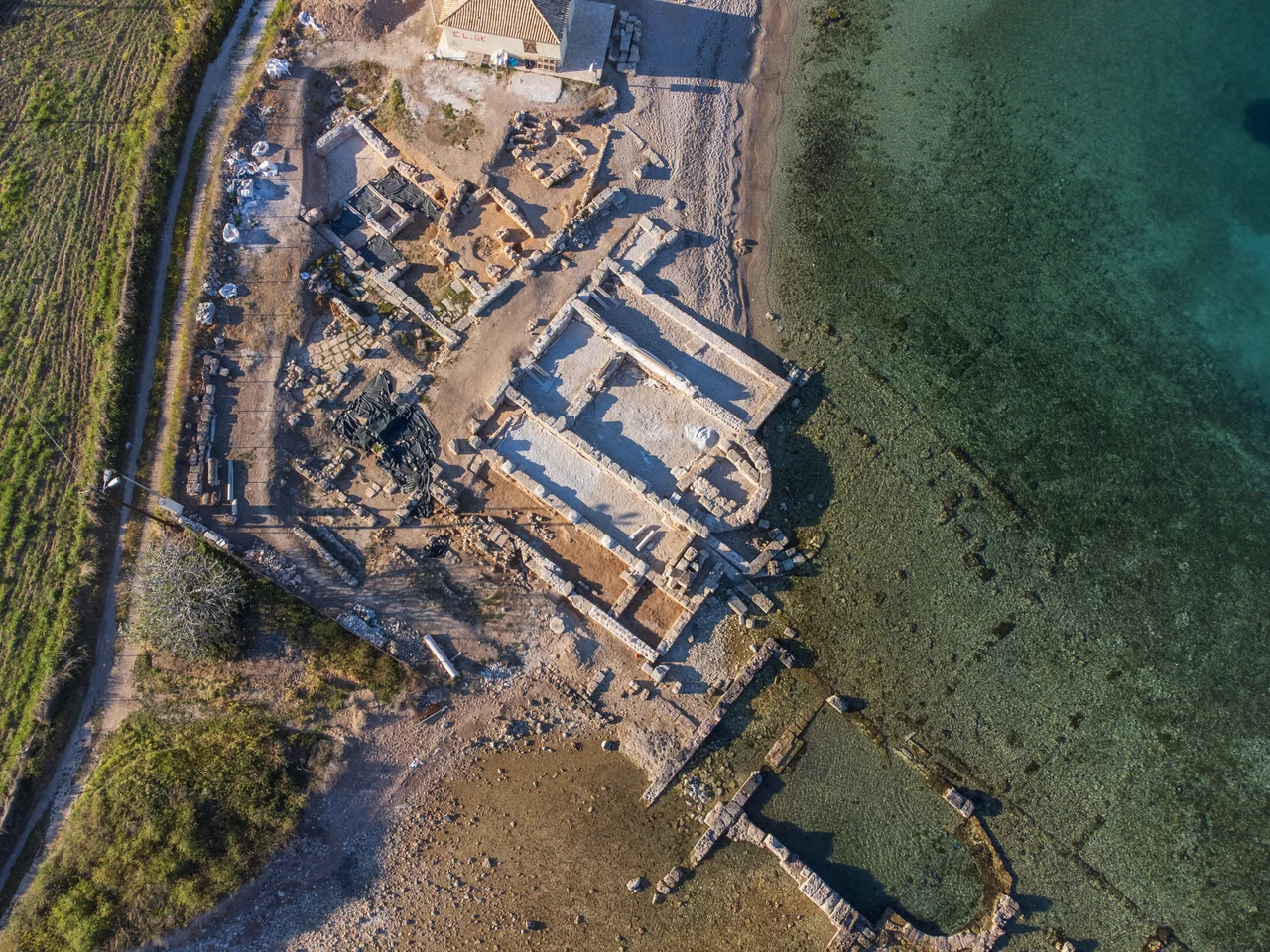
In the Acts of the Apostles, Paul shaved his head at Kenchreai before sailing east — a Nazirite vow fulfilled at the water's edge of a busy Roman port. The harbour he departed from once received merchant ships from the Aegean, the Near East, and Egypt, their cargoes crossing the isthmus by road to reach Corinth's western harbour on the other sea. Today the village of Kechries has 319 residents. Parts of the ancient harbour are sunk beneath the Saronic Gulf, visible only to divers. What the water preserved, and what archaeologists recovered between 1962 and 1969, turned out to be extraordinary.
Rome's Eastern Gate
Kenchreai sat at the eastern end of one of the ancient world's great commercial shortcuts. Ships from Alexandria, Antioch, and the Aegean islands arrived here laden with grain, textiles, and luxury goods; their cargo was offloaded and dragged overland across the isthmus on the stone trackway called the Diolkos to reach Lechaion, Corinth's port on the Gulf of Corinth, bound for Italy. The harbour made Corinth fabulously wealthy. The 2nd-century writer Pausanias noted temples of Aphrodite and Isis at Kenchreai; the cult of Isis, with its great annual festival of ship-launching, drew worshippers from across the Roman world. The port thrived through the Roman Empire and apparently remained active into the 7th century AD, when maritime commerce gradually diminished.
Crates Waiting to Be Opened
When an American School of Classical Studies team led by Robert Scranton excavated the harbour between 1962 and 1969, they found the warehouses, fishtanks, mosaic pavements, and monumental marble-clad complexes that Pausanias and common sense both predicted. But the single most remarkable discovery was something no one could have anticipated: more than a hundred fourth-century glass opus sectile panels — intricate pictorial works made from cut coloured glass — found still packed in their original wooden crates, apparently awaiting installation in what may have been a sanctuary of Isis. The harbour had silted up and subsided before the panels could be unpacked. They had waited untouched in their crates for some sixteen centuries. The finds are documented in six published volumes and stored at the Archaeological Museum of Isthmia.
The Apostle's Departure
Paul came to Corinth around AD 50 and stayed for approximately eighteen months, establishing a congregation that would receive at least two of his surviving letters. When he finally left, he sailed from Kenchreai — taking the eastern sea route toward Syria, with Priscilla and Aquila accompanying him as far as Ephesus. Acts 18:18 records that he shaved his head at the harbour before departure, honouring a vow. The congregation at Corinth that he left behind was a fractious, diverse community in a diverse, fractious port city — and his two surviving letters to them are among the most intimate and theologically dense in the New Testament. 'If I speak in the tongues of mortals and of angels, but do not have love, I am a noisy gong or a clanging cymbal' — 1 Corinthians 13, written to this harbour town.
The Koutsongila Ridge
Since 2002, joint excavations by the American School of Classical Studies and the Greek Ministry of Culture have explored the low coastal ridge immediately north of the harbour, called Koutsongila. The investigations revealed a vast cemetery of Early Roman chamber tombs, Early Byzantine cist graves, an opulent residential quarter facing the sea, and large structures overlooking the harbour. The material — objects of exceptional artistic quality, imports from across the Aegean, Asia Minor, and the Near East — tells of residents who were wealthy, well-connected, and cosmopolitan. Kenchreai was not simply a transit point. It was a place people chose to live, to worship, and to be buried within sight of the water.
Beneath the Surface
The ancient harbour infrastructure is now partly submerged, drowned by the slow subsidence of the coastline that has claimed many ancient Greek ports around the Aegean. Diving archaeologists have mapped harbour walls and mole structures beneath the Saronic Gulf. What remains above water is modest: a small modern village, a quiet bay. But the story condensed into this stretch of shoreline covers Paul's missionary journey, the religion of Isis, Roman commerce, Byzantine burial practices, and one of the most improbable archaeological time-capsules ever found — glass panels packed for a job that never happened, waiting patiently under the sea for modern hands to open the crates.
From the Air
Kechries lies at 37.883°N, 22.989°E on the Saronic Gulf coast of the Corinthian isthmus. From the air the bay is a gentle arc of coastline southeast of the Corinth Canal; the modern village is small but the sweep of the ancient harbour's location is clear. The limestone ridge of Acrocorinth is visible to the west, rising sharply above the plain. Recommended viewing altitude is 2,000–3,000 feet. Nearest major airport: LGAV (Athens International Eleftherios Venizelos), approximately 65 km to the northeast; the Saronic Gulf opens toward Athens to the north.
Nearby Stories
- Stymfalia 3 km away
- Sanctuary of Asclepius, Epidaurus 4.6 km away
- German Submarine U-133 (1941) 5.9 km away
- Battle of the Trench (1821) 6.7 km away
- 1981 Gulf of Corinth Earthquakes 12 km away
- Aigeira 13 km away
- Agios Thomas, Boeotia 14 km away
- Agios Georgios (island) 36 km away