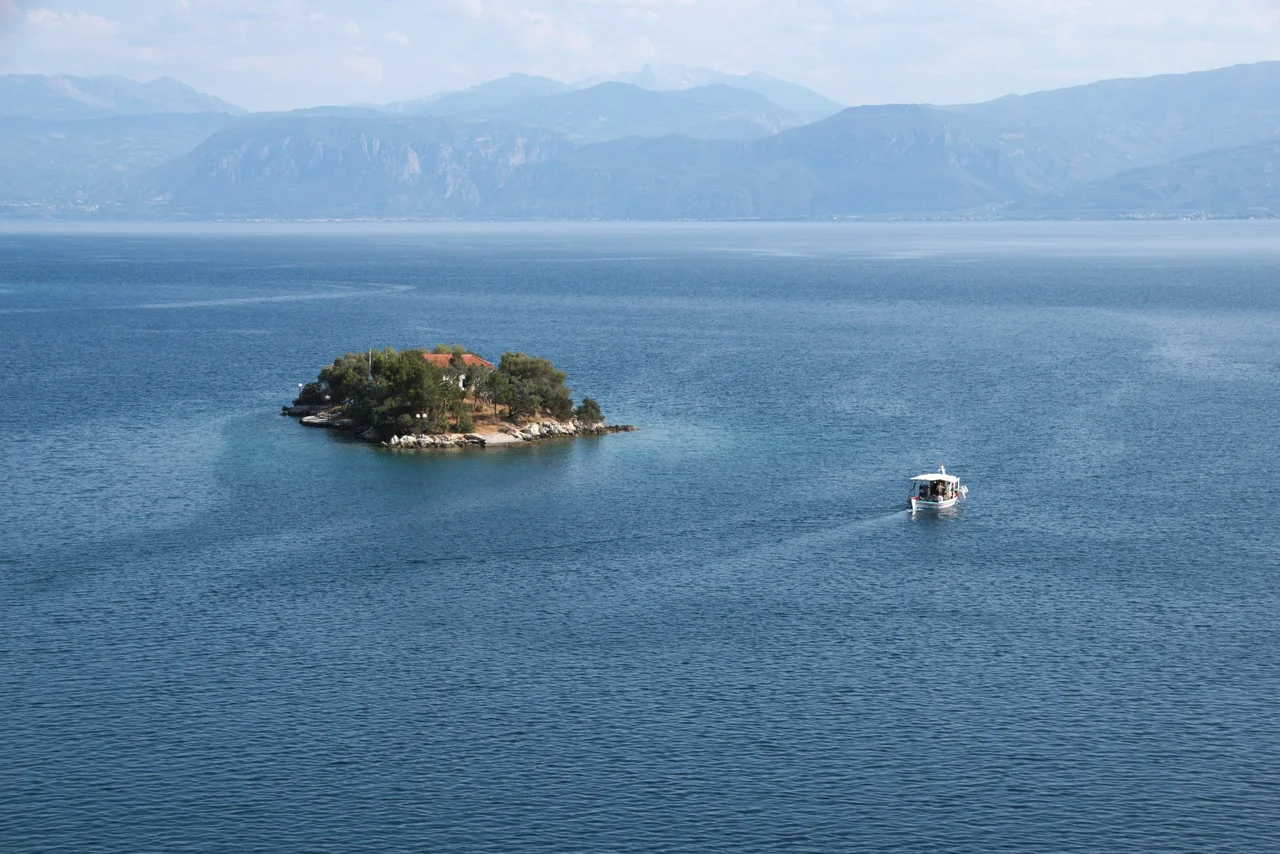

Phocis (Ancient Region)
To understand why Phocis mattered, you have to understand what Delphi was. It was not merely a temple complex or a pilgrimage site. In the ancient world, Delphi was the place where you went before making any serious decision — before going to war, founding a colony, changing a law. Kings sent embassies. Cities paid tribute. The oracle's pronouncements, famously ambiguous, shaped the course of Greek history for centuries. Phocis was the mountainous region that contained this place. That single geographic fact made a small pastoral state, with no large cities and no particular commercial advantage, one of the most contested pieces of territory in ancient Greece.
Mountain Country
Ancient Phocis occupied an area bounded on the west by Ozolian Locris and Doris, on the north by Opuntian Locris, on the east by Boeotia, and on the south by the Gulf of Corinth. The ridge of Parnassus — the same mountain that towers over modern Delphi — divided the region into two distinct portions. Neither was particularly wealthy. The land was mainly pastoral, suited to grazing rather than intensive agriculture. No large cities grew up within Phocian territory; the places that became notable — Delphi and Elatea — were important for strategic or cultural reasons, not economic ones. The Phocians spoke their own version of Doric Greek, one of the major dialects of ancient Greek, classified with the Northwest Doric group shared by several neighboring small states. This dialect connection mattered: it tied the Phocians to the broader Dorian cultural world, which had implications for how their disputes were judged by interstate bodies.
An Unreliable Ally
Phocis's early history is shadowy, but the classical period offers a clearer — and less flattering — record. During the Second Persian invasion of Greece in 480 BC, the Phocians initially joined the Greek coalition, then wavered at the Battle of Thermopylae in a way that contributed to the Greek loss of that position. At the Battle of Plataea the following year, they fought on the Persian side. The switch was stunning: a state that had presented itself as part of the Greek defense was now fighting for the invaders. Whether this reflected genuine political calculation, coercion, or local factional conflict is not entirely clear. What is clear is that the Phocians emerged from the Persian Wars with damaged standing. Over the following decades, they aligned with Athens at various points, lost control of Delphi, regained it with Athenian help, and lost it again — the sanctuary changing hands several times as larger powers competed for the prestige it conferred.
The Ten-Year War Over a Temple
The Third Sacred War, which ran from 356 to 346 BC, was triggered when the Amphictyonic council — the interstate body that oversaw Delphi — levied a heavy fine against Phocis. The Phocians responded by seizing the sanctuary itself and using its treasury to hire a mercenary army. What followed was a decade of war across Boeotia, Thessaly, and beyond. Under generals Philomelus and Onomarchus, Phocian forces fought effectively enough to defeat Philip II of Macedon in at least one engagement — Polyaenus, writing later, credited Onomarchus with deploying catapults against the Macedonian phalanx on a hillside, the first recorded tactical use of artillery to break an infantry assault. But Onomarchus was then defeated and killed at the Battle of Crocus Field in 353 or 352 BC, and the war gradually turned against Phocis. By 346 BC, the temple funds were exhausted and Philip had become decisive. The terms he imposed required the restoration of the stolen temple money and the dispersal of the Phocian population into open villages rather than fortified towns.
Resilience and Absorption
The Phocians did not disappear. By 339 BC they had begun rebuilding their cities, defying the settlement's terms. In 323 BC they joined the Lamian War against the Macedonian regent Antipater following Alexander the Great's death. In 279 BC they helped defend Thermopylae against a Gaulish invasion from the north. These were the actions of a community that had not given up on having a role in Greek affairs. The political tide ran against them nonetheless. During the 3rd century BC, Phocis passed under Macedonian control and then into the Aetolian League, to which it was formally annexed in 196 BC. Rome dissolved the Aetolian League after the Macedonian Wars, but Augustus later restored Phocis's votes in the Delphic Amphictyony — a symbolic rehabilitation of a community whose ancestors had been stripped of that standing in 346 BC. The Phocians had outlasted the Sacred War's verdict. Their region, named after them, still carries the name today.
From the Air
Ancient Phocis centered on the terrain around modern Phocis prefecture in central Greece, roughly 38.53°N, 22.38°E. The defining landmark from the air is the Parnassus massif — at 2,457 meters, it forms a dramatic white-capped ridge that divides the region and points directly to Delphi on its southern slopes. Flying west from Athens (LGAV, about 170 km east), the mountain becomes visible well before you reach it. The nearest airport is LGRX (Araxos), roughly 120 km to the southwest. From 10,000 feet, you can see the Gulf of Corinth forming the southern boundary of the ancient region, the Cephissus valley cutting across the eastern portion, and the peaks of Giona to the northwest. Afternoon visibility is excellent in summer; the Parnassus summit is frequently snow-capped until late spring.
Nearby Stories
- Rio Castle 1.7 km away
- Hyampolis 5.6 km away
- Karpenisi 7.2 km away
- Ypati 7.8 km away
- French Cruiser Châteaurenault (1898) 7.9 km away
- Thermos (Aetolia) 12 km away
- 1981 Gulf of Corinth Earthquakes 13 km away
- Free and Real 20 km away