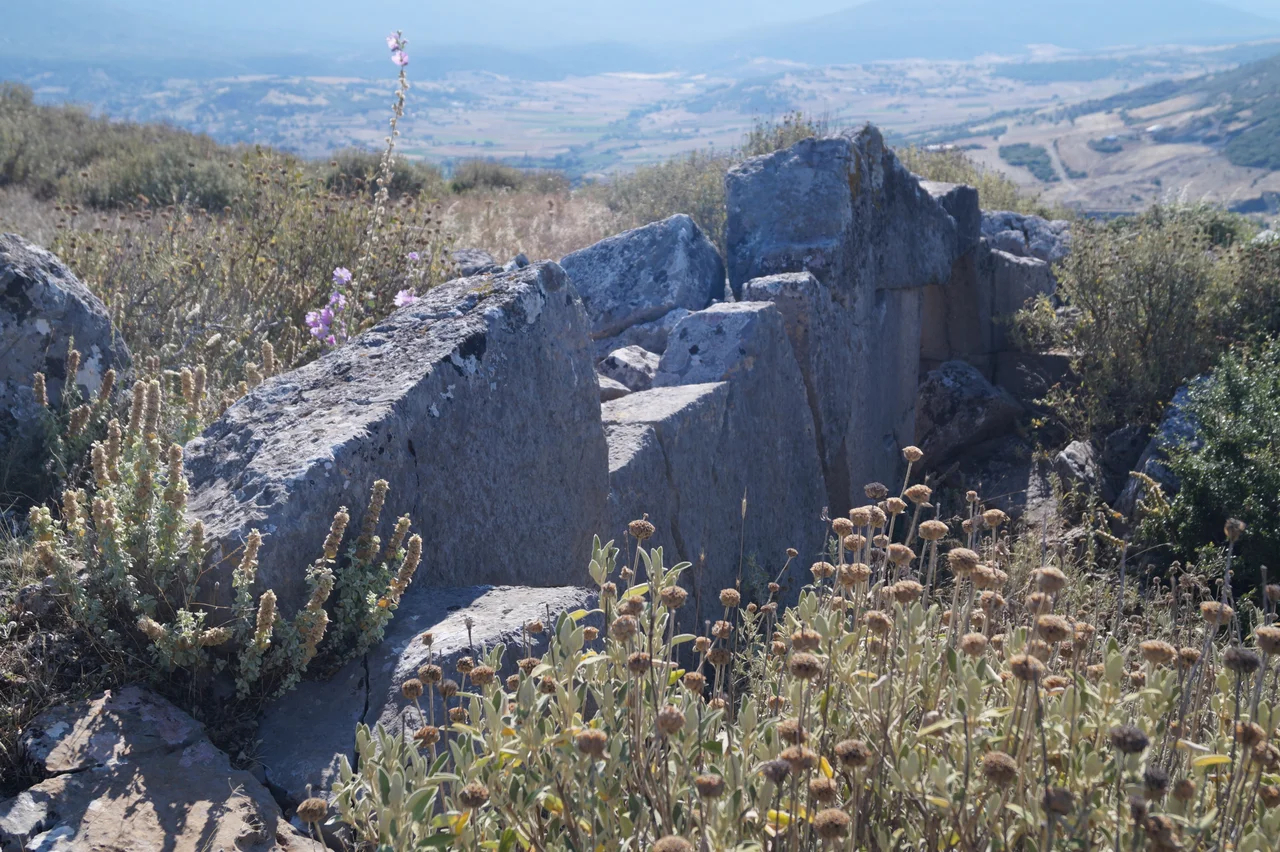

Hyampolis
Homer listed it. That alone is remarkable. In the Catalogue of Ships in the Iliad, that vast roll-call of Greek contingents who sailed for Troy, Hyampolis appears alongside the great cities of the age — a signal that even in the deep antiquity of the Greek heroic tradition, this Phocian town on its valley road counted for something. By the time history catches up with Hyampolis in the fifth century BC, it is still counting for something, though the reasons are more strategic than poetic. The city sat at the entrance to a mountain pass in east Phocis, about eight kilometers from the sanctuary city of Abae, on the road connecting Orchomenus to Opus. Whoever held Hyampolis held the gate.
The Gate of Phocis
Phocis was a small, hilly region in central Greece — not a great power, not a city-state of the first rank, but geographically indispensable. Its mountain passes linked Boeotia to the north, Thessaly beyond that, and the coast of the Corinthian Gulf. Hyampolis sat at one of these passages, and its strategic value meant it was perpetually in someone's path. The city was said, in mythological tradition, to have been founded by the Hyantes people after their expulsion from Boeotia by the Cadmeians — exiles building a new home in the hills. A separate tradition names Hyamus, son of Lycorus, as the eponymous founder. Whichever origin story one follows, the result was the same: a fortified valley settlement, its circumference about three-quarters of a mile according to the nineteenth-century traveler William Martin Leake, its walls traceable in his day and most complete on the western side.
Victory, then Destruction
During the Greco-Persian Wars, Hyampolis achieved something remarkable: the Phocians used its pass to defeat the Thessalians in battle. The Thessalians had allied with Persia, and the Phocians — traditional enemies of Thessaly — used the terrain of Hyampolis to repel their advance. That victory, however, counted for nothing when the main Persian army arrived. In 480 BC, as Xerxes' forces swept through central Greece after the fall of Thermopylae, Hyampolis was destroyed along with the other Phocian towns. The invaders showed no mercy to Phocis, which had resisted while its neighbors collaborated. The city was rebuilt. By 395 BC it was strong enough that the Boeotians besieged it and failed to take it. Then, in 371 BC, Jason of Pherae — tyrant of the Thessalian city of Pherae and a man with an eye for vulnerable targets — destroyed the unprotected lower town as he marched home after the Battle of Leuctra. In 347 BC a battle between Boeotians and Phocians was fought near its walls. Philip II of Macedon destroyed its fortifications. The city rebuilt, again.
Plague, Oracle, and a He-Goat Sacrifice
The ancient travel writer Pausanias recorded a story about Hyampolis that cuts through all the battles and sieges to something more intimate: a plague. The city was struck by pestilence, and its people consulted the Oracle of Delphi — as Greeks did in every extremity, political or personal. The Oracle's guidance was specific and strange. The Hyampolites were told to sacrifice a he-goat to Helios, the sun god. They did, and the plague relented. That story, preserved by Pausanias as he walked through the region in the second century AD, is one of the few glimpses of ordinary religious life in the city — not the grand politics of leagues and alliances, but a community in fear, reaching toward the divine for relief. Emperor Hadrian later had a stoa built in Hyampolis, a covered colonnade of the kind that Roman emperors built across the Greek world as acts of civic patronage. For a small Phocian city that had been destroyed and rebuilt multiple times over eight centuries, a Hadrianic stoa was a mark of something like respectability.
What the Archaeologists Found
The site of Hyampolis lies near the modern village of Exarkhos, in the hills of central Greece above the Cephissus valley. Excavations in the early twentieth century were frustrating — the buildings Pausanias described proved elusive, though a large cistern of Hellenistic construction may correspond to the well he mentioned. What survives today includes a wall from the fourth century BC and scattered structural remains. The fortification circuit is still traceable. A spring still flows from the rock below the site, discharging through stone spouts into a reservoir that Leake thought might stand in its original ancient position. Five kilometers to the north, near the village of Kalapodi, excavators discovered remains of a sanctuary probably dedicated to Artemis Elaphebolos — the deer-hunting Artemis — and possibly also to Apollo. Votive offerings place the sanctuary's oldest building phase in the Geometric period, centuries before the classical era. The festival of the Elaphebolia, honoring Artemis, was celebrated here; an earthquake damaged the temple in 426 BC, but repairs were made before the century was out. The sanctuary continued functioning into Roman times, and a Byzantine burial site was found nearby — one more layer in a landscape that never quite stopped being used.
A City in Homer's List
What is left of Hyampolis is modest by the standards of the great Greek sites. There is no towering temple, no famous oracle, no battle that schoolchildren still learn about. But the city endured. It absorbed the Persian sack, the Boeotian sieges, Jason of Pherae's torch, Philip's engineers, and the Roman general Flamininus's capture in 198 BC, and it kept being a city. The spring still runs. The wall is still traceable. The pass it guarded is still a pass. And in the Iliad, among the bronze-armored heroes and the ships drawn up on the shore before Troy, the name Hyampolis appears — evidence that even a small Phocian valley city had its moment in the story the Greeks told about themselves, at the very beginning of the tradition.
From the Air
Hyampolis lies in the hills of central Greece (Phocis) at approximately 38.58°N, 22.92°E, near the modern village of Exarkhos in the regional unit of Phthiotis. The site sits above the Cephissus River valley, which is clearly visible from altitude as a green lowland corridor running through the mountainous terrain of central Greece. From the air, the landscape here is characteristically rugged — limestone ridges, narrow valleys, olive groves on the lower slopes. The nearest major airport is Athens International (LGAV), Eleftherios Venizelos, at 37.936°N, 23.944°E, approximately 110 km to the southeast. The sanctuary site near Kalapodi, 5 km north of Hyampolis, is located at roughly 38.63°N, 22.91°E. At 4,000 to 6,000 feet altitude heading northwest from Athens, the terrain rises quickly into the mountains of Boeotia and Phocis; Hyampolis sits just beyond the visible ridgeline, in a valley that is sheltered but not hidden.
Nearby Stories
- Battle of Alamana 3.6 km away
- Free and Real 5.7 km away
- Agios Thomas Tanagras 5.7 km away
- Pythian Games 11 km away
- Thespiae 12 km away
- Euripus Strait 14 km away
- French Cruiser Châteaurenault (1898) 17 km away
- Skopelos 32 km away