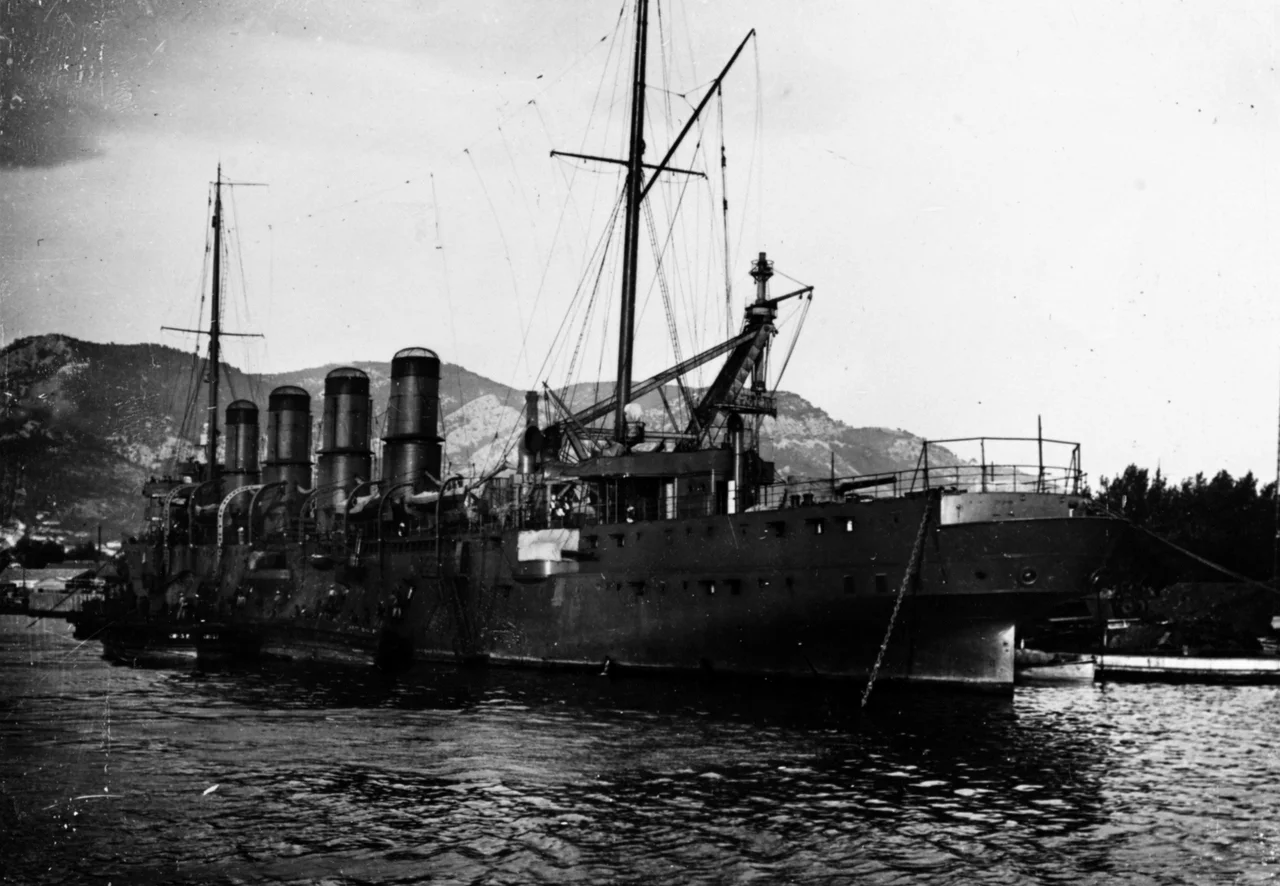

French Cruiser Châteaurenault (1898)
She was built to look like something she was not. Four tall funnels, evenly spaced. An overhanging stern. The lines of a passenger liner, deliberate and calculated — because the French Navy intended Châteaurenault to pass for one while hunting merchant ships across the open ocean. She spent fifteen years trying to fulfill that design, with limited success. It was on an ordinary wartime crossing, carrying soldiers rather than raiding, that she met her end: in the Gulf of Corinth on a December morning in 1917, two torpedoes settled what her troubled engines never quite could.
A Ship Built on a Theory
The Jeune École — 'Young School' — was a faction in the French Navy of the 1880s that argued against trying to match Britain's battleship fleet. Instead, they proposed commerce raiding: fast, long-range cruisers that would attack merchant shipping and strangle the British economy rather than engage the Royal Navy directly. Châteaurenault was their most ambitious expression. Laid down in 1896 and launched in 1898 at La Seyne-sur-Mer, she was designed by Antoine Lagane to resemble a passenger liner — the disguise was built into her profile from the keel up. Eight guns, a 7,500-nautical-mile cruising range, a crew of 604. She was placed in full commission in October 1902, after years of trials in which engineers struggled, never entirely successfully, to eliminate a violent vibration in her engines at certain speeds.
Indochina, Groundings, and Reserve
Her active career was more accident-prone than her designers had hoped. She served in French Indochina from 1902 through mid-1904, then struck an uncharted rock off Phan Rang and had to return to France for repairs that kept her out of service until 1910. Fifteen days after recommissioning, she ran aground off Cape Spartel in Morocco in poor weather and had to be towed to Gibraltar and then Toulon. By 1911 she was in the Reserve Division of the Mediterranean Squadron; by 1913 she was a training ship for boatswains in the Atlantic. She had never raided a merchant vessel. The theory that produced her had already been overtaken by events.
One Year Before the Torpedo
When war came in August 1914, the French Navy mobilized Châteaurenault into the 2nd Light Squadron. She patrolled the English Channel, then moved to the Mediterranean in 1915, then to Dakar in Senegal to search for German commerce raiders in the south Atlantic. In October 1916, passing back through the eastern Mediterranean, she came upon survivors in the water from an unnamed troopship — a converted passenger liner carrying more than 2,000 soldiers and crew to Greece — that had been torpedoed by a German U-boat the previous day without being able to send a distress signal. More than 1,300 of those aboard had died before Châteaurenault arrived. She rescued the survivors she could find. The following year, she would be in those same waters herself.
December 14, 1917
On 14 December 1917, Châteaurenault was carrying 985 troops toward Salonika to take part in the Allied intervention in Greece. As she passed into the Gulf of Corinth, the German submarine UC-38 found her. A first torpedo struck amidships at 06:47. Among those aboard was Ronald Ross, the Nobel laureate who had discovered the mosquito transmission of malaria, traveling in an official capacity; he later described the sinking in his memoirs. The escorting destroyers Mameluck, Rouen, and Lansquenet came alongside and took off the soldiers; by 07:26 the troop evacuation was complete. UC-38 then fired a second torpedo at 08:20, which struck and caused Châteaurenault to founder quickly. A small number of engine-room personnel were killed by the torpedo explosions. The destroyers replied with depth charges, forcing UC-38 to the surface, and then sank her by gunfire. The German submarine's survivors were picked up alongside Châteaurenault's own. The 1,162 survivors were disembarked at Itea, on the northern shore of the Gulf.
From the Air
The approximate position where Châteaurenault was torpedoed is in the Gulf of Corinth, near 38.25°N, 22.33°E, roughly in the central Gulf between the narrows and the Corinth end. From the air at 5,000 feet, the Gulf of Corinth is visible as a long, fjord-like inland sea, its entrance marked by the Rio–Antirrio bridge to the west and the Corinth Canal to the east. The water is intensely blue against the surrounding limestone mountains. The nearest major airport is LGRX (Araxos), approximately 40 km west of the sinking site at the mouth of the Gulf. The wreck of Châteaurenault lies on the Gulf floor; the wreck of UC-38, sunk nearby in the same action, lies close by — two adversaries resting not far apart.
Nearby Stories
- Battle of Chaeronea (86 BC) 1.2 km away
- Mycenaean Cemetery of Voudeni 2.7 km away
- Battle of Lechaeum 4.8 km away
- Amfissa 5.5 km away
- Pheneus 6.3 km away
- 1981 Gulf of Corinth Earthquakes 7.3 km away
- Thermos (Aetolia) 13 km away
- Battle of Lalas 30 km away