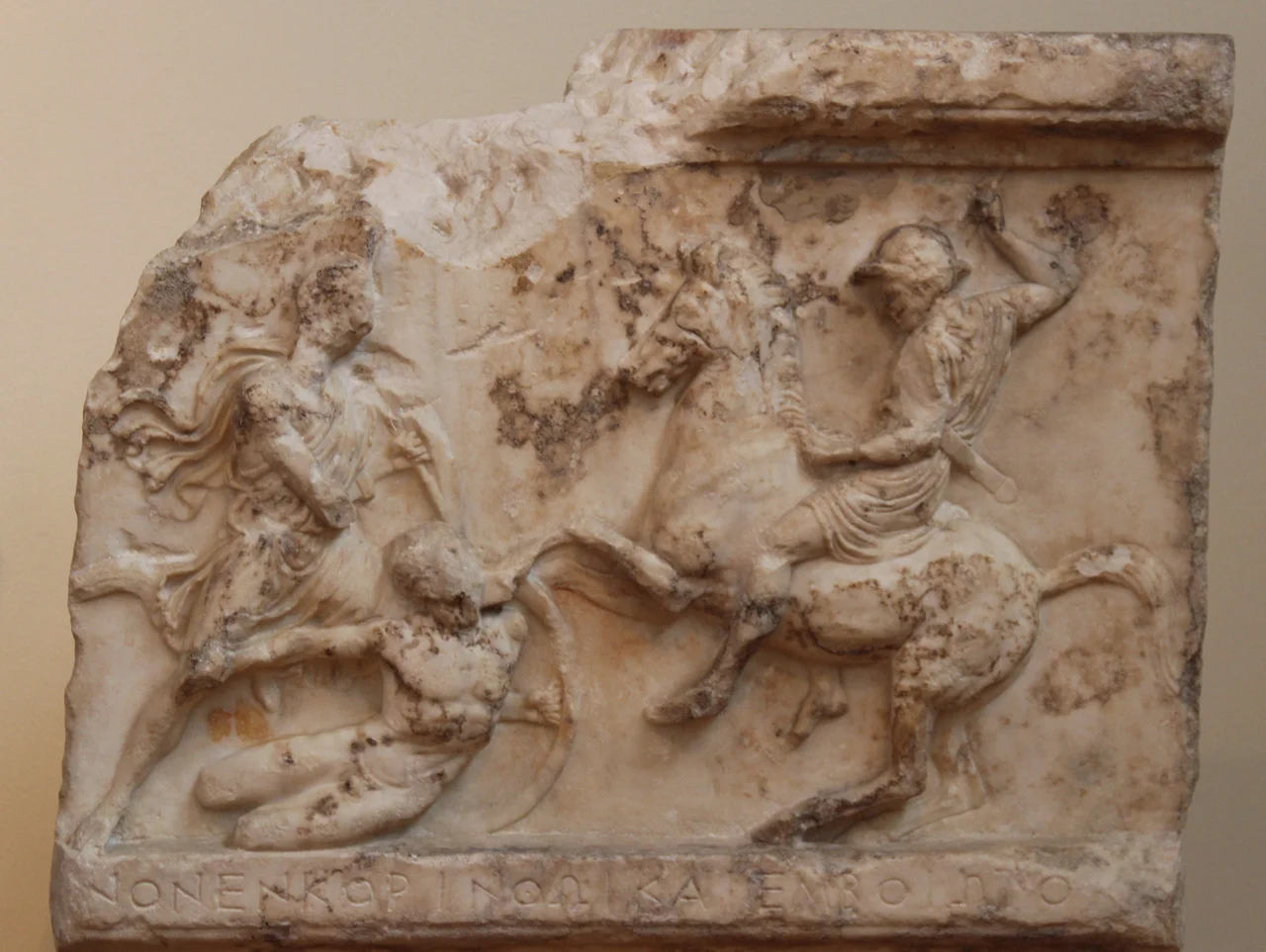

Battle of Lechaeum
The Spartan commander made a small, sensible decision that turned out to be ruinous. He had escorted the Amyclaean contingent past Corinth so they could go home for a religious festival, then turned his hoplites back toward the port at Lechaeum without any cavalry or peltasts to screen them. The walls of Corinth were close, but the men inside, he believed, were thoroughly cowed. Watching from those walls were two Athenian commanders, Iphicrates and Callias, who saw something he did not see: a regiment of six hundred Spartans marching unprotected through open country.
A Quiet Walk That Became Famous
In 391 BC the Corinthian War had settled into the kind of grinding stalemate that exhausts everyone but resolves nothing. Sparta's King Agesilaus had moved through the territory of Corinth, capturing strongpoints and burning whatever the locals had not already harvested. The pro-Spartan exiles held Lechaeum, the city's vital port on the gulf. The Athenians had arrived to help, with a contingent of peltasts under Iphicrates - light infantry armed with javelins, light shields, and an unusual willingness to run. They had, until that morning, found no way to break the Spartan grip on the surrounding country.
The Trap That Wasn't Planned
What followed was less an ambush than an opportunity seized in real time. The Athenian hoplites under Callias formed up outside Corinth's walls. The peltasts began throwing javelins at the Spartan column. When the Spartans charged, the peltasts simply ran - faster than men in heavy armor could chase them. When the Spartans turned back to rejoin their formation, the peltasts followed and threw again. The cycle repeated. Spartan cavalry arrived but, for reasons Xenophon later called curious, kept pace with the hoplites instead of riding the peltasts down. Step by step, javelin by javelin, the regiment was bled.
The Hill and the Boats
Driven onto a hilltop overlooking Lechaeum, the surviving Spartans could see help coming - small boats from the port, rowed out by their countrymen as close to the slope as they could reach, perhaps half a mile distant. They could also see the Athenian hoplites finally moving up. The choice was between standing and dying or breaking for the water. They broke. The peltasts pursued them down the slope, throwing javelins until the survivors reached the boats. Two hundred and fifty men of the six hundred did not make it. They were Spartiates and Lacedaemonians from a society that prepared men for war from boyhood, and they died on a Greek hillside at the hands of soldiers their own tradition had taught them to despise.
What the News Did
Agesilaus heard the report and went home to Sparta. Xenophon, himself a friend of Sparta, recorded the disaster as a profound shock - not because the numbers were enormous, but because of what they meant. A mora had been broken by men who would not stand still. Iphicrates spent the following months recovering forts the Spartans had taken, raiding their allies, demonstrating that the new arithmetic of light troops and discipline had not been a fluke. The Spartans kept Lechaeum until the war ended, but the aura that had moved across Greek battlefields for a century was thinner afterward, and every general who came later took notes.
What Remains
Modern Lechaio sits where the ancient port did, at the western edge of the Corinth Canal, a quiet stretch of coast on the Corinthian Gulf. The hilltop where the Spartans made their last stand is no longer easy to identify with certainty - the shoreline has shifted, the marshes have changed, the modern road runs over much of what would have been the line of pursuit. What survives is the memory: that on a summer day in 391 BC, the question of what kind of soldier wins a battle quietly received a different answer.
From the Air
Battle site near modern Lechaio at 37.93N, 22.88E, on the southern shore of the Corinthian Gulf about 3 km northwest of ancient Corinth. From cruising altitude the narrow Corinth Canal cuts a clean line across the isthmus to the east, with the Saronic Gulf beyond. Athens International Airport (LGAV) is roughly 80 km east-northeast, Araxos (LGRX) lies west along the gulf, and Megara airfield (LGMG) is the nearest small field. Best viewing altitude is 6,000-10,000 ft on a clear day, when the relationship between Corinth's acropolis (Acrocorinth, the prominent rock to the south) and the port becomes obvious.
Nearby Stories
- Stymfalia 3 km away
- Sanctuary of Asclepius, Epidaurus 4.6 km away
- German Submarine U-133 (1941) 5.9 km away
- Battle of the Trench (1821) 6.7 km away
- 1981 Gulf of Corinth Earthquakes 12 km away
- Aigeira 13 km away
- Agios Thomas, Boeotia 14 km away
- Agios Georgios (island) 36 km away