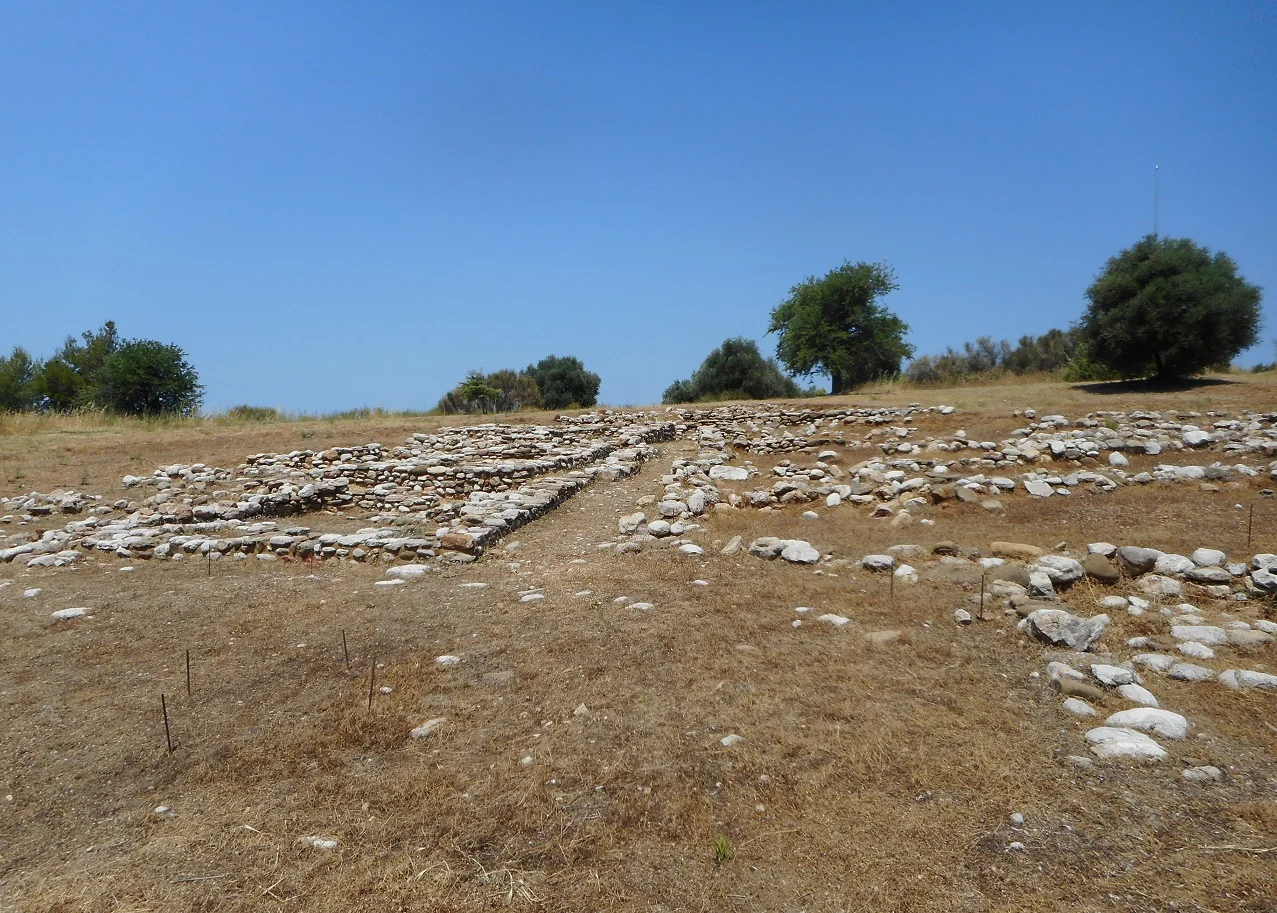

Mycenaean Cemetery of Voudeni
The tombs were cut by hand into the soft hillside at Amygdalia, overlooking the Gulf of Patras, sometime around 1500 BC. The people who made them chose the spot carefully: high enough to see the sea, close enough to the harbor at what is now the marsh of Agyia, and sheltered by the Bortzi hill at the foot of Mount Panachaiko. Over the next four and a half centuries, generation after generation brought their dead here — chieftains and farmers and warriors and ordinary families — and sealed them into circular, horseshoe-shaped, and domed chambers with the objects of their daily lives. In 1923, archaeologist Nikolaos Kyparissis began opening the doors.
A Community Built to Last
The prehistoric settlement of Voudeni — also known as Skioessa — lasted approximately five hundred years, from around 1500 to 1050 BC, making it one of the most enduring sites on the western edge of the Mycenaean world. Its location was not accidental. The Bortzi hill provided natural fortification; the sea below offered trade routes in every direction; the plains stretching to the south yielded enough agricultural and livestock produce for self-sufficiency.
What emerged was not an isolated village but a regional center, the hub of a network of smaller settlements scattered across the surrounding lowlands. The community had access to the entire Gulf of Patras through its natural harbor, giving it the power to monitor and control maritime traffic in a strategically critical corridor — the passage between mainland Greece and the Ionian islands, and beyond them, the Adriatic.
The site may correspond to ancient Mesatis, though the identification remains tentative. What is certain is that this was a prosperous place, connected to the wider Mycenaean trade network that stretched from the Aegean to the eastern Mediterranean.
Seventy-Eight Chambers in the Hillside
Southeast of the settlement, at a place called Amygdalia, the community built its necropolis. Excavations led first by Kyparissis and later by archaeologist Lazaros Kolonas uncovered 78 chamber tombs across an 18-acre area, with recent research suggesting another dozen or more may remain undiscovered.
The tombs vary considerably in size and shape — circular, square, horseshoe, quadrilateral, many with dome-like ceilings. Most contained multiple burials, placed there over generations. The largest, tomb number 4 and tomb number 75, are presumed to have belonged to community leaders or officials, given their exceptional dimensions. Inside them, the pattern that archaeologists found repeated across every chamber: objects of daily life placed with the dead. Pottery, jewellery, bronze tools, weapons, utensils — the material culture of a community that believed the dead would need what the living used.
The variety of goods testifies to Voudeni's commercial reach. Objects that could not have been produced locally point to exchange networks spanning the Mycenaean world.
What the Tombs Gave Up
Among the finds were clay statuettes, bronze artifacts, and jewelry sophisticated enough to suggest skilled craftspeople at work in or near the settlement. The weapons — swords, daggers, spearheads — indicate a community with warriors as well as farmers, not surprising for a site controlling an important maritime route during a period of endemic conflict across the Aegean.
The most significant objects are now displayed in the Archaeological Museum of Patras, a modern building near the city center that opened in 2009. The museum was built partly in response to the richness of sites like Voudeni; its collection makes the abstract fact of Mycenaean civilization concrete and immediate. Smaller finds remain in storage, awaiting study.
The site itself has been transformed into the Patras Mycenaean Park — 180 acres in total at an altitude of 220 meters, where the tombs are accessible to visitors. It is 7 kilometers northeast of the city center, a short drive through the hills above Patras.
The Long View from Amygdalia
From the hillside at Voudeni, the view has changed in three thousand years, but not entirely. The gulf is still there, gray-blue and wide. The mountains of Aitoloakarnania still mark the horizon to the north. Ships still pass below, though they carry trucks and tourists now instead of Mycenaean trade goods.
The people buried in these chambers lived in a world connected by sea, animated by trade and warfare, organized around communities powerful enough to shape stone into lasting tombs. They disappeared — the Bronze Age collapse of around 1200 BC ended the Mycenaean world across the eastern Mediterranean — but they left their hillside necropolis intact, waiting for the twentieth century to open it up again and begin asking what they meant to leave behind.
From the Air
The Mycenaean cemetery of Voudeni sits at approximately 38.2540°N, 21.7816°E, at an altitude of about 220 meters in the hills northeast of Patras. At 4,000–6,000 feet the site is visible as a terraced hillside above the urban fringe of Patras, with the Gulf of Patras opening to the west and Mount Panachaiko rising steeply to the east. The nearest major airport is LGRX (Araxos), roughly 45 km to the west-northwest. Follow the coastline west from Patras to locate Araxos; the cemetery lies on the slopes above the city, easily identified by the contour of the Bortzi hill.
Nearby Stories
- Thermos (Aetolia) 8.2 km away
- 1861 Eliki Earthquake 9.6 km away
- Pheneus 14 km away
- Battle of the Echinades (1427) 15 km away
- HMS Perseus (N36) 19 km away
- Amfissa 20 km away
- Astras 21 km away
- Acarnania 28 km away