
Pythian Games
Six months before the festival began, nine envoys left Delphi on foot and by ship, bound for every corner of the Greek world. Their message was the same in every city-state they reached: the Pythian Games are coming. Lay down your weapons. Safe passage must be guaranteed. The Sacred Truce — the Hieromenia — was in effect. Any city that continued armed conflict or allowed robbery during the truce forfeited the right to attend the sanctuary, consult the oracle, or compete. In a world that rarely stopped fighting, the Pythian Games created a temporary, recurring peace — not for politics, but for Apollo.
A God's Festival, Born from a Serpent
The story the Greeks told about the games' origin is characteristically violent and then remorseful. Apollo, seeking a site for his temple, was attacked by Python, the great serpent who guarded the spring at what would become Delphi. He slew it with his bow and claimed the land. Then, depending on which version you follow, either Zeus judged Apollo guilty of the killing and required atonement — the games as penance — or Apollo himself established the festival to celebrate his victory. The two explanations are not as contradictory as they sound: the games could simultaneously mark triumph and serve as ritual expiation.
Originally held every eight years, the Pythian Games were reorganized after the Delphic Amphictyony — a council of twelve Greek tribes — took over administration. The interval was shortened to every four years, timed so the festival fell two years after each Olympic Games, alternating with the Nemean and Isthmian Games. Together these four events formed the Panhellenic circuit, the crowning competitions of the ancient Greek athletic world. Of the four, the Pythian Games ranked second only to Olympia in prestige.
Art Before Athletics
What distinguished Delphi from Olympia was this: the Pythian Games began as a music festival. Athletic events came later. Apollo was the god of music as much as prophecy, and the original competitions — held in a theater above the Temple of Apollo — were for lyre playing, singing, and instrumental performance. Painting competitions were added in the mid-5th century BC. Poetry and prose contests joined the program. The games celebrated Greek culture as a whole, not merely physical excellence.
When athletic events were eventually introduced, they followed the Olympian model closely: running, wrestling, jumping, discus, javelin. But there were differences. The Pythian Games included a four-horse chariot race (the tethrippon), held in a hippodrome on the plain below, and they also added extra running races for boys. The prize was a wreath of bay laurel cut from the sacred grove near the sanctuary — the Pythian crown, different from Olympia's olive wreath but equally coveted. A Pythian victory was the kind of achievement that earned a man odes from Pindar, the greatest lyric poet of the age, who wrote twelve surviving poems celebrating Pythian victors.
Women at the Games
The Pythian Games, like most ancient Greek athletic festivals, were primarily male spaces. Women were largely excluded from participation and, in many events, from spectatorship. Yet the historical record preserves at least one female victor: Tryphosa, who won the girl's stadion — the sprint race — and whose victory is the only surviving record of a woman winning at the Pythian Games. She is a single name in the historical record, but she is there.
The inclusion of girls' races, however limited, reflects something about how Delphi's games evolved. The expansion of the program over centuries — more events, more participants, more categories — tracks the widening of what counted as worthy of Apollo's festival. The games were never static. They adapted across nearly a thousand years of continuous celebration, from their founding in the 6th century BC until they continued into the 4th century AD, outlasting much of classical civilization itself.
What the Inscriptions Say
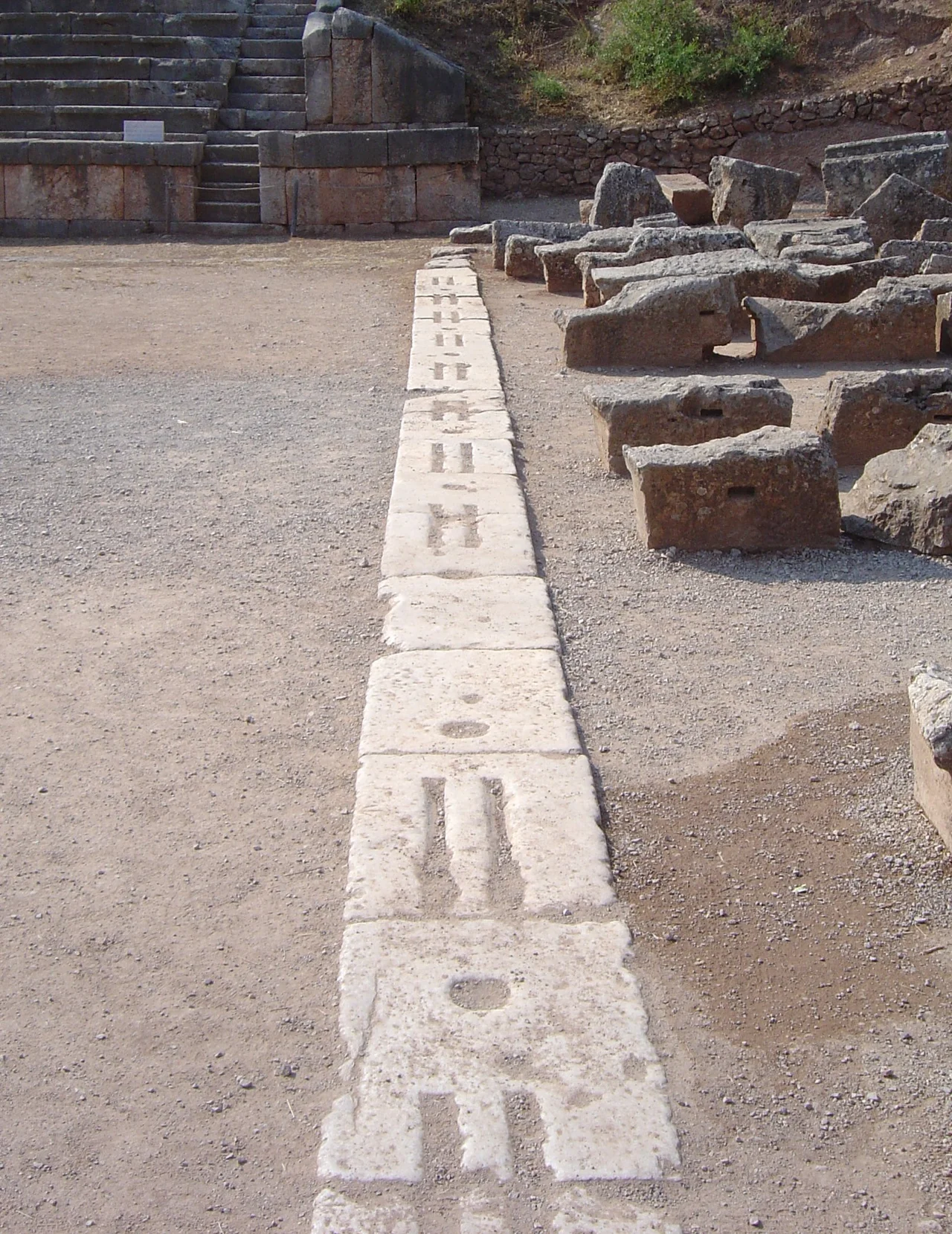
The physical site of the games is still legible today. The stone starting blocks of the stadium's running track survive in place, carved with grooves for the athletes' feet. An inscription from the 2nd century BC records a performer named Satyr of Samos who played a hymn "for the god and the Greeks" on the guitar — an early document of musical performance at the festival. Another inscription on the stadium's retaining wall forbids the removal of wine designated for sacred rituals; archaeologists debate whether it was placed in its current location originally or reused from elsewhere.
Scores of people traveled to Delphi for the games from across the Greek world, bringing substantial revenue to the city. The atmosphere would have been dense with competing purposes: athletic spectacle, musical performance, religious pilgrimage, commercial trade, diplomatic exchange. The Amphictyony used the interval before the games to restore the sanctuary's temples, streets, and fountains. Delphi, for those weeks, was the center of the Greek world — and everyone knew it.
From the Air
The site of the Pythian Games at Delphi lies at approximately 38.48°N, 22.50°E on the slopes of Mount Parnassus in Phocis. The stadium, at the highest point of the sanctuary, is visible from altitude as a long rectangular clearing above the terraced temple complex. The theater and the Temple of Apollo terrace are immediately below. The Corinthian Gulf is visible 10 km to the south. Recommended altitude for the full Delphi sanctuary view: 3,000–4,000 ft. Nearest major airports: LGRX (Araxos, ~80 km south across the gulf) and LGAV (Athens Eleftherios Venizelos, ~150 km east, the standard visitor gateway). Weather at Delphi: sunny and dry in the August–September festival season, with exceptional visibility on clear days.
Nearby Stories
- Battle of Leontion 2.8 km away
- Siege of Livadeia 3.1 km away
- Pyre of Heracles 8.2 km away
- Corinth Rail Disaster 8.8 km away
- Rio–Antirrio Bridge 9.9 km away
- Heraion of Perachora 13 km away
- Prousou Monastery 15 km away
- Free and Real 30 km away