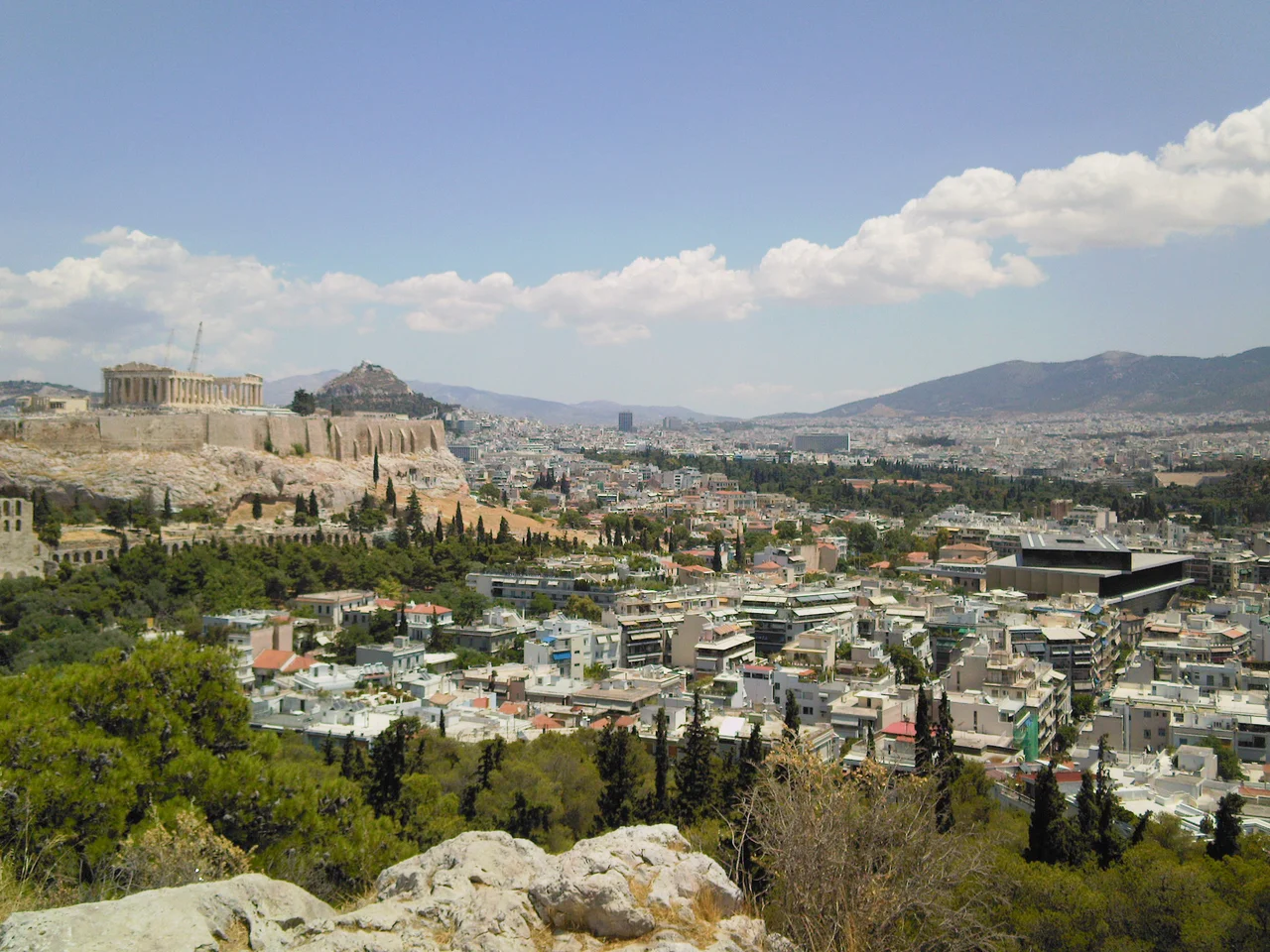

Acropolis Museum
It took four months to move them, three tower cranes, and a route only 280 meters long. In October 2007, the marbles of the Acropolis began their final journey down the southern slope of the sacred rock to a new home built specifically for them. The Acropolis Museum opened to the public on June 20, 2009, and from its top floor, visitors can look up through glass walls and see the Parthenon itself, sitting on its hill exactly as the columns inside the gallery once stood on theirs.
Three Failed Competitions
The path to this building was longer than the distance the marbles eventually traveled. Greece tried to design a new Acropolis museum in 1976, then again in 1979, then again in 1989. Each attempt collapsed: unsuitable plots, archaeological surprises, the kinds of bureaucratic and physical obstacles that any city built on top of three thousand years of itself eventually produces. The 1989 international competition went to Italian architects Manfredi Nicoletti and Lucio Passarelli, but excavation for their foundations turned up sensitive remains and the design was annulled in 1999. By the fourth competition, the location was finally obvious. The old Camp Makrygianni gendarmerie barracks sat right across from the Theater of Dionysus, on public land, in plain sight of the rock. The barracks came down. The neoclassical Weiler Building stayed.
A Building on Bearings
Bernard Tschumi, working with Greek architect Michael Photiadis, designed the building to float. Excavation revealed two layers of houses and workshops underneath the site, one classical and one early Byzantine. Rather than disturb them, the foundation pillars thread between the ruins down to bedrock and rest on roller bearings rated to absorb a magnitude-10 earthquake. Some of the floor is glass, so visitors walk above the ancient neighborhood as they enter. Since June 2019, you can also walk through it. Tschumi built around three ideas: light, movement, and the meeting of structure and program. The lower galleries slope upward, mimicking the climb to the rock itself, before opening into the trapezoidal hall of archaic finds.
The Parthenon Gallery
The top floor is the argument. Tschumi rotated it on its lower levels so its columns align with the Parthenon's actual cardinal orientation, 280 meters away. The 48 columns mark the temple's outline at full scale, and the spacing matches the original. Glass walls on all four sides flood the marbles with the same Aegean light that has always lit them. Pediment sculptures are at eye level. Metopes face outward, two per column, the way a worshipper in the fifth century BC would have seen them as they approached the temple. The frieze runs in a continuous band behind the metopes, around a rectangular hall that mirrors the Parthenon's interior. The British Museum's Duveen Gallery presents the marbles facing inward; this gallery presents them facing the world. Greek officials have never disguised that the design is also an invitation.
An Excavation That Does Not Stop
Below ground, the dig continues. Visitors watch through the glass floor as archaeologists work the early Byzantine and classical layers, then descend into the site through the museum courtyard. On August full moons, the museum stays open until midnight and admission is free, with concerts in the courtyard. In 2014, the University of Sydney's Nicholson Museum lent a model of the Acropolis built by Ryan McNaught from more than 120,000 Lego bricks. Hermitage objects, Vienna quadrigas, and the Brial silver cup from the 1896 Athens Olympics have all passed through these galleries. In its first two months, more than 523,000 visitors came; sixty percent were foreign. Barack Obama toured the rooms in November 2016. The museum's standing question, repeated in stone and steel and natural light, remains: shouldn't the rest of the marbles come home?
From the Air
Acropolis Museum at 37.9684°N, 23.7285°E in central Athens, southeastern slope of the Acropolis. From altitudes of 3,000-5,000 ft (cleared by Athens TMA) the rock and the museum read as a paired complex; glass-and-concrete museum sits 280 m southeast of the Parthenon. Nearest airport is Athens International (LGAV), about 19 nm east. Smog and summer haze can flatten the Attica basin; clearest visibility is morning or after autumn rain.
Nearby Stories
- Parnitha 3.4 km away
- Kea (island) 7.3 km away
- Sanctuary of Apollo Maleatas 11 km away
- Sousaki Volcano 12 km away
- Battle of Leuctra 14 km away
- Great Sand Beach 18 km away
- Agios Georgios (island) 23 km away
- Skyros 84 km away