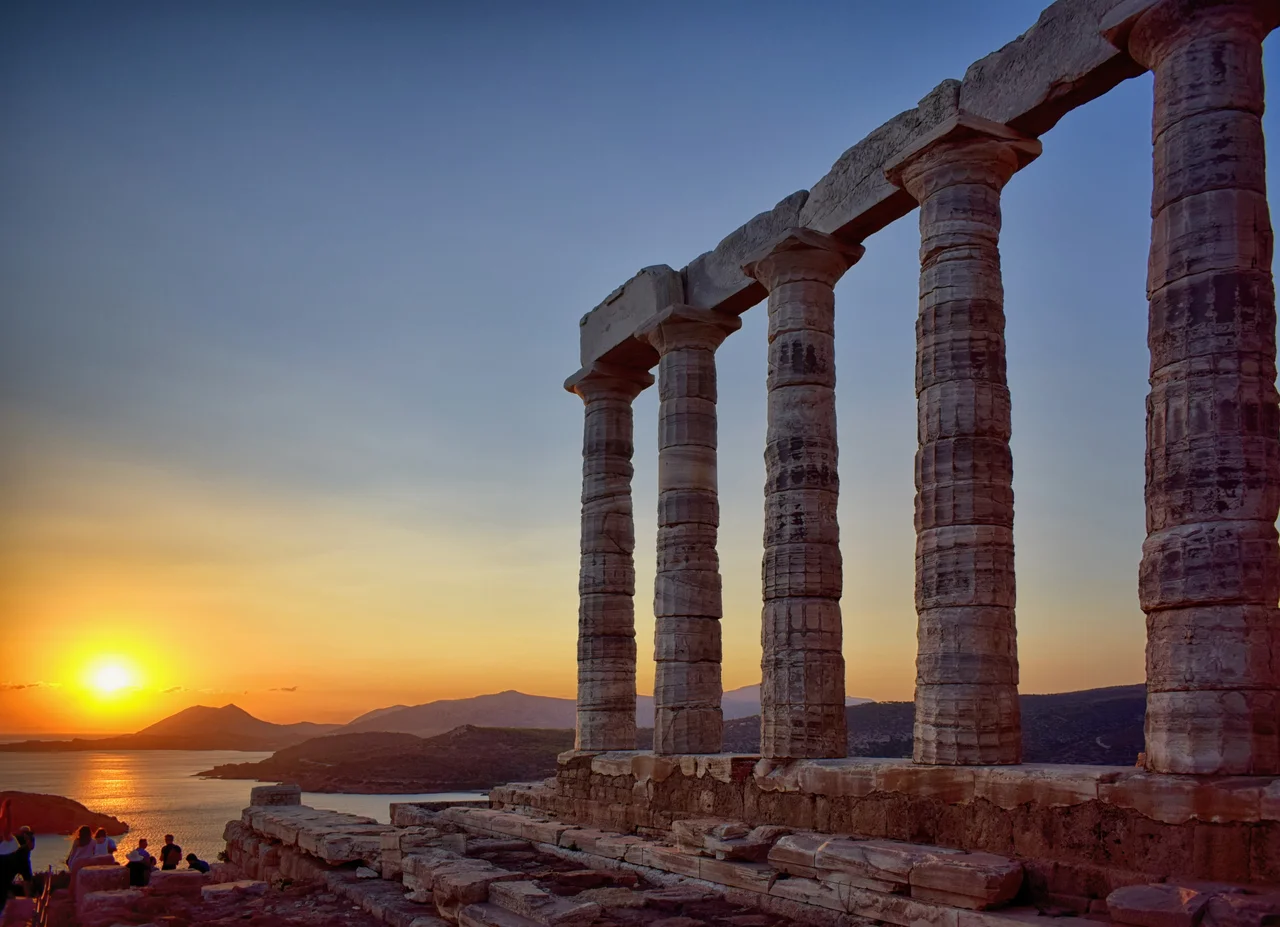

Temple of Poseidon, Sounion
Lord Byron carved his name into one of the columns. So did everyone else worth a damn in 19th-century Romanticism, though the British Museum's discreet later erasures have left fewer signatures than there used to be. The Temple of Poseidon at Cape Sounion is one of those places that has been a tourist attraction so long that the graffiti is itself a historical record. The temple sits on a 60-meter cliff at the southern tip of Attica, a triangular promontory of marble jutting into the Aegean. For sailors leaving Athens for the Cyclades or returning from Crete or Asia Minor, this was the last patch of Athenian land going out and the first sign of home coming back. The Greeks built a temple here for the same reason. They wanted the god of the sea to see his own house from the water.
An Older Sanctuary
Worship at Sounion is far older than the standing temple. Excavators have found evidence of sanctuaries on the cape going back to the 11th century BC. The first significant temples to Athena and Poseidon went up around 700 BC, and within a century kouroi, life-size standing statues of young men, were being dedicated as votive offerings. The metalwork that survived from the early sanctuary tells a story about who came here: ornate copper artifacts, eighth-century bronze figurines of warrior gods, ex-voto double axes and spearheads, finger rings and tweezers and arrowheads. These were not the offerings of poor pilgrims. The temple at Sounion was a place where the elite of Athens dedicated objects of value, and the value reflected what they were asking for, which was safety on the sea.
Rebuilt in Pericles's Athens
An earlier Archaic temple stood here, possibly destroyed during the Persian invasions of 480 BC. The temple visible today was built between 444 and 440 BC, during the same Periclean building program that produced the Parthenon. The architect, whose name has not survived, was clearly familiar with the work being done at the Temple of Hephaestus in Athens. Both temples share unusual ceiling designs, with marble beams wider than the slots between them. The Sounion temple has six columns across the ends and thirteen along the long sides, on a stepped marble platform, and the original plan called for twelve columns along the flanks before the design was changed. The German archaeologist Wilhelm Dorpfeld figured this out in 1884, by examining cuts in the foundation that did not align with the standing structure. He also discovered that the new Classical temple was built directly on top of the burned-out limestone foundations of the older Archaic version.
A Captured Persian Ship
After the Athenian fleet defeated Xerxes at the Battle of Salamis in 480 BC, ending the Persian invasion, the Athenians chose Sounion as the place to dedicate their thanks to Poseidon. They hauled an entire captured Persian trireme up onto the cape and left it there as a trophy. The wood is long gone, but the gesture is preserved in the historical record. Athens depended on the sea. Its empire, its navy, its grain supply, its maritime trade all required Poseidon's favor, and Sounion was where they came to bargain. The Greek geographer Strabo wrote that the sanctuary at Sounion was the most notable in that part of the world, and that ships sailing across from Asia to Attica navigated by it. The visibility of the cape from the sea was the entire point. Sailors saw the temple before they saw the city.
The Columns of Venice
Two columns collapsed in 1825. One of them, the fifth from the northeast corner, was dismantled the next year on the orders of Amilcare Paulucci, commander of the Imperial Austrian Navy. Five of its eight original drums and the capital were shipped to Venice, where they were reassembled in the garden of a neoclassical palazzo on the Fondamenta Briati. The blocks bear graffiti from the period of their removal, including French sailors' inscriptions like Le Zefire Bric Du ROI 1816. Wooden dowels recovered from the column, inscribed with letters in early-to-mid-5th-century BC Greek, were placed on display in Venice's Seminario Patriarcale. Their current location is unknown. Pieces of Sounion are scattered across European museums and gardens, fragments of Athenian piety dispersed by the souvenir habits of empire.
The Sunset Cliche, and Why It Works
Sounion's sunsets have been photographed and painted and described to the point of cliche. The cape faces west across the Saronic Gulf, the sun drops behind the islands of Aegina and the distant Peloponnese, and the white marble of the columns picks up the orange light and holds it. There are exactly fifteen columns standing today, plus part of one wall of the cella. From below, looking up, the temple appears against blank sky. From the temple, looking out, you see ships moving on three different sea lanes. Lord Byron, in Don Juan, wrote that he wished to be left alone here to die, watching the sea. He carved his name into a column, which is a less elevated impulse but reveals the same thing. Some places make you want to leave a mark.
From the Air
Located at 37.65 N, 24.02 E on Cape Sounion at the southern tip of Attica, on a 60-meter coastal cliff. The cape extends into the Aegean about 70 km southeast of central Athens. Nearest airport: Athens-Eleftherios Venizelos (LGAV) 50 km north. Best viewed from the southeast or southwest below 800 meters AGL, especially in the hour before sunset when the marble takes the warm light. The temple's white columns stand out clearly against the dark cliff and surrounding scrubland. The Saronic Gulf lies west, with Aegina island visible 35 km away on clear days.
Nearby Stories
- Salamis Naval Base 1.9 km away
- Battle of Andros (1790) 5 km away
- Temple of Aphaia 5.8 km away
- Hydra: The Island That Refused the Car 13 km away
- Gyaros 14 km away
- Saint Ephraim Monastery, Nea Makri 16 km away
- Kythnos 30 km away
- Archaeological Museum of Sifnos 53 km away