_03.jpg)
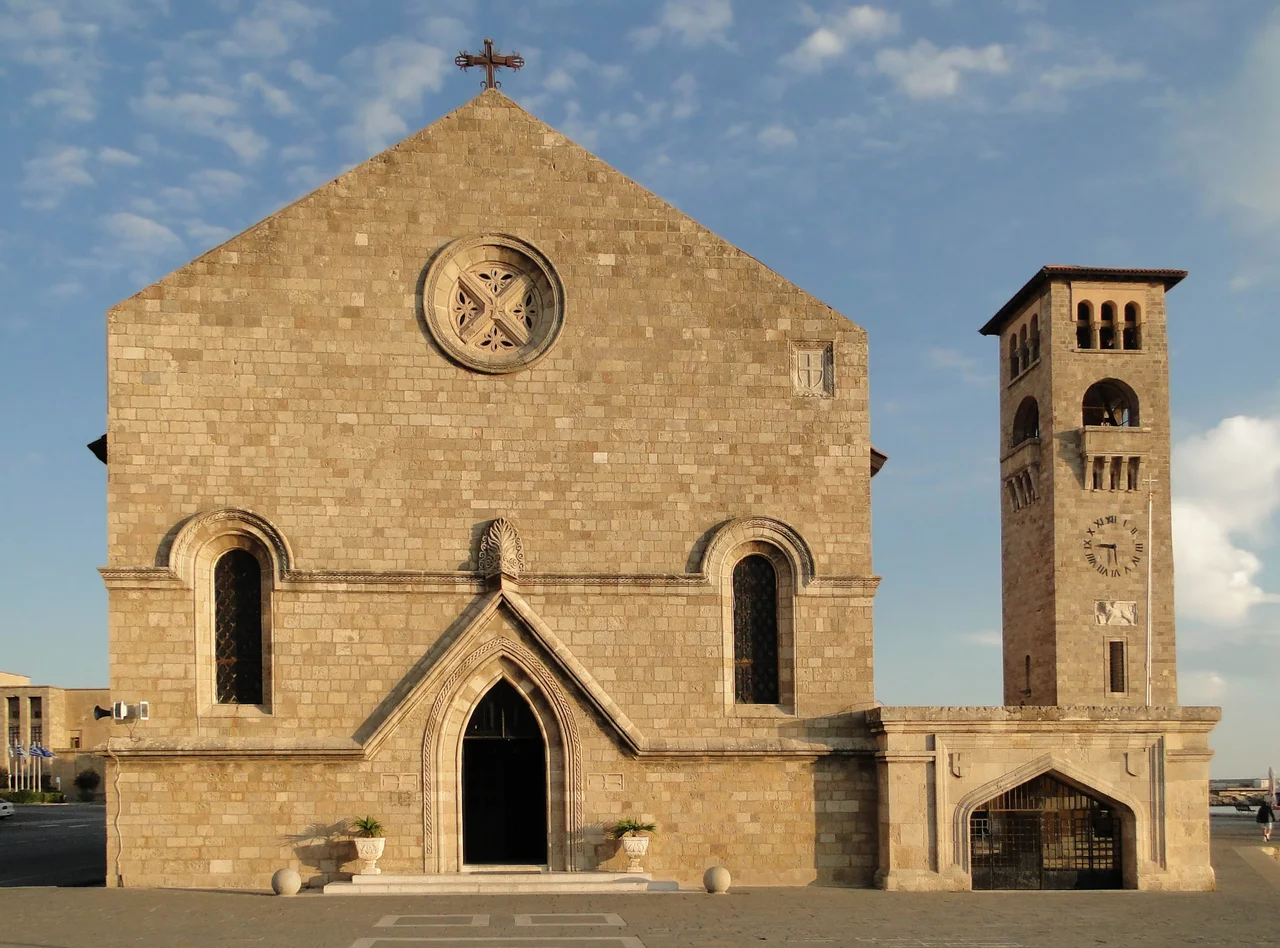
Church of St John of the Collachium
On the night of November 6, 1856, lightning struck the bell tower of an old church in the medieval quarter of Rhodes. The cellars beneath the tower held a stockpile of Ottoman gunpowder. The flash, the ignition, and the detonation came so close together that there was no time to evacuate. At least two hundred people died, the adjacent Palace of the Grand Master was damaged, and the Church of St John of the Collachium, which had stood for more than five centuries, was simply gone. A school was eventually built on top of the rubble, and only a few foundation stones along the northern edge still mark where one of the most important Gothic buildings in the Eastern Mediterranean once stood.
The Knights' House of Saints
When the Knights Hospitaller seized the city of Rhodes in 1310, they needed a church worthy of an order that traced its founding to the care of pilgrims in Jerusalem. They chose a site in the collachium, the walled inner quarter where the brothers lived apart from the local Greek population, and dedicated the new building to John the Baptist, their patron. Foulques de Villaret is traditionally said to have laid the foundation stone on 24 June 1310, the saint's feast day, although that detail rests on a single later manuscript whose authenticity scholars now doubt. Construction continued under his successor Hélion de Villeneuve, whose coat of arms ended up carved into the north wall. By 1314, the order's chapter general had written rules for the church's staff and services. By 1318, a meeting was held inside the building to choose envoys to Pope John XXII. The church had become the order's spiritual headquarters within a generation.
Spolia and Salt Light
Architecturally, the church was a three-aisled Gothic basilica, about 48 meters long and 15 wide, with a transept covered in four ribbed vaults and a coffered barrel vault running the length of the nave. The aisles were separated from the nave by pointed arcades supported on eight granite columns. Those columns were not new. They were spolia, lifted from some earlier ancient building, their capitals carved in classical Corinthian and Doric orders, with one base still bearing an inscription in Ancient Greek. When the British archaeologist Charles Newton walked through in April 1853, he found the wooden roof painted blue and dotted with stars. Stained glass windows bearing the escutcheons of dead knights had vanished by the time he arrived, but they had been there a generation earlier when the Flemish officer Bernard Rottiers visited and sketched them. The historian Sofia Zoitou has written that the building "eloquently articulated the Knights' political and religious essence," which is another way of saying that the masonry itself argued for the order's place in the world.
A Cabinet of Holy Bones
By the late fourteenth century, with revenues squeezed by the Papal Schism, the Hospitallers turned their relic collection into an income stream. Pilgrims sailing to the Holy Land stopped at Rhodes specifically to see what the knights had gathered, and the inventory was extraordinary. The right hand of John the Baptist arrived from somewhere in 1413; in 1484 the Ottoman sultan Bayezid II ceremonially sent another version of the same relic, which the Hospitallers accepted as authentic and housed in a gold reliquary studded with pearls. There was a fragment of the True Cross brought from the Levant, a bowl said to be the one Jesus used to wash his disciples' feet, and one of the thirty pieces of silver paid to Judas, which pilgrims described in enough detail that scholars now believe it was actually a Hellenistic Rhodian drachm minted between 360 and 230 BCE. By the early sixteenth century, the church also held gilt statues of the Apostles, a gold statue of the Lamb of God, and a set of silver-gilt kneeling angels reserved for the highest feast days.
Mosque, Earthquake, Lightning
When Suleiman the Magnificent's forces took Rhodes in 1522, the church became the city's main mosque. A mihrab niche was added, the bell tower was rebuilt as a minaret, and non-Muslims were forbidden to enter. The building survived in this second life for more than three centuries, and the medieval frescoes of the Apostles still gazed out of their niches when Ludwig Ross visited in 1843. Then earthquakes hit. The 1851 tremor brought down the top of the belfry. The 1856 quake destroyed the minaret. Later that same year, the lightning strike found the gunpowder. The amateur archaeologist Alfred Biliotti, working in his day job as a British consular official, organized an impromptu rescue dig through the smoking debris. The marble tomb slab of Grand Master Fabrizio del Carretto, buried beneath the church floor in 1521, was looted in the chaos. Pieces of the destroyed structure were eventually used to build the school that now stands on the site.
From the Air
Coordinates: 36.4448 N, 28.2243 E. Suggested viewing altitude 2,000-3,500 ft AGL over the medieval city of Rhodes. Look for the dense walled grid of the Old Town just south of Mandraki harbor; the site sits in the northwest sector adjacent to the restored Palace of the Grand Master. Nearest airport: Rhodes International (LGRP), about 14 km southwest. Diagonios (LGRD) handles regional traffic. Summer northwesterly meltemi winds can produce afternoon turbulence; mornings offer the cleanest views of the Aegean and the Turkish coast 18 km to the east.
Nearby Stories
- Temple of Athena Lindia 23 km away
- Bodrum Castle 45 km away
- Battle of Rhodes (1912) 51 km away
- Bodrum 84 km away
- Antalya Museum 166 km away
- Antalya 175 km away
- Toplou Monastery 179 km away
- Agios Neophytos Monastery 361 km away