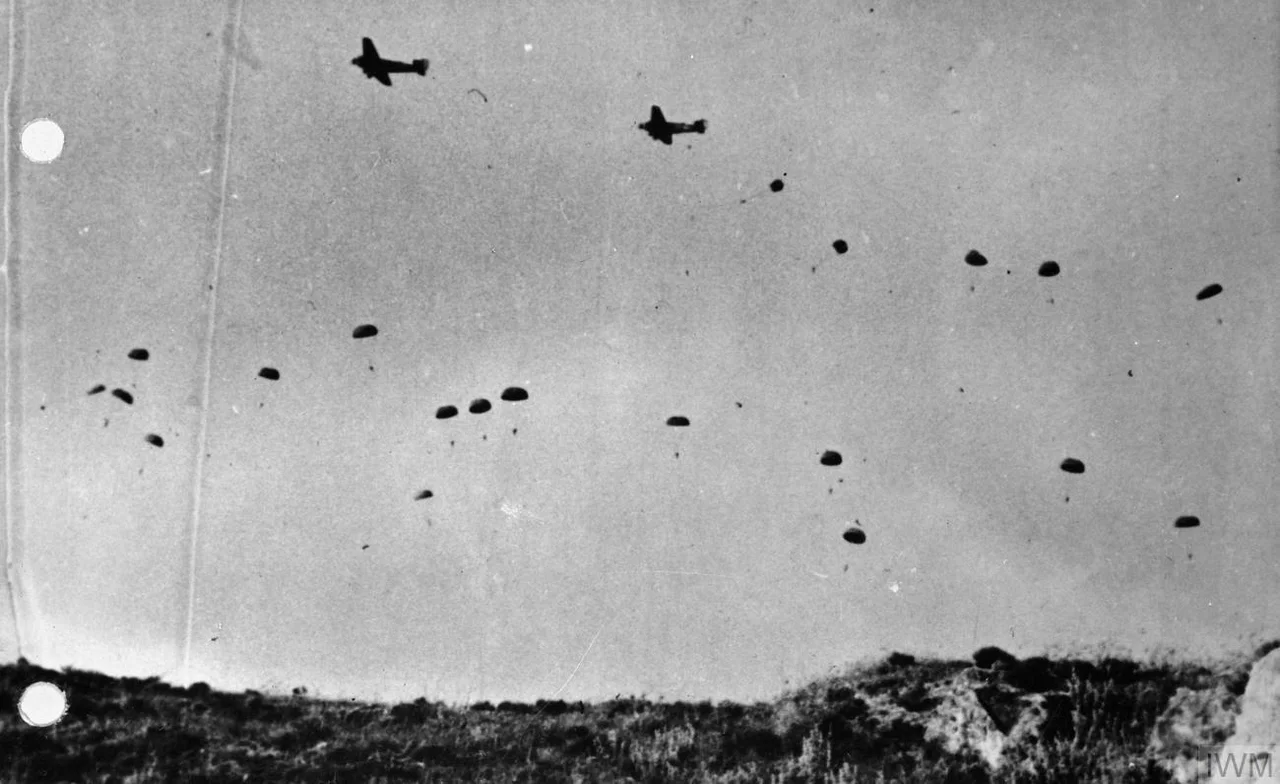

Battle of Heraklion
An old Cretan farmer at Galatas reportedly killed a German paratrooper with his walking stick before the man could reach his weapons container. The story may be apocryphal - oral histories of Crete in May 1941 are full of such moments, and not all of them happened to the people who told them. But the spine of it is true. When the German Fallschirmjager dropped onto Crete on 20 May 1941, the villagers came out of their houses with hunting rifles, axes, scythes, and rolling pins, and they joined the British, Australian, and Greek soldiers already dug in around the airfields. They had no doctrine, no command structure, and no orders. They had a homeland that was being attacked.
The Last Place Left
By April 1941 the Greek mainland was lost. German divisions had overrun Yugoslavia and Greece in a six-week campaign, and the Royal Navy had evacuated some 47,000 Commonwealth troops south to Crete and Egypt. Most arrived on Crete with their personal weapons and not much else - artillery and vehicles had been left behind in the rush to the beaches. Major-General Bernard Freyberg, a New Zealander who had been wounded eleven times in the First World War, took command of Crete on 30 April with orders to hold an island that was militarily a backwater, geographically a barrier, and politically a test of British resolve. He had perhaps 32,000 Commonwealth troops and 10,000 Greek soldiers - many of them gendarmes, recruits, and depot battalions of variable training - distributed across four airfields on the north coast. The defense of Heraklion airfield, the only airfield on Crete with a concrete runway, fell to the British 14th Infantry Brigade under Brigadier Brian Chappel: the 2nd York and Lancaster, the 2nd Black Watch, the 2nd Leicesters, and the Australian 2/4th Battalion, with 2,700 Greek soldiers attached. About 7,000 men in total.
Falling Through Anti-Aircraft Fire
The German plan was Operation Mercury, the largest airborne assault yet attempted in any war. Fallschirmjager of the 7th Air Division and Air-landing Assault Regiment, supported by the 5th Mountain Division, would seize the four north-coast airfields - Maleme, Chania, Rethymno, and Heraklion - in simultaneous drops on the morning of 20 May. The Heraklion drop was scheduled for the afternoon, after the morning aircraft had returned to refuel in mainland Greece. The afternoon attack went badly from the start. Refueling delays meant the Junkers Ju-52 transports arrived over Heraklion in stretched-out groups rather than concentrated waves, and the close air support that should have suppressed the British anti-aircraft guns had run low on fuel and gone home. The Australians on the ridge they called the Charlies fired into the open doorways of the transport aircraft as the paratroopers were jumping. Many men of the 2nd Battalion of the 1st Parachute Regiment were dead in the air before they reached the ground. Within thirty minutes the battalion lost 400 dead and wounded out of perhaps 600 who had jumped.
The Cretan Counter-Attack
West of Heraklion, the 3rd Battalion of the 1st Parachute Regiment landed in open country and tried to fight its way into the town. The early-modern walls of Venetian Heraklion - built by the Republic of Venice in the sixteenth century, expanded to handle gunpowder, never stormed in centuries - obstructed them. They had no artillery and no explosives. They concentrated on the town gates. House-to-house fighting raged into the night. Greek soldiers and armed civilians, men and women, fought in the narrow streets they had known their whole lives. Some of the German groups reached the harbor before being driven back. By dawn the paratroopers had withdrawn to the surrounding hills, and the German commander Colonel Bruno Brauer, dropped east of Heraklion with the regimental headquarters, learned that his attack had effectively been destroyed. The villages around Gournes saw entire German platoons annihilated by armed civilians, including women and children defending their families. The Germans estimated 200 of their men were killed by Cretan irregulars in the first 24 hours alone. The reprisals would come later, and they would be terrible.
Decision at Maleme
Heraklion held. So did Rethymno. So did Chania. The decisive battle was at Maleme airfield in the west, where Allied confusion and a New Zealand decision to abandon the high ground above the airfield on the night of 20-21 May allowed German transports to land troops directly on the runway under fire. By 23 May the 5th Mountain Division was pouring into Crete through Maleme. General Freyberg, commanding from a single radio in a cave above Chania, ordered general retreat to the south coast on 27 May. At Heraklion, the 14th Brigade was still essentially intact and had the upper hand against an exhausted Brauer. They held until the night of 28-29 May, when Royal Navy destroyers and cruisers slipped into Heraklion harbor under cover of darkness and took them off. The voyage back to Alexandria was a slow disaster - Stuka attacks at first light sank the destroyers Hereward and Imperial, badly damaged the cruisers Orion and Dido, and killed more than 440 Allied servicemen on ships that had survived everything onshore. The men of the 14th Brigade took heavier losses on the trip home than they had taken in ten days of fighting.
What the Stones Remember
The Germans suffered roughly 6,500 casualties on Crete - a number small in comparison to Eastern Front operations a month later, but enormous as a percentage of the Fallschirmjager elite committed. Hitler never authorized another large-scale airborne operation. The cost to the Cretans was not yet counted. German reprisals for civilian resistance began immediately and continued for the next three years - villages burned, men shot, the destruction of Kandanos, Anogeia, Kondomari, and many others. By 1945 thousands of Cretan civilians had been murdered as collective punishment. The Venetian walls of Heraklion still stand today, the longest urban wall in Europe, encircling the old city. The airfield where the Australians of the 2/4th and the Black Watch dug in is now part of Heraklion International Airport, named for the Cretan-born statesman Eleftherios Venizelos. Tourists arrive there every summer by the millions. The graves of the men who fell here - Cretan, German, Australian, British, Greek - are scattered across the island, in cemeteries and family plots, and in memory that has not yet faded.
From the Air
Heraklion lies on the north-central coast of Crete, Greece, at approximately 35.34N, 25.13E. The 1941 battle was fought around the town and the airfield to its east (now Heraklion International Airport, LGIR / HER). The Venetian walls still encircle the old city. Recommended viewing altitude 3,500-5,000 ft AGL. LGIR is the active airfield; Chania International (LGSA) sits 75 nm west. From altitude the dramatic geography of Crete is visible - the Psiloritis (Mount Ida) massif rises to 8,058 ft south of Heraklion, the Aegean stretches north toward the Cyclades, and the historic Cretan north coast - Knossos just inland - has been a contested shoreline for four thousand years.
Nearby Stories
- Battle of Rethymno 9.8 km away
- Archaeological Museum of Agios Nikolaos 26 km away
- Battle of Cape Spada 80 km away
- Santorini: The Volcano That May Have Destroyed Atlantis 84 km away
- 1956 Amorgos Earthquake 112 km away
- Battle of Derna (1805) 322 km away
- Siege of Derna 352 km away
- Battle of Sidi Barrani 395 km away