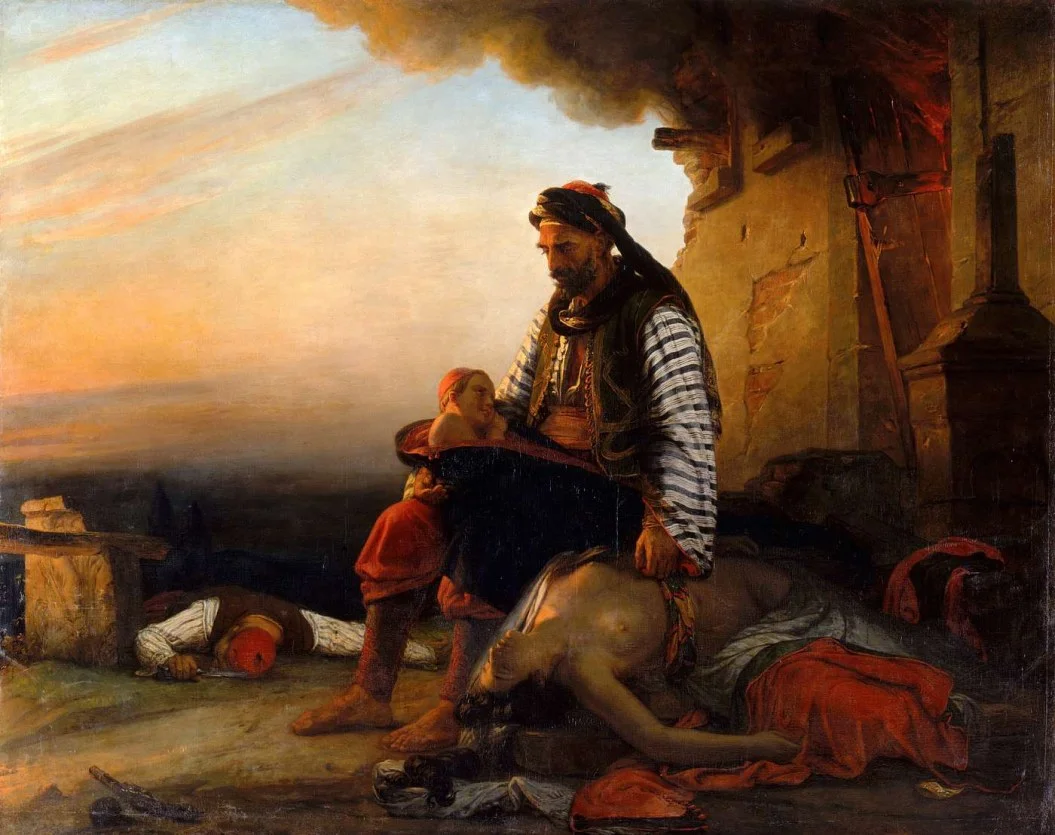

Massacre of Samothrace (1821)
The proverb survives in Samothracian Greek to this day: 'I am not one of the seven hundred.' It means I am not easily fooled. The seven hundred are the men who came down from the mountains in the autumn of 1821 because a turncoat named Kyriakos told them an Ottoman amnesty awaited if they surrendered. They were brought beneath a Byzantine fortress at Efka and killed there, most of them beheaded. Their wives and children were already aboard ships bound for the slave markets of Constantinople and Smyrna. The proverb is the surviving voice of a community whose population was reduced from somewhere between four and ten thousand people to roughly two hundred over the course of a few weeks. The American philhellene George Jarvis, who reached the island in July 1822, found those survivors living in absolute poverty among the ashes of their villages.
The Island Before
Samothrace is a small mountainous island in the northern Aegean, dominated by the 1,611-meter Mount Saos. It has no natural year-round harbor, which has shaped its history as much as anything. In antiquity it was the site of the Sanctuary of the Great Gods, the mystery cult that gave the world the Winged Victory of Samothrace, now in the Louvre. In the Ottoman era, the same isolation that made it strategically marginal also let its Greek Orthodox population live with relatively little interference. By the late 18th century the island was prospering. Agriculture had grown, the population had increased, and the historian Sofi Papageorgiou estimates it numbered between approximately 4,000 and over 10,000 people when the Greek War of Independence broke out. They were farmers, fishermen, sailors, weavers; they had families and harvest festivals and saints' days; they were under Ottoman authority but largely left alone.
April 1821
News of the rising in the Peloponnese reached Samothrace in April 1821. A number of the island's prokritoi, the local notables who managed community affairs under the Ottoman millet system, had already joined the Filiki Eteria, the secret revolutionary society that prepared the Greek revolt. Samothrace voted to declare independence, refused to pay further taxes to the Ottomans, and arrested the small number of Ottoman officials living on the island. A Samiot exile who had settled on Samothrace began training young men in marksmanship. The decision was brave and almost certainly doomed. Samothrace was small, isolated from the Greek mainland, and had no capacity to manufacture ammunition. Worse, it sat directly opposite the major Ottoman naval base at the Dardanelles, just a short voyage by warship. The Ottomans, preoccupied with the larger uprising in mainland Greece, did not respond immediately. When they decided to, they decided that Samothrace deserved exemplary punishment.
September 1, 1821
An Ottoman fleet sailed from the Dardanelles in August. On September 1, a force of one thousand to two thousand soldiers under Mehmed Pasha, the Castellan of the Dardanelles, landed at Makrylies and marched on Chora, the island's largest town. The vastly outnumbered Samothracian rebels took positions on the heights of Koukou and Vrychou and held them for hours, firing as the Ottoman column approached Myloi, until they ran out of ammunition. They retreated into the mountains. Twenty-three Ottoman soldiers were killed, including their standard-bearer, and thirty-two were wounded. The rebels had inflicted real losses; what came next was the response. The Ottomans took Chora and then descended on the smaller villages and began to systematically kill almost everyone they found. Children were spared in order to be enslaved. The villages were looted, the cattle driven off, and the houses burned. Twelve people, named individuals from named families, were hanged from the masts of the Ottoman ships in the harbor as a warning to anyone watching from the hills.
Efka
Many had escaped into the mountains. To draw them down, the Ottomans turned a man named Kyriakos into a collaborator and sent him through the slopes promising amnesty for any who surrendered. Roughly seven hundred men believed him and came in. The women and children were sorted out and taken aboard the ships, destined for the slave markets at Constantinople and Smyrna. The men were marched to a place called Efka, beneath a ruined Byzantine fortress, and killed there. Most were beheaded. Mehmed Pasha captured three Samothracian ships, loaded them with prisoners and with the heads and ears of the dead, and sailed back to Istanbul. The heads were dumped on the ground in front of the Topkapı Palace gate. The Sultan sent Mehmed Pasha a congratulatory letter for his service.
What Came Back
Some came home. The Ottoman government granted formal amnesty in April 1822, and the survivors who had hidden in the mountains came down. Others were ransomed out of slavery in the years that followed by European philhellenes who raised funds across western Europe specifically for that purpose. Many of the women returned and married Greek men from other parts of Greece who came to settle the depopulated island. The Ottoman census of 1831 counted 430 Greek and 3 Turkish males of fighting age on Samothrace, and the actual population was higher because women, children, and the elderly were not counted. Five Samothracian men, captured during the massacre and brought to Constantinople, had converted to Islam under duress, then recanted and returned to Christianity after their ransom in 1837. The Ottomans took them to Makri and executed them. Their names were Manouel Palogoudas, Michael Kyprios, Theodoros Dimitriou Kalakou, Georgios Kourounis, and Georgios. The Greek Orthodox Church recognized them as neomartyrs.
What Survives
An acolouthia, a service of remembrance, was written for the five neomartyrs in 1843 by a monk named Iakovos. It is still performed every year on the seventh Sunday after Orthodox Easter, on Samothrace, in Makri, and in the monasteries of Mount Athos. The relics of the saints, taken from Makri to Mount Athos in the 19th century, were returned to Samothrace by July 1906. A Bible bayoneted by Ottoman soldiers during the massacre was recovered from the ruined village church at Chora and rediscovered by the writer Ion Dragoumis during his 1906 visit. He donated it to the National Historical Museum in Athens, where it remains. On March 23, 1980, the Academy of Athens awarded the island its golden medal in recognition of its contribution to the Greek War of Independence. The proverb is older than the medal, and it remembers more.
From the Air
Samothrace is a Greek island in the northern Aegean, located at approximately 40.50 degrees N, 25.53 degrees E, with the original article coordinates near 40.29 degrees N, 25.31 degrees E. The island is dominated by Mount Saos rising to 1,611 meters. The nearest airports are Alexandroupolis (LGAL) on the Greek mainland to the north, about 25nm away, and Çanakkale (LTBH) to the east in Turkey. There is no airport on Samothrace itself; access is by ferry from Alexandroupolis.
Nearby Stories
- Battle of Athos 18 km away
- Battle of Imbros 28 km away
- Canakkale Martyrs' Memorial 47 km away
- Battle of Philippi 53 km away
- Battle of Amphipolis 84 km away
- Cyclops Cave (Youra) 88 km away
- Didymoteicho Fortress 108 km away
- Archaeological Museum of Amphipolis 111 km away