
Battle of Amphipolis
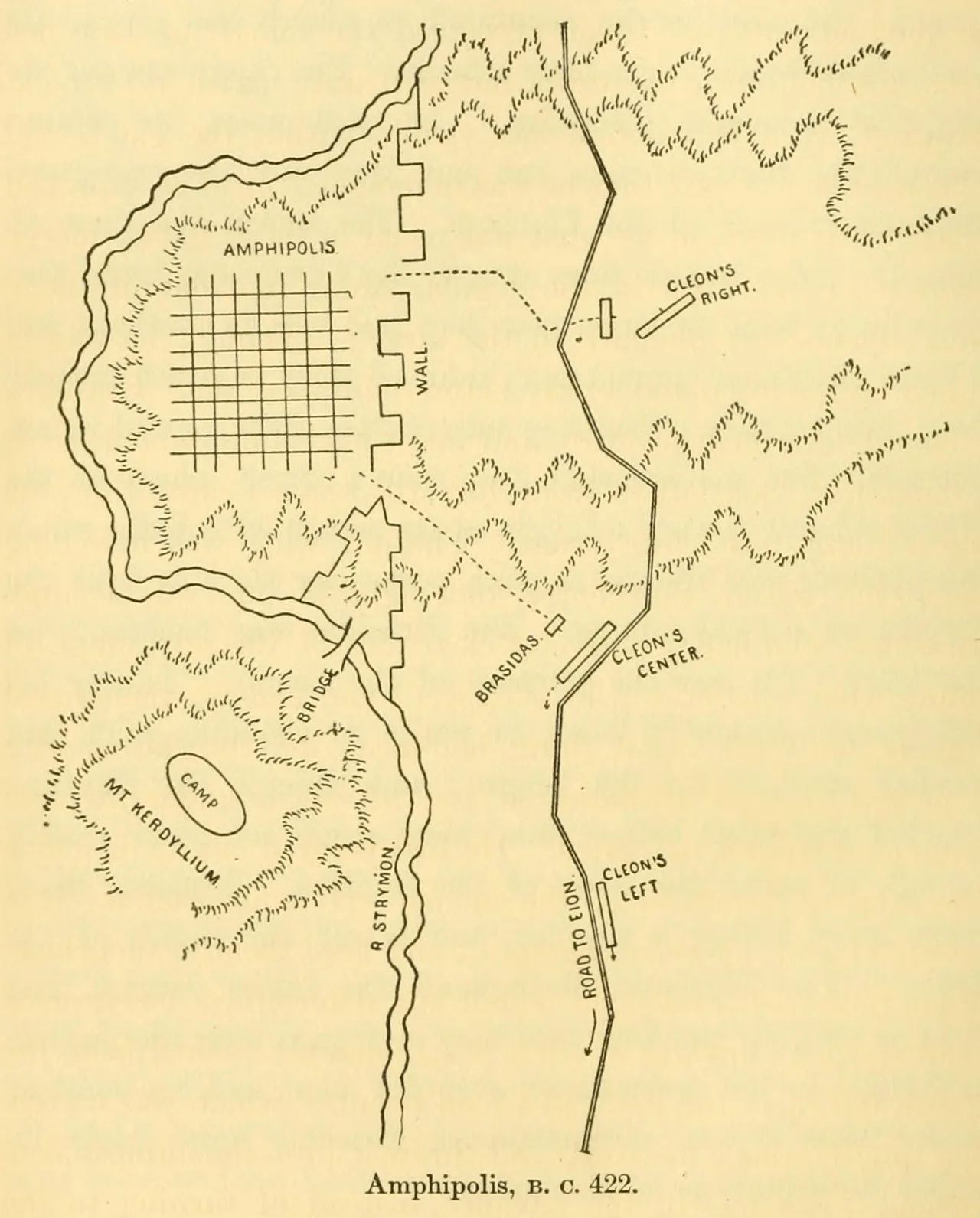
Both commanders died on the same day, on the same ground, fighting each other. The Spartan general Brasidas had taken the Athenian colony of Amphipolis two years earlier through clever talk and favorable surrender terms, much to the embarrassment of the Athenian general who had failed to save it: a man named Thucydides, who would go home to be tried, exiled, and reduced to writing the history of the war he had lost. In 422 BC the Athenians sent a recovery force under the demagogue Cleon, the loudest hawk in their assembly. Brasidas waited inside Amphipolis with about 2,000 hoplites and 300 cavalry. When Cleon's army began a clumsy retreat, Brasidas attacked. In the rout that followed, Cleon was killed, Brasidas was mortally wounded, and the Athenian losses ran to about 600 men against just seven on the Spartan side. The two men whose appetite for victory had kept the war going were both gone, and within a year a peace was signed.
A Spartan Who Talked Cities into Switching Sides
Brasidas was an unusual Spartan. He had been authorized in 424 BC to march an army north to attack Athenian holdings in Thrace, raising 700 helots equipped as hoplites and 1,000 mercenary hoplites from the Peloponnese. He was a persuasive negotiator, which was not what most Greeks expected from a Spartan officer. When he besieged Amphipolis, an Athenian colony on the Strymon River with timber resources Athens needed for shipbuilding, he offered the inhabitants generous terms: anyone who wanted to leave could keep their property and have safe passage; anyone who stayed kept their citizenship. The city surrendered. The Athenian general Eucles inside the walls protested. Thucydides, then a strategos with a small fleet at Thasos, sailed for the port of Eion as fast as he could and arrived on the same day Amphipolis surrendered. He saved Eion. He could not save Amphipolis, and he was recalled to Athens, tried for failure, and exiled.
The Truce Nobody Honored
Athens and Sparta signed a one-year armistice after the loss of Amphipolis: each side would keep what it currently held, and Athens hoped to fortify against further Brasidian charm offensives while Sparta wanted its prisoners from the Battle of Sphacteria back. While the negotiations were still in progress, Brasidas captured another city, Scione, and refused to surrender it under the terms of the truce. The Athenian leader Cleon sent forces to recapture it anyway. The pattern by 422 BC was simple: both sides claimed peace and continued fighting around the edges. When the armistice expired, Cleon arrived in Thrace with thirty ships, 1,200 Athenian hoplites, 300 cavalry, and contingents from Athens' allies. He recaptured Torone and Scione, took the Spartan commander Pasitelidas prisoner, and set up at Eion to plan the assault on Amphipolis.
The Battle Brasidas Did Not Want
Brasidas understood that he could not beat Cleon's army in a pitched battle. He had perhaps 2,000 hoplites and 300 cavalry, plus the garrison inside Amphipolis. Cleon had more men and better-equipped allies. Brasidas took position at Cerdylion, a high point across the Strymon, and watched. Cleon advanced, found the Spartans not coming out, and decided to retreat before reinforcements arrived to support the Athenian position. The retreat was badly arranged. Brasidas saw a disordered enemy and attacked from inside Amphipolis. His pre-battle speech to his Lacedaemonian troops, who he placed under Clearidas while he himself led 150 handpicked hoplites, has come down to us through Thucydides: bear in mind that the three virtues of a good soldier are zeal in battle, sense of honor, and obedience to the leaders, and I will conduct myself in action following the advice I give to my comrades. He kept the promise. He was mortally wounded leading the charge. Cleon was killed by troops under Clearidas. About 600 Athenians died trying to reach the safety of Eion. Sparta lost seven men.
A Hero's Tomb in the Agora
Brasidas lived long enough to learn that he had won. The Amphipolitans buried him in the agora and treated him afterwards as the founder of their city, instituting yearly games and offerings in his honor and pulling down the buildings that had memorialized the Athenian Hagnon, the colony's actual founder, to make space for his cult. Decades of Greek archaeology produced what may be physical confirmation. Ch. Koukouli-Chrysanthaki's three-decade excavation at Amphipolis uncovered the foundations of a small monument and a cist grave at the agora containing a silver ossuary accompanied by a gold wreath, believed by the excavators to hold the remains of Brasidas. The ossuary is now in the Archaeological Museum of Amphipolis. Back in Athens, neither Cleon nor any other hawk remained loud enough to keep the war going, and in 421 BC the Peace of Nicias was signed. It would not hold, but it gave Athens and Sparta a chance to bury their dead. Plato has Socrates say in the Apology that he was a veteran of this battle. He survived. Cleon and Brasidas did not.
From the Air
Located at 40.824N, 23.847E in central Macedonia, Greece, on the east bank of the Strymon River about 25 kilometers inland from the Aegean coast. Recommended viewing altitude 4,000 to 6,000 feet to see the river valley, the surrounding rolling countryside, and the famous Lion of Amphipolis, a colossal Hellenistic monument visible near the modern village. Nearest airport is Thessaloniki (LGTS) about 90 kilometers west. Mount Pangaion, the source of much of Macedon's gold and silver, stands across the river to the south. The Kasta Tomb, a large fourth-century BC tumulus excavated dramatically in 2014, sits on a hill nearby. Best in late afternoon when the river catches the light.
Nearby Stories
- Byzantine Empire under the Palaiologos Dynasty 15 km away
- Battle of Philippi 16 km away
- Battle of Kleidion 30 km away
- Battle of Kilkis (1944) 31 km away
- Battle of Pydna (148 BC) 59 km away
- Battle of Athos 83 km away
- Battle of Doiran (1917) 85 km away
- Roman Forum of Philippopolis 120 km away