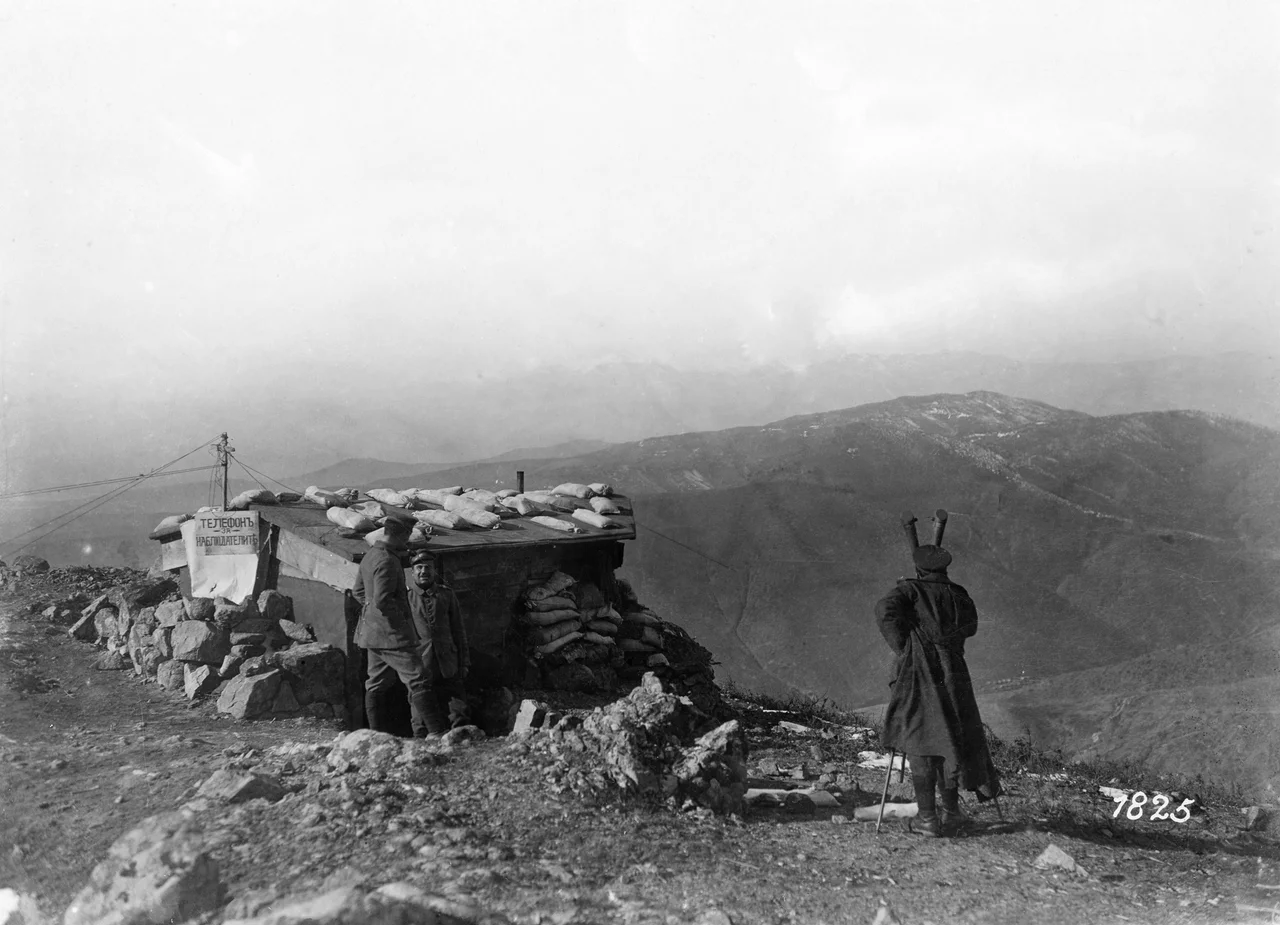

Battle of Doiran (1917)
The British called it the Valley of Death. The men of the Bulgarian 9th Pleven Infantry Division, dug into the rocky heights above Lake Doiran in the spring of 1917, called it the Boris position, after the prince in whose name they thought they were fighting. The valley runs west-southwest from the lake toward the Vardar River, between bare hills on what is now the border between Greece and North Macedonia. From late February through May, three British divisions and their supporting Greek and French units threw themselves at the Bulgarian line. They were stopped both times. The British losses ran to 12,000 killed, wounded, and captured, of whom the Bulgarian defenders buried 2,250 on the field. The Pleven Division lost about 2,000 men, half of them to disease and wounds rather than combat. The front then went quiet for sixteen months. It would not break here until September 1918, in the Third Battle of Doiran, when the war was already ending elsewhere.
A Front Most Soldiers Could Not Find on a Map
The Macedonian Front was the war's overlooked theater. After Bulgaria entered the war on the Central Powers' side in October 1915, an Allied force based at Thessaloniki found itself in a long stalemate against Bulgarian and German troops along a line that ran from the Adriatic to the Aegean. By 1917 the front had been static for more than a year, with the Allies holding the lower ground and the Bulgarians holding the heights. The Second Conference of the Military Counsel of the Entente at Chantilly directed the commanders at Thessaloniki to attempt a breakthrough, in coordination with offensives planned in France. The objective was to drive north along the Vardar valley toward Skopje and Belgrade, which would force Bulgaria out of the war and unhinge Austria-Hungary. The Bulgarian command had spent a year improving its positions. By the spring of 1917 the heights at Doiran were among the most heavily fortified positions on any active front in the war.
Vladimir Vazov and the Pleven Division
In early 1917 the 2nd Bulgarian Thracian Infantry Division was rotated out of Doiran and replaced by the 9th Pleven Infantry Division under Colonel Vladimir Vazov, an experienced officer from a famous Bulgarian military family. Vazov had something most defenders on the Western Front would have envied: terrain that did the work for him. The Bulgarian positions were on rocky heights, with clear fields of fire down into the British forming-up grounds 800 to 1,500 meters below. He had 30,000 men, 147 guns, 35 mortars, and 130 machine guns. He divided the front into three zones, with two brigades and a regiment covering ground from the Vardar River to Lake Doiran, and ordered systematic preparation of the artillery. When British intelligence confirmed an Allied buildup, the Bulgarians replied with their own buildup. Vazov's pre-attack barrage on the British forming-up grounds fired roughly 10,000 shells in a single hour. By the time British infantry began to climb the slopes, the routes they had to cross were already smashed.
The Night Attacks
The British concentrated three divisions for the assault: the 22nd, 26th, and 60th, with more than 43,000 men, 160 guns, 110 mortars, and 440 machine guns. The first major attack went in on the night of 24 to 25 April. The infantry climbed in darkness toward the Bulgarian wire and were caught by the prepared barrage and the counterattack that followed. By 8 pm on the 25th they had retreated. The second major attack came on the night of 8 to 9 May. The same pattern: bayonet assault on prepared positions in the dark, Bulgarian artillery cutting up the supporting waves, counterattack rolling the survivors back down the slope. The Times correspondent at Salonika wrote that the British soldiers called the Boris position the valley of death, and the name stuck. Vazov was promoted to Major-General. The artillery duel continued into early May, but the British command had run out of unwounded infantry and called off offensive operations. The front then sat in silence for sixteen months.
What the Silence Meant
The Macedonian Front did finally break, but not at Doiran. In September 1918 a French and Serbian force punched through the Bulgarian line at Dobro Pole, about 100 kilometers to the west, and Bulgaria sued for peace within weeks. The Third Battle of Doiran in mid-September 1918 was a coordinated Anglo-Greek attack designed to pin Bulgarian reserves while the main breakthrough happened elsewhere; the Pleven Division, now without Vazov but still in roughly the same positions, repulsed the British and Greek assaults the same way it had in 1917. The Doiran heights were never taken in combat. The Swedish heavy metal band Sabaton wrote a song called The Valley of Death for their 2022 album The War to End All Wars, drawing on the British nickname. The lake itself today straddles the border between Greece and North Macedonia. War cemeteries in both countries hold the men who could not finish climbing the hill. The names on the headstones are British, Greek, French, Bulgarian. They were trying to take the same ground.
From the Air
Located at 41.188N, 22.721E on the rocky heights west of Lake Doiran, on what is now the border between Greece (Kilkis regional unit) and North Macedonia. Recommended viewing altitude 5,000 to 7,000 feet to take in the lake (split by the modern border), the surrounding heights including Pip Ridge and Grand Couronne where the British attacks broke against Bulgarian positions, and the Vardar River valley to the west. Nearest airport is Thessaloniki (LGTS) about 70 kilometers south. Skopje (LWSK) is about 95 kilometers north. The Doiran Memorial, the British war cemetery on the Greek side, and the Bulgarian and Greek military cemeteries on the North Macedonian side mark the principal positions. Best in late spring or autumn when the dry hills are clear and the lake is at full level.
Nearby Stories
- Archaeological Museum of Pella 25 km away
- Battle of Kresna Gorge 53 km away
- Byzantine Empire under the Palaiologos Dynasty 54 km away
- Archaeological Museum of Amphipolis 70 km away
- Old Bazaar, Skopje 82 km away
- Battle of Plovdiv (1878) 88 km away
- 1963 Skopje Earthquake 105 km away
- Meteora: The Monasteries Built on Impossible Pillars 144 km away