.jpg)
Archaeological Museum of Pella
The boy who would conquer Persia learned to walk on these stones. Pella was the capital of Macedon when Alexander was born here in 356 BC, and the museum that opened in 2009 sits directly on the ancient city's edge, designed by architect Kostas Skroumpellos around a rectangular atrium that echoes the peristyle courtyards of the houses still being excavated outside its walls. You step through the doors and meet two faces almost immediately: a marble head believed to portray Alexander himself, and a small statuette bristling with the horns and pipes of the god Pan. The whole museum is structured this way, as if the curators want you to understand from the first room that Pella was a place where mythology and a teenager who became a god lived in the same neighborhood.
Floors That Walked With Kings
Pella's mosaics are the reason most visitors come, and they deserve the trip. The pebble floors lifted from the Houses of Dionysus and the House of the Wall Plasters were not made of cut tesserae but of small natural stones, sorted by color and pressed into mortar by craftsmen working in the late fourth century BC. The Stag Hunt mosaic, dated to roughly 300 BC, shows two hunters and a deer rendered with such confident anatomy that you can see the strain in a thigh, the lift of a hand. A lion hunt and a griffin tearing into a fawn share the rooms with the Abduction of Helen, an entire Greek epic compressed into a few square meters of floor. These are some of the earliest figural mosaics in the Greek world, and they were not in temples. They decorated the dining rooms of wealthy Macedonian houses, where guests reclined and looked down at art.
A City of Many Voices
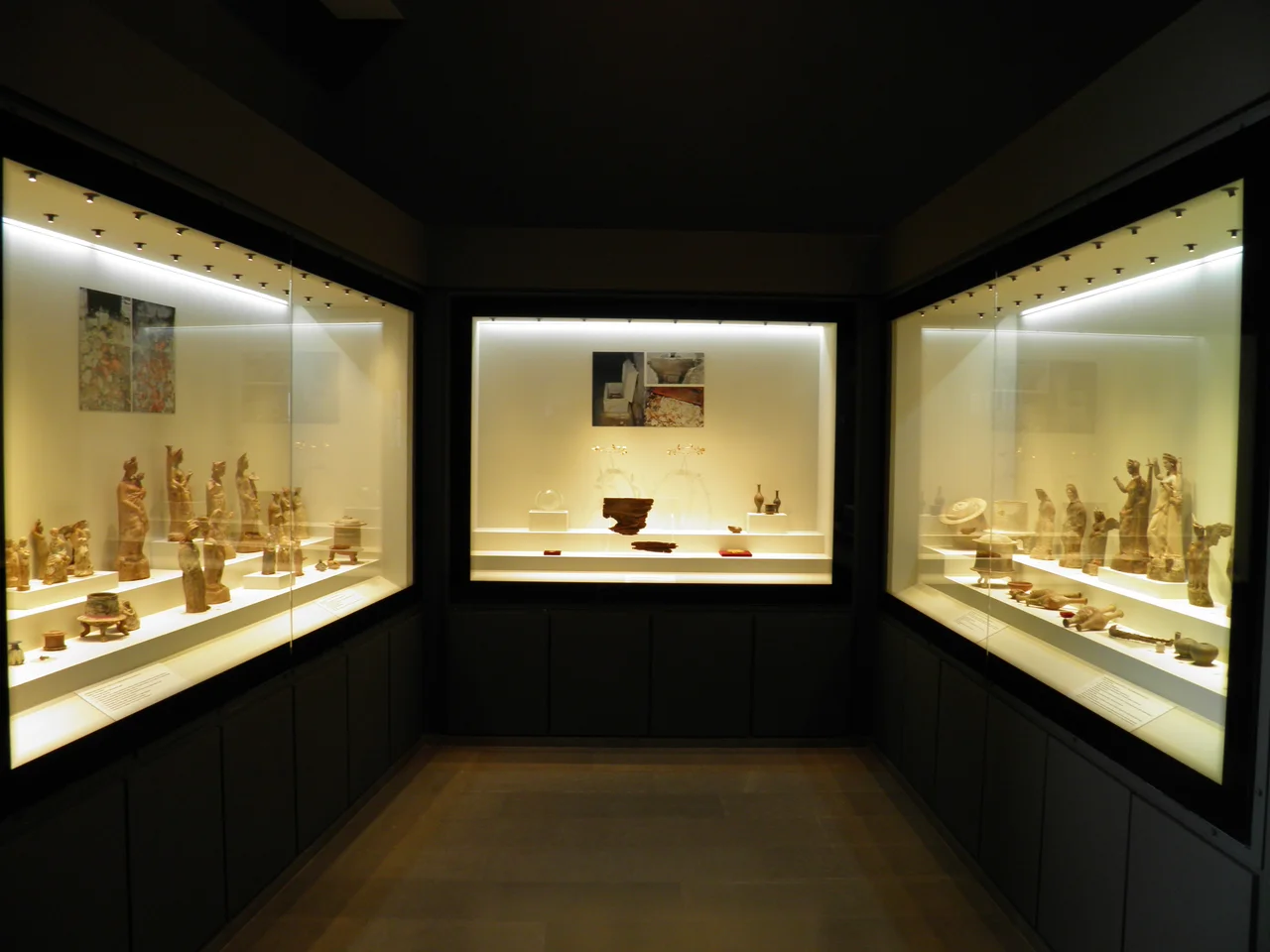
The museum organizes its collection by how Pellans actually lived. One thematic group covers the agora, where coins and inscriptions and amphora fragments record a working commercial center. Another reconstructs domestic interiors with restored furniture, terracotta figurines, and cookware. A third pulls together votive offerings from the sanctuaries of Darron, Aphrodite, and the Mother of the Gods. The cemeteries form their own grouping, with burials spanning the Bronze Age through the Hellenistic period, and the inscribed grave stelai confirm something language scholars long debated: the Pellans spoke a Doric Greek dialect, settling the question with the bluntness of stones cut for the dead. A small gold mask, gold jewellery, and a terracotta Aphrodite removing her sandal complete a portrait of a city that buried its people with care.
The Boy and the Province
The final gallery belongs to the palace and to Alexander himself. The architectural reconstructions show a sprawling complex on a hill north of the residential city, with vast peristyle courts and royal apartments, the building where Alexander received tutoring from Aristotle before he was sent to Mieza. The marble head of Alexander on display was a chance find from the area of nearby Giannitsa, dated 325 to 300 BC. He looks young in it, his hair tousled in the leonine style his portraitists adopted, and the visitor information panels do something rare for archaeological museums: they discuss his personality. The exhibit closes the loop. You arrive among Macedonian dinner parties and leave with the kingdom's most consequential son, who left this plain at twenty and never came back.
The Plain Outside
Step out of the museum and the ancient city is right there. The agora, the houses, the foundations of the palace on the hill behind you, the long colonnaded streets that once ran through what is now farmland: this is one of the largest exposed urban excavations in Greece. The shoreline of the Thermaic Gulf, which once reached close to the city and made Pella a port, has retreated about thirty kilometers as the Axios River silted in its delta. That geographic fact is part of the city's story too. Pella died slowly after the Romans defeated Macedon in 168 BC, and one of the reasons it never recovered was that the sea quietly walked away.
From the Air
Located at 40.762N, 22.519E on the Macedonian plain north of Mount Olympus and west of Thessaloniki. Recommended viewing altitude 5,000 to 8,000 feet for a clear sense of the broad agricultural plain where the ancient capital sat. The modern village of Pella and the excavated ancient site sit just south of the E86 highway. Nearest major airport is Thessaloniki (LGTS), about 38 kilometers southeast. The Axios River and its delta are visible to the east. Best in summer haze when the surrounding fields turn gold and the relief of the palace hill becomes legible.
Nearby Stories
- Battle of Pydna (148 BC) 11 km away
- Battle of Kilkis (1944) 16 km away
- Battle of Spartolos 18 km away
- Byzantine Empire under the Palaiologos Dynasty 35 km away
- Meteora: The Monasteries Built on Impossible Pillars 90 km away
- Battle of Philippi 91 km away
- Ohrid 114 km away
- Church of Saint Sophia, Ohrid 123 km away