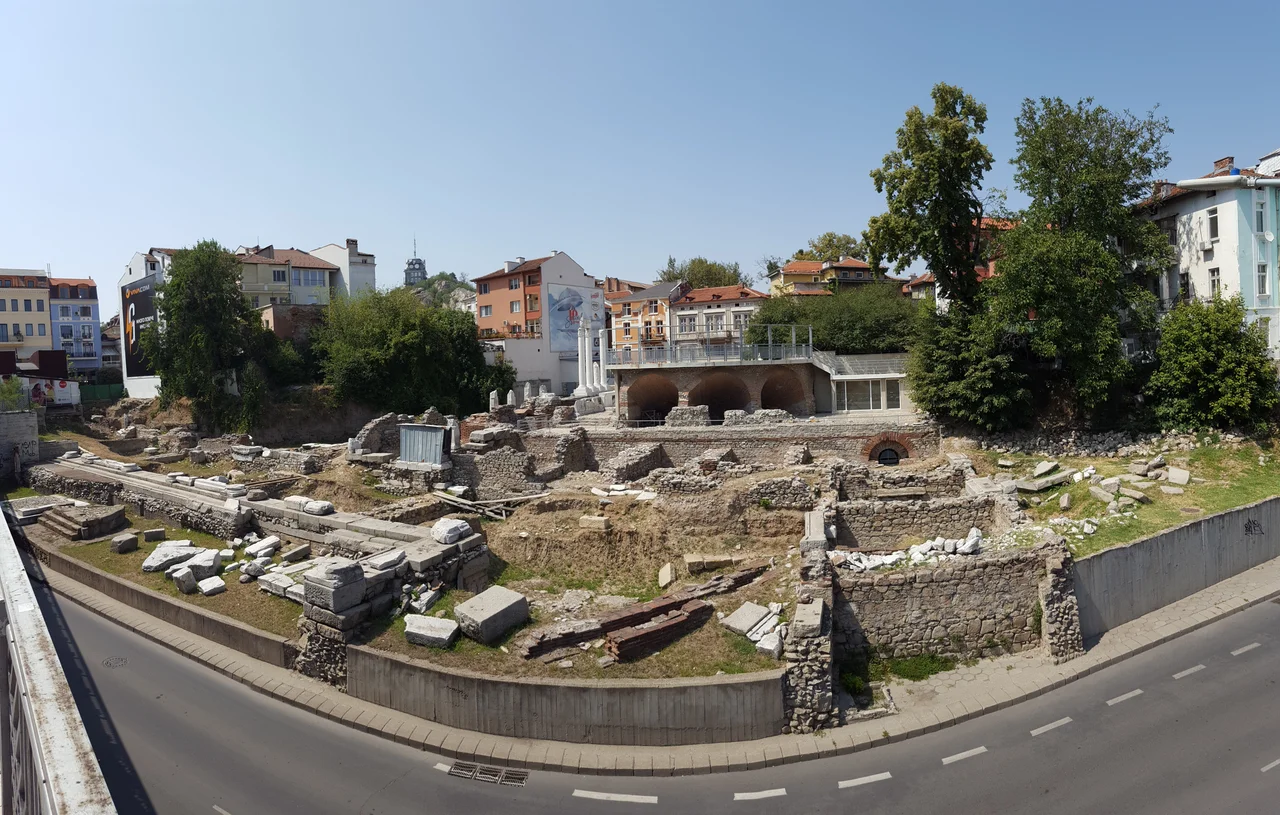

Roman Forum of Philippopolis
A construction crew was digging a foundation for the central post office of Plovdiv in 1971 when they hit marble. Then more marble. Then a Doric column drum. Then a Corinthian capital. By the time the archaeologists arrived, the workers had stumbled into the largest Roman forum ever found in Bulgaria, a twenty-hectare civic square that had been the political and commercial heart of ancient Philippopolis. The post office got built anyway, planted directly on top of the western quarter of the forum. The eastern, northern, and southern sections were excavated, and today they stretch open beneath the modern pedestrian streets, a layer of empire interrupted by 1980s Brutalism.
Vespasian's Plan
Construction began in the 1st century AD during the reign of Emperor Vespasian, when Rome reorganized Philippopolis according to the standard imperial template. The cardo and decumanus maximus, the two main streets that defined every Roman city's grid, intersected just outside the eastern entrance to the forum. Public buildings clustered to the north: an odeon for council meetings and small performances, the Library of Philippopolis, and the city treasury. The forum proper measured 143 by 136 meters, almost a perfect square, surrounded on three sides by stoas where Thracian merchants traded grain, wood, and honey for fine pottery and bronze vessels imported from as far as Italy.
Four Phases of Marble
Archaeologists have identified four distinct construction phases in the forum's stratigraphy, each with different floor levels, building materials, and architectural orders. The first laid the basic urban grid. The second raised everything by introducing a Doric sandstone colonnade on a heavy crepidoma, with eleven-meter ambulations and the original stone drainage that still funnels rainwater away from the porticoes. The third phase replaced the sandstone with marble. The fourth and final phase built freestanding Roman Corinthian columns of syenite blocks topped with marble capitals. Most of what visitors see today comes from this final, most ambitious iteration, the forum at its imperial peak.
Civic Life and Gladiator Tickets
This was where Philippopolis governed itself. An exedra, a curved platform for orators, held formal speeches. Pedestals carried bronze statues of magistrates and emperors. An altar inscribed with dedications to Demeter and her daughter Kore (Persephone) hosted civic religion. Inscriptions document an official treasury, suggesting the forum complex held the city's tax revenues and public funds. Among the smaller archaeological finds was a fragment of an invitation card to a gladiatorial contest, the kind of throwaway notice that survives only when a city is destroyed quickly enough to preserve its trash. The Bouleuterion in the northeast corner is where the city council deliberated.
Going Silent
The forum went quiet in the middle of the 5th century. Wave after wave of Goth, Hun, and other barbarian incursions made the lower city untenable. Residents abandoned the plain and retreated to the more defensible acropolis on Nebet Tepe and the surrounding hills. The shops emptied. The colonnades fell. Earth slowly buried the marble. Fifteen centuries later the post office crews started digging. Excavations resumed in 2012 in the northwestern quadrant, revealing 400 square meters between the post office and the Tsar Simeon Gardens. Archaeology in Plovdiv is rarely a question of whether ancient material survives. It is a question of where the next backhoe will hit it.
An Open-Air Map of Empire
What remains today is a sort of partial open-air museum threaded through the modern city center. You can stand at the eastern entrance where the cardo crossed the decumanus, look toward the north and trace the outline of the city library, watch tourists eat ice cream on the stylobate, and listen to electric scooters whirring past. The marble freestanding columns of the final construction phase still rise from their syenite blocks. Plovdiv is one of the world's oldest continuously inhabited cities, and the forum is one of its most legible pages, a Roman imperial chapter that the modern city has framed rather than erased.
From the Air
Located at 42.1421 N, 24.7509 E in the heart of modern Plovdiv, on the northern edge of the city center next to the Tsar Simeon Gardens. The forum is integrated into the pedestrian streets, with the central post office building covering its western quadrant. Plovdiv International Airport (LBPD) lies 5 km southeast at Krumovo. Sofia Airport (LBSF) is 130 km west. The Rhodope Mountains rise dramatically to the south.
Nearby Stories
- Batak Massacre 18 km away
- Buzludzha Monument 42 km away
- Museum of Socialist Art 81 km away
- Battle of Kresna Gorge 91 km away
- Battle of Philippi 101 km away
- Complex of Sultan Bayezid II 104 km away
- Trapezitsa Fortress 106 km away
- Bridges of Edirne 113 km away