_95.jpg)
Museum of Socialist Art
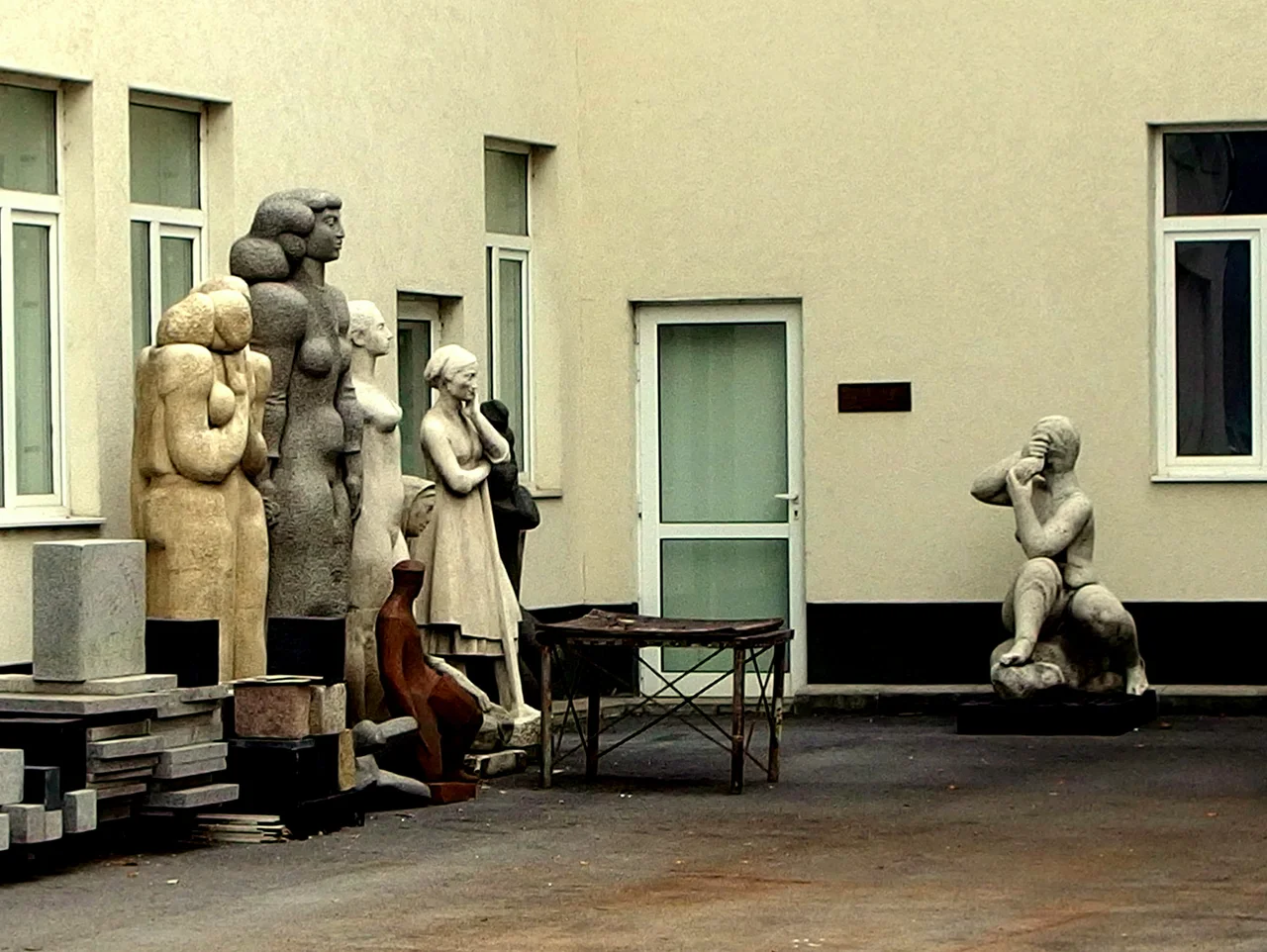
The five-pointed red star at the entrance is enormous. For thirty years, from 1954 to 1984, it sat on top of the Communist Party headquarters in central Sofia, visible across the city. Now it lies at ground level outside a museum in the Red Star suburb, an artifact rather than a symbol. Around it stand 77 statues of Lenin, of Bulgarian communist leaders, of Red Army soldiers, of agricultural workers and Herculean laborers, gathered from public spaces across Bulgaria after 1989 and brought here. The Museum of Socialist Art opened on 19 September 2011 with no clear answer to the question Bulgarians had been asking for two decades: what to do with all this stone.
The Naming
The argument over the museum's name began before it opened and never fully ended. Some Bulgarians, particularly anti-communist activists and victims of the regime, wanted it called the Museum of Totalitarian Art, language that would frame the period from 1944 to 1989 as a time of repression and crime. Others, including officials at the National Art Gallery, of which the new museum became a branch, preferred Museum of Socialist Art, language that sat closer to how the period described itself. The dispute reflected a real disagreement that had run through Bulgarian politics since 1989. Many Bulgarians lived productive ordinary lives under the regime: they worked, raised families, took vacations to the Black Sea coast. Others lost careers, freedom, or relatives to the State Security apparatus. Both experiences are real. The museum's eventual name, socialist, was a compromise that satisfied neither side and may be the most honest possible label for that reason.
What Is in the Park
The 7,500-square-meter site outside Sofia is divided into three parts: a sculpture park, an exhibition hall with paintings and easel works, and a media room screening propaganda films and newsreels from the period. The sculpture park is what most visitors come to see. Statues, busts, and figures of Bulgarian communist leaders stand among trees and lawns: poets celebrated by the regime, partisan resistance fighters from the Second World War, idealized agricultural workers and industrial laborers. A statue of Lenin stands among them, removed from its original location in central Sofia after 1989. The grouping is intentionally non-judgmental in its arrangement, which itself was controversial. Critics argued that placing the figures in a pleasant park risked making the regime look benign. Defenders argued that warehousing the statues without context would have been worse, an attempt to pretend the period had not happened.
The Paintings
Inside the exhibition hall hang 60 paintings and 25 easel works produced under the regime's official aesthetic of socialist realism. Many depict the entry of the Soviet Army into Bulgaria in 1944, the founding of communist party branches, idealized portraits of leaders, and pastoral landscapes celebrating collective farms. The wall labels describe a presumed theme of eternal friendship between Bulgaria and the Soviet Union, a phrase that ran through decades of official discourse. The art reflects the people who made it. Some artists believed in the project they served and produced sincere work in the style their training rewarded. Others worked within the system because painting was their profession and the state was the only patron available. A few used the conventions of socialist realism to encode quieter messages. The museum's paintings show all of these tendencies, sometimes in the same artist's work, without sorting them into heroes and collaborators. The museum's restaurant, perhaps awkwardly, hangs portraits of Marx, Lenin, Engels, and Stalin on its walls.
Lyudmila Zhivkova
In 2012 the museum hosted an exhibition called The Cultural Opening of Bulgaria to the World, devoted to the work of Lyudmila Zhivkova, daughter of the long-ruling Bulgarian communist leader Todor Zhivkov. Lyudmila served as Bulgaria's Minister of Culture from 1975 until her death in 1981 at age 38. She used her father's protection to push Bulgarian culture in unconventional directions: yoga, theosophy, ancient Thracian heritage, international cultural exchanges that opened the country to artists and ideas the regime would normally have blocked. She is remembered ambivalently. To some Bulgarians she represented a brief moment of cultural opening that made the late communist period more livable. To others she was a beneficiary of nepotism whose interests verged on the bizarre. Her exhibition at the museum framed her years as a golden age of socialist culture. The phrase, like much else here, is contested. The museum collects the contestation along with the art.
From the Air
Museum of Socialist Art: 42.6660 N, 23.3578 E, in the Red Star suburb of southeastern Sofia, near the Iztok and Tsarigradsko Shose neighborhoods. Best viewed below 2500 feet. Identifiable as a fenced park with scattered large statues visible among trees, set among modern residential and office buildings. Sofia Airport (LBSF) is about 4 nm east-northeast; the museum sits roughly under the approach pattern. Class C airspace; coordinate with Sofia approach for any low-level operations. The Vitosha mountain range, with peaks above 7,500 feet, rises immediately south of Sofia and dominates the local horizon.
Nearby Stories
- Battle of the Gates of Trajan 1.3 km away
- Battle of Kresna Gorge 65 km away
- Battle of Plovdiv (1878) 70 km away
- Battle of Kosturino 114 km away
- New Europe Bridge 129 km away
- Old Bazaar, Skopje 136 km away
- Trapezitsa Fortress 142 km away
- Trajan's Bridge 193 km away