.jpg)
Trajan's Bridge
Apollodorus of Damascus had two and a half years and a river that nobody had ever bridged. The lower Danube at this stretch - east of the Iron Gates, where the river narrows between high banks near modern Drobeta-Turnu Severin in Romania and Kladovo in Serbia - is wide, deep, and seasonal in its temper. By the spring of 105 CE, a Roman bridge ran across it: twenty masonry piers rising from the riverbed, each supporting a wooden segmental arch spanning thirty-eight metres, the whole superstructure long enough to march a legion across without breaking step. Trajan needed the bridge to invade Dacia. He got the longest arch bridge in the world, and the world held that record for the next thousand years.
The Engineer
Apollodorus was a Greek architect from Damascus who had become Trajan's military engineer of choice - the kind of imperial servant whose name shows up on no triumphal arch but whose work made the arches possible. He had already designed Trajan's Forum in Rome and would later design Trajan's Column. To build the bridge he applied a trick the Greeks had known since Thales of Miletus six centuries earlier: do not fight the river, move it. Engineers waited for the lowest water of a particularly dry year, then dug a 3.2-kilometre canal around the construction site, redirecting the Danube two kilometres downstream while crews drove oak piles into the exposed riverbed. The piles were arranged in rectangles, sealed with clay, and filled with stone bound by pozzolana cement - the volcanic-ash mortar that allowed Roman concrete to set underwater. Each pier rose 44.46 metres tall and 17.78 metres wide, fifty metres apart from the next. Twenty piers, twenty arches, one improbable crossing.
Why It Stood
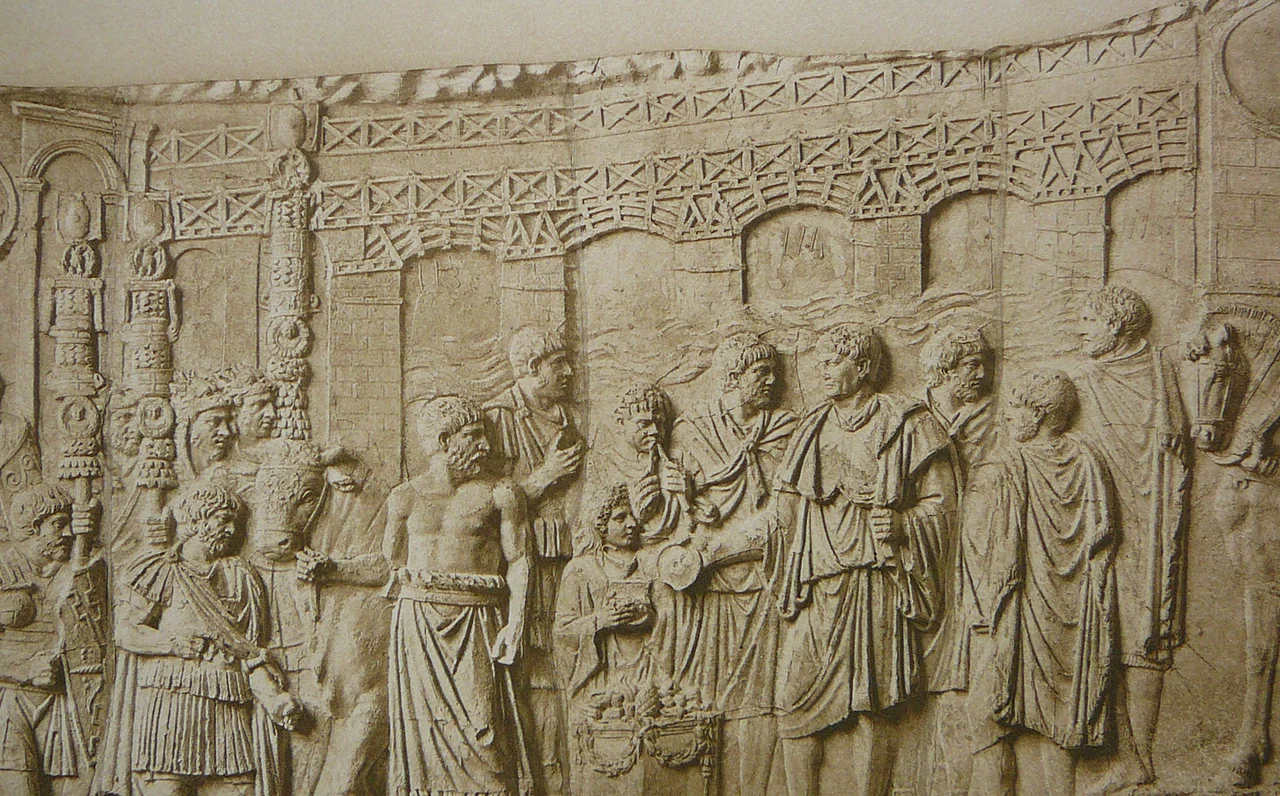
The piers were stone; the arches above them were wood. This was the decision that made the bridge buildable in three seasons and also made it vulnerable. Wooden segmental arches - flatter and more horizontal than the heavy semicircular arches of most Roman bridges - allowed Apollodorus to span thirty-eight metres without the towering rise that masonry would have required. Oak was the material; the bridge was high enough that ships could still pass beneath. The relief on Trajan's Column shows the structure in stylised form: those flat arches, the high concrete piers, Trajan himself sacrificing by the river bank in the foreground. The Roman bricks Apollodorus laid into the pier facings can still be picked up in the village of Kostol on the Serbian side. They retain the same physical properties they had two thousand years ago - one of those ordinary miracles you only notice when you stop to consider how few human-made objects last that long.
Built to Win a War, Demolished to Lose One
The bridge served the Second Dacian War. Trajan's legions crossed it, conquered Dacia, and turned the territory north of the Danube into a Roman province whose Latin-speaking descendants are the Romanians of today. Then the bridge stood for about 165 years - shorter than its construction had been impressive. Hadrian, Trajan's successor, is reported to have ordered the wooden superstructure dismantled, fearing the same crossing that brought legions north could bring barbarians south. The piers remained. The river, freed from its detour, gradually buried what it could. Some of the wooden pile foundations survived underwater for centuries, and Roman writers as late as Cassius Dio still wrote about the bridge as a marvel of the past tense. Whether the superstructure actually burned or was deliberately demolished is debated; the columns themselves slowly succumbed to flood, ice, and treasure-hunters.
What Remains
Today, two pier stumps still rise from the water - one on the Serbian bank near Kostol, one across at Drobeta-Turnu Severin in Romania. They look at first like the natural rocks they have nearly become: weathered brick and concrete fused into the riverbed by twenty centuries of current. Romania protected the site as a Historic Monument in 2004; Serbia listed it as an Archaeological Site of Exceptional Importance in 1983. Underwater archaeologists have surveyed the foundations several times since the river was partly dammed by the Iron Gates I hydroelectric project upstream. The longest arch bridge in the world for a thousand years now exists mostly as memory, two stones, and a relief carving on Trajan's Column twenty-five hundred kilometres away in Rome - which is, in its way, the most Roman fate possible.
From the Air
The bridge ruins span the Danube at 44.62°N, 22.67°E, between Drobeta-Turnu Severin (Romania) on the north bank and Kladovo (Serbia) on the south. From the air, the Iron Gates gorge to the west forms a dramatic 100-km canyon where the Danube cuts through the southern Carpathians. Nearest airports: Craiova (LRCV) about 100 km north, and Belgrade (LYBE) about 200 km west. Recommended altitude: 4,000-7,000 ft to follow the river and pick out the pier remnants on both banks.
Nearby Stories
- Domogled-Valea Cernei National Park 30 km away
- New Europe Bridge 39 km away
- Buila-Vanturarita National Park 84 km away
- Cozia Monastery 118 km away
- Church of Saint George, Sofia 178 km away
- Old Bazaar, Skopje 262 km away
- 1963 Skopje Earthquake 291 km away
- Budapest 382 km away