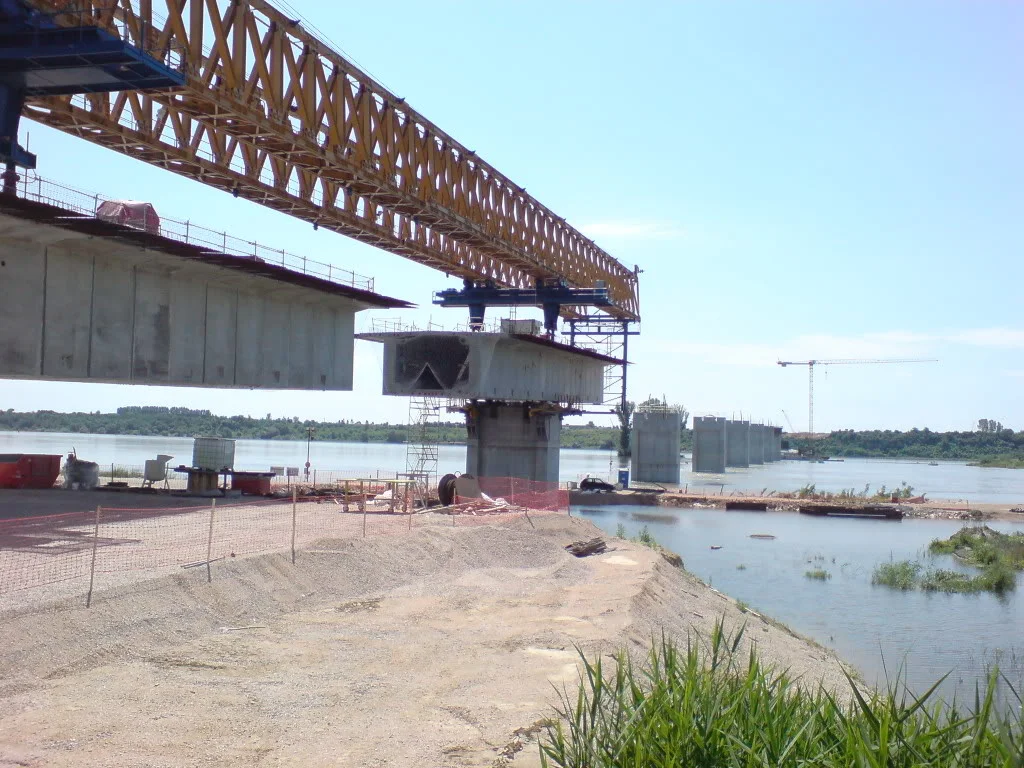

New Europe Bridge
Bulgarian newspapers called it the materialising of a century-old dream. In 1909, the local council in Vidin had petitioned Prime Minister Aleksandar Malinov for a bridge across the Danube to Romanian Calafat. They got nothing. Their grandchildren tried again. Their great-grandchildren tried again. For a hundred years, the trip from Vidin to Calafat, an hour by car if a bridge had existed, instead meant waiting for a ferry that would not leave its loading ramp until enough trucks had stacked aboard, then crossing a river that froze in some winters and ran too low to launch in some summers. On 14 June 2013, Bulgaria and Romania finally cut the ribbon on the New Europe Bridge.
Why It Took So Long
Before 2013, only one bridge crossed the Danube between Bulgaria and Romania, the Friendship Bridge at Ruse and Giurgiu, opened in 1954 with Soviet help. Before that, a stretch of more than 470 kilometers of shared river had no fixed crossing at all, a state of affairs unchanged since the destruction of Constantine's Bridge in late antiquity. Both countries spent the 1990s arguing about where a second bridge should go. Bulgaria wanted it as far west as possible, near Vidin, to revive a city wrecked by the Yugoslav wars and isolated by the boycott against Belgrade. Romania wanted it east, between Turnu Magurele and Nikopol, to keep transit traffic on Romanian roads longer. A European study suggested a third location, between Lom and Rast, that pleased no one. The dispute lasted seven years before the western route won.
The Ferry Years
Anyone who used the Vidin-Calafat ferry remembers the waiting. In summer, the river sometimes dropped low enough to strand the boat at its ramp. In winter, ice could shut the crossing for weeks. The ferry would not depart until fully loaded with trucks, which meant night passengers might wait three or four hours for enough freight to arrive. Drivers running the long route from Istanbul or Sofia toward Vienna or Munich could either queue at the ferry, detour 307 kilometers downstream to the Friendship Bridge at Ruse, or cut through Serbia. The Serbian route was usually fastest but came with non-EU customs that could swallow another five hours at the border. None of the options were good. About a month after the bridge opened in June 2013, the ferry simply stopped running.
Building It
Construction officially began on 13 May 2007, with the Spanish company FCC Construccion as principal contractor and a budget that climbed from an initial 99 million euros to a final 226 million. The bridge is an extradosed design with eight pillars in the shallow non-navigable channel and four main pillars, numbered PB9 through PB12, carrying 13 pairs of stay cables each over the navigable Danube. The main pillar foundations are extraordinary: 24 piles per pier, two meters across, sunk between 68 and 80 meters into the riverbed, among the deepest such foundations in Europe. Work dragged. Land disputes around Vidin held up early progress. The two bridge decks did not meet until October 2012, and even then a 45-centimeter height difference between halves had to be corrected before they could be joined. A Romanian worker fell to his death in November 2012; his body was never recovered.
What the Bridge Did
In its first year, 508,294 vehicles crossed the New Europe Bridge, beating early projections. Most of the traffic was freight: trucks running the new corridor from Kapitan Andreevo at the Bulgarian-Turkish border, north through Vidin, then northwest through Romania and Hungary toward Austria and Germany, all of it now possible without leaving the European Union. The bridge cut about 20 kilometers off the equivalent route via the Ruse bridge and avoided Serbian customs entirely. Vidin, isolated and depressed for most of the post-Communist period, had a reason for traffic to come through it again. Calafat saw its first significant European transit. On 1 January 2025, Bulgaria and Romania finally entered the Schengen Area, and the border posts at the Romanian end of the bridge stopped checking passports, though the toll booths kept collecting their six euros from each passenger car.
Standing on the Span
From the Bulgarian bank near Vidin, the bridge rises gently into the air, the four main pillars showing their fans of pale stay cables silhouetted against the Romanian shore. The Danube here makes a long, mirrored S-shape, and the bridge sits near the middle of it, crossing from northwest to southeast even though Bulgaria lies south of Romania. The Bulgarian bank is low and protected by dikes; the Calafat side rises higher above the water. Cyclists can cross on a combined pedestrian and bike path along one side, though navigating the approach roads requires patient attention to faded signs. For trucks pounding through at all hours, the bridge is just infrastructure. For people who remember the ferry, it is a small daily miracle.
From the Air
The bridge crosses the Danube at 44.005 N, 22.9475 E, between Vidin on the Bulgarian (south) bank and Calafat on the Romanian (north) bank. From above, look for the Danube's distinctive S-bend through the Bulgarian-Romanian border country, with the four cable-stayed main pillars marking the navigation channel and approach causeways extending well into the floodplain on both sides. Craiova International (LRCV) is 70 km north; Sofia (LBSF) lies 195 km south-southwest. Recommended viewing altitude 1,500 to 3,500 ft AGL; the Danube valley channels strong west winds and produces low fog in autumn.
Nearby Stories
- Trajan's Bridge 46 km away
- Buila-Vanturarita National Park 113 km away
- Church of Saint George, Sofia 122 km away
- The Battle of Karansebes: When an Army Defeated Itself 127 km away
- Cozia Monastery 150 km away
- Battle of the Gates of Trajan 160 km away
- Old Bazaar, Skopje 215 km away
- 1963 Skopje Earthquake 242 km away