
Battle of the Gates of Trajan
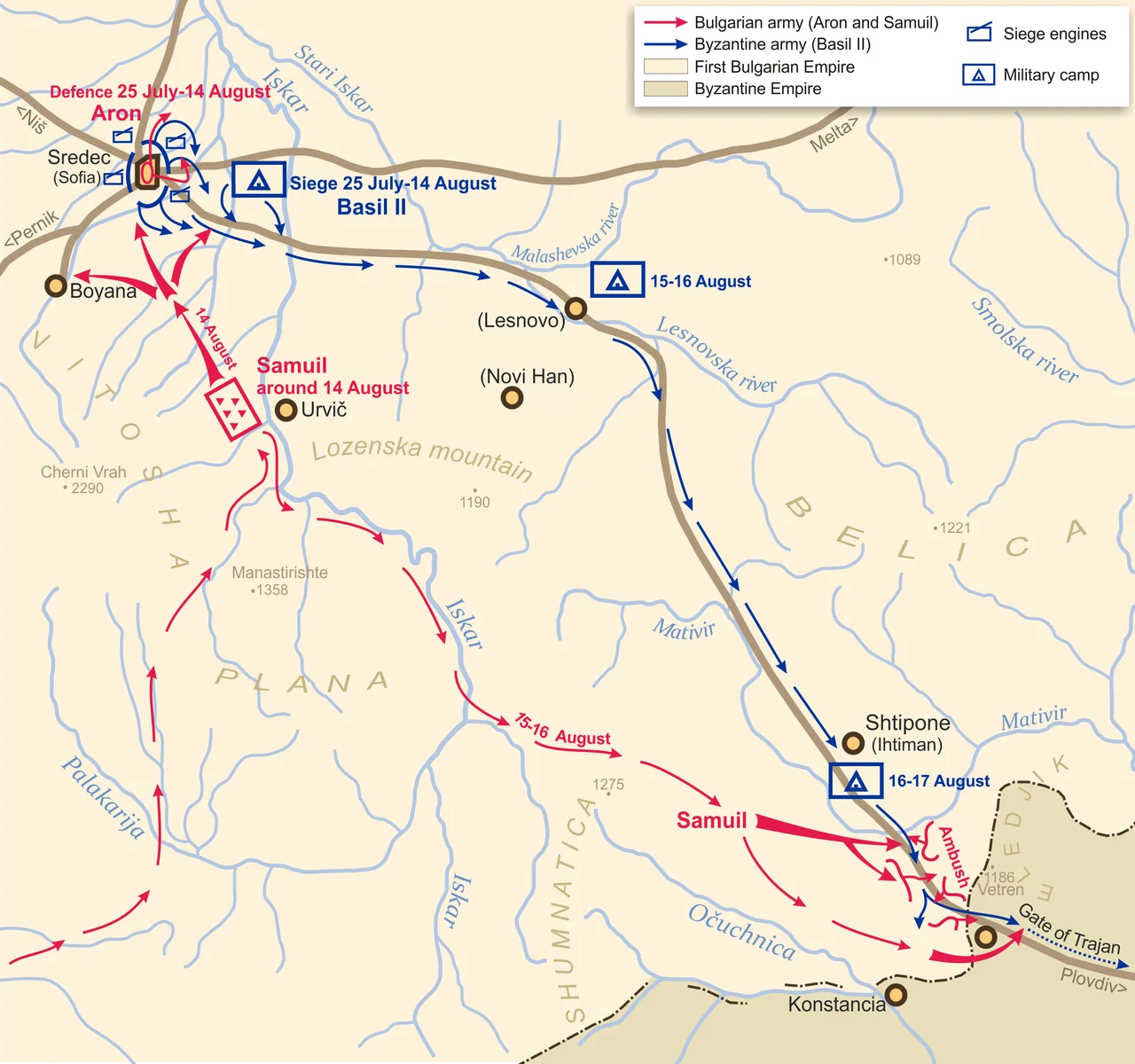
He was twenty-eight years old and had inherited a throne too big for him, and now Tsar Samuel of Bulgaria had him trapped in the mountains. Basil II had marched on Sofia in the summer of 986 with fifteen to twenty thousand soldiers, expecting to take the city, restore Byzantine rule over the western Bulgarian lands, and write himself into the imperial pantheon. The siege had failed. His supplies were cut. The officer he had left to guard his rear had inexplicably retreated. Now, somewhere east of Ihtiman in a narrow pass the Romans had named for the emperor Trajan, his army began to disintegrate around him. Men shouted, then ran. Wagons overturned. Bulgarians came out of the trees on every slope. The young emperor would survive that day. He would not forget it.
The Brothers Who Wouldn't Surrender
When Bulgarian Tsar Boris II was forced to abdicate in 971, the eastern half of his empire fell under Byzantine occupation. The western half did not. Four sons of a regional count named Nikola - David, Moses, Samuel, and Aron - kept resisting from cities scattered across what is now western Bulgaria, North Macedonia, and Albania. Two of the brothers died early in the campaigns. Samuel and Aron continued. They had a long advantage: the Byzantine government was busy elsewhere. Basil II's accession in 976 had been followed by a decade of civil war in Asia Minor against the rebel general Bardas Skleros, and emperor John Tzimiskes before him had been more interested in Syrian battles against the Arabs than Bulgarian ones in the Balkans. By 986 Samuel had pushed Bulgarian power south as far as Larissa in Thessaly. Basil decided enough was enough.
The March on Sofia
The army Basil led north was not his best. The eastern legions remained pinned down on the Arab frontier. He marched from Adrianople through Plovdiv to the Bulgarian fortress of Sredets - the city now called Sofia. He invested the walls. The siege went badly almost from the start. Bulgarian raiders cut Byzantine supply lines through the surrounding country. The besiegers found themselves running out of food before the besieged did. Basil had stationed an officer named Leon Melissenos to guard the rear of the army on the road back to Plovdiv, and an army under Samuel had moved into the mountains to close the trap. When Basil decided he had to retreat, Melissenos had already pulled back to Plovdiv on his own initiative, leaving the pass open.
Panic in the Pass
The Byzantine army left the Sofia valley and stopped for the night near Ihtiman. By that night, men around the campfires were swapping rumors - the Bulgarians had blocked every pass ahead, the army was surrounded, retreat was impossible. The whispers ate at discipline. By morning the retreat had become a stumble. Then the Bulgarians struck. Samuel's men - and probably his nephew Roman, the son of the last Bulgarian tsar - swept down the slopes of the Sredna Gora into the marching column. The Byzantine vanguard managed to push through the pass before it fully closed. The center and rear did not. Surrounded soldiers tried to form lines on broken ground, were broken, ran, were caught. The imperial insignia - the standards an emperor was supposed to die before losing - fell into Bulgarian hands. Only the elite Armenian infantry held together long enough to cut a path through the secondary slopes and lead Basil out alive. The men who saved the emperor that day did so at heavy cost; many of them did not come back from the gap they punched.
The Humiliation and the Vow
The campaign of 986 was a catastrophe Basil II spent the rest of his life answering. The disaster emboldened his rivals: the noble families of Asia Minor, led by Bardas Phokas, rose in three years of civil war that nearly took the throne from him. Samuel meanwhile took the initiative across the Balkans, raided Thessaloniki and Edessa, marched to the Adriatic coast, and incorporated Serbia into Bulgaria. Both emperors had time. The Byzantine-Bulgarian war that began in earnest after Trajan's Gates would last another thirty-two years. Basil rebuilt his armies, learned patience, and waited. By 1014 he was finally able to crush a Bulgarian army at the Battle of Kleidion, and his treatment of the prisoners afterward - traditionally, fifteen thousand men blinded, every hundredth left with one eye to lead the rest home - earned him the surname Bulgaroctonos, the Bulgar-slayer. Samuel reportedly died of a stroke at the sight of his returning men. By 1018 Bulgaria was a Byzantine province.
The Pass Today
Trajan's Gate sits on the modern E-80 motorway between Sofia and Plovdiv, in the Sredna Gora foothills. Roman ruins still mark the ancient pass - a fortress called Stipon, walls and towers, the foundations of the road station that gave the gate its name. The mountains here are not high by Balkan standards but they channel everything moving between the Sofia plain and the Maritsa valley, which is why armies have fought here for two thousand years. A Bitola inscription, carved a generation later by Samuel's grandson Ivan Vladislav, was the first written confirmation of the great Bulgarian victory the medieval Byzantine sources had tried to minimize. Stand on the ridge in late summer, with cicadas screaming and the air shimmering above the highway, and you can see why the Byzantines panicked. The slopes close in. There is nowhere to form up. There is, for an army on the wrong day, nowhere at all to go.
From the Air
Located at 42.36 N, 23.92 E, in the Sredna Gora foothills along the modern E-80 corridor, about 60 km southeast of Sofia. Best viewed at 5,000-8,000 feet altitude. The pass is the natural gap between the Sofia basin and the upper Maritsa valley; Vitosha mountain is visible to the west, the Rhodopes to the south. Nearest airports are Sofia (LBSF) and Plovdiv (LBPD).
Nearby Stories
- Battle of Plovdiv (1878) 6.9 km away
- Battle of Philippopolis (1208) 18 km away
- Museum of Socialist Art 21 km away
- Battle of Kresna Gorge 40 km away
- Boyana Church 47 km away
- Monument to the Soviet Army, Sofia 64 km away
- Buzludzha Monument 68 km away
- Complex of Sultan Bayezid II 164 km away