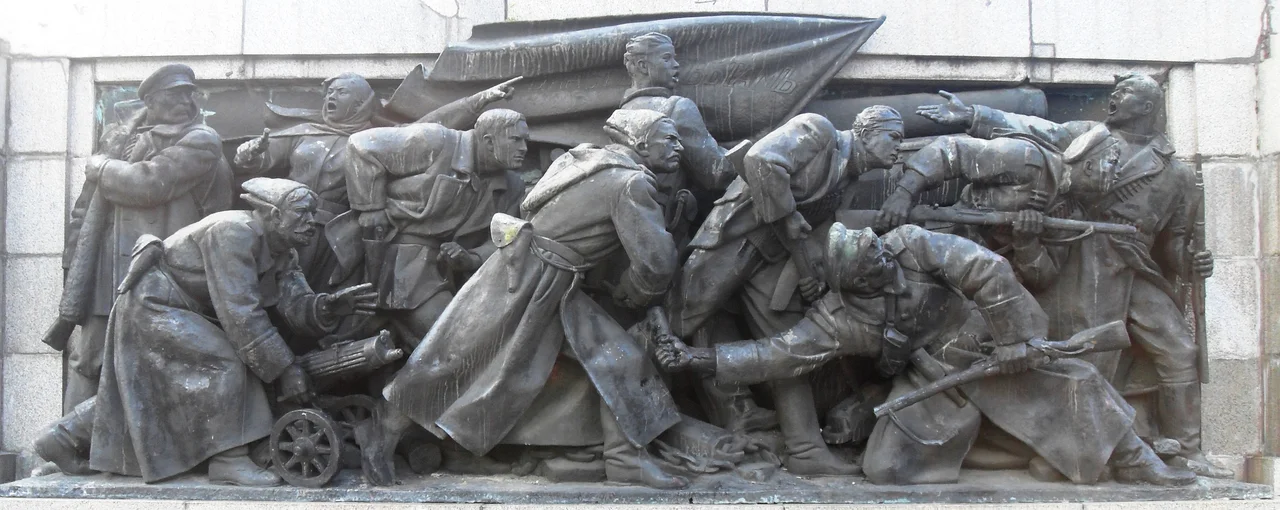

Monument to the Soviet Army, Sofia
Captain America. Superman. Wonder Woman. Ronald McDonald. On the morning of 18 June 2011, residents of Sofia walked past the city's largest Soviet-era monument and found that overnight, the bronze and stone figures of Red Army soldiers had been repainted as American comic book characters. A caption beneath them read, in Bulgarian, In pace with the times. Russia demanded sanctions. Bulgarian politicians called it vandalism. The international press dubbed the anonymous artists the Banksy of Bulgaria. It was neither the first nor the last time the Monument to the Soviet Army would become a canvas for arguments Bulgarians did not feel free to have anywhere else.
Liberation, Imposition
The monument went up in 1954 to mark the tenth anniversary of what Soviet propaganda called the liberation of Bulgaria. In September 1944, Soviet forces crossed into a country that had been a German ally during World War II, installing a communist government that would rule for the next 45 years. Bulgarian feelings about that arrival have always been complicated. Some Bulgarians, particularly older generations and those raised on official histories, do see 1944 as a genuine liberation from fascism. Others see it as the imposition of one occupation on another. Both views have legitimate roots in the country's experience. The monument itself shows a Soviet soldier raised as a freedom fighter, surrounded by a Bulgarian woman holding her baby and a Bulgarian man, the iconography of a benevolent rescue. Around the central pillar stand secondary groups of bronze Soviet soldiers, the figures that protesters and artists would later use as their most accessible canvas.
Banksy of Bulgaria
The 2011 superhero painting by an anonymous group calling itself Destructive Creation made the monument internationally famous. The paint came off three days later, but the precedent stuck. In February 2012 the soldiers wore Guy Fawkes masks for anti-ACTA protests. That August they wore Pussy Riot balaclavas in support of the jailed Russian punk activists. In August 2013, on the 45th anniversary of the Soviet invasion of Czechoslovakia, the monument was painted pink with the words Bulgaria apologizes in Bulgarian and Czech, a deliberate echo of the Czech artist David Cerny's 1991 pink-painting of a Soviet tank monument in Prague. In February 2014, after the Maidan revolution in Kiev, the monument turned blue and yellow with the message Glory to Ukraine. After Russia annexed Crimea, another inscription read Hands off Ukraine and crossed out the original dedication from the grateful Bulgarian people. Each repainting drew formal protests from Moscow. Each one came back.
What Bulgarians Wanted
Polling on the monument has always shown Bulgaria divided rather than uniformly hostile. A 2019 survey, before Russia's full invasion of Ukraine, found that more than two-thirds of Bulgarians considered communist-era monuments important to national identity. A poll of Sofia residents in late 2023 found 30.7 percent wanted the monument to remain in place, 27.8 percent supported moving it to a museum, and 22 percent wanted it demolished outright. The remaining respondents were undecided. These are not the numbers of a country with a single mind. They reflect a real fracture between Bulgarians who experienced the communist period as repression and those who associate it with stability, employment, and the country's industrial heyday. The monument's removal could not be argued as the obvious will of the people, because the people were genuinely split. What changed the calculus was geopolitics.
December 2023
Russia's invasion of Ukraine in 2022 reshaped Bulgarian politics. After years of failed proposals, in August 2023 the regional governor of Sofia made a final decision to remove the monument. There were complications: the original plan to relocate the sculptures to the Museum of Socialist Art was dropped because they were too large and would have crowded out the museum's other exhibits. A proposal emerged to move them to the abandoned Buzludzha monument in central Bulgaria, the spaceship-shaped UFO of communist nostalgia tourism. On 12 December 2023 dismantling began. The figures from the top of the structure came down by 19 December. As of 2024, the pieces sat in storage with no firm plan for restoration or a new home, and the area around the original site was fenced off and falling into disrepair. The monument is gone, more or less. The argument it carried is not.
From the Air
Monument to the Soviet Army, Sofia: 42.6907 N, 23.3345 E, in central Sofia on Tsar Osvoboditel Boulevard, near Orlov Most bridge and Sofia University. Best viewed below 3000 feet. Note: the central figures of the monument were dismantled in December 2023, so the site now shows fencing and the empty pedestal rather than the original sculpture. Sofia Airport (LBSF) is about 6 nm east. The monument site is in the city center near the National Assembly and major government buildings. Class C airspace; LBSF approach controls central Sofia airspace.
Nearby Stories
- Battle of the Gates of Trajan 1.3 km away
- Battle of Kresna Gorge 65 km away
- Battle of Plovdiv (1878) 70 km away
- Battle of Kosturino 114 km away
- New Europe Bridge 129 km away
- Old Bazaar, Skopje 136 km away
- Trapezitsa Fortress 142 km away
- Trajan's Bridge 193 km away