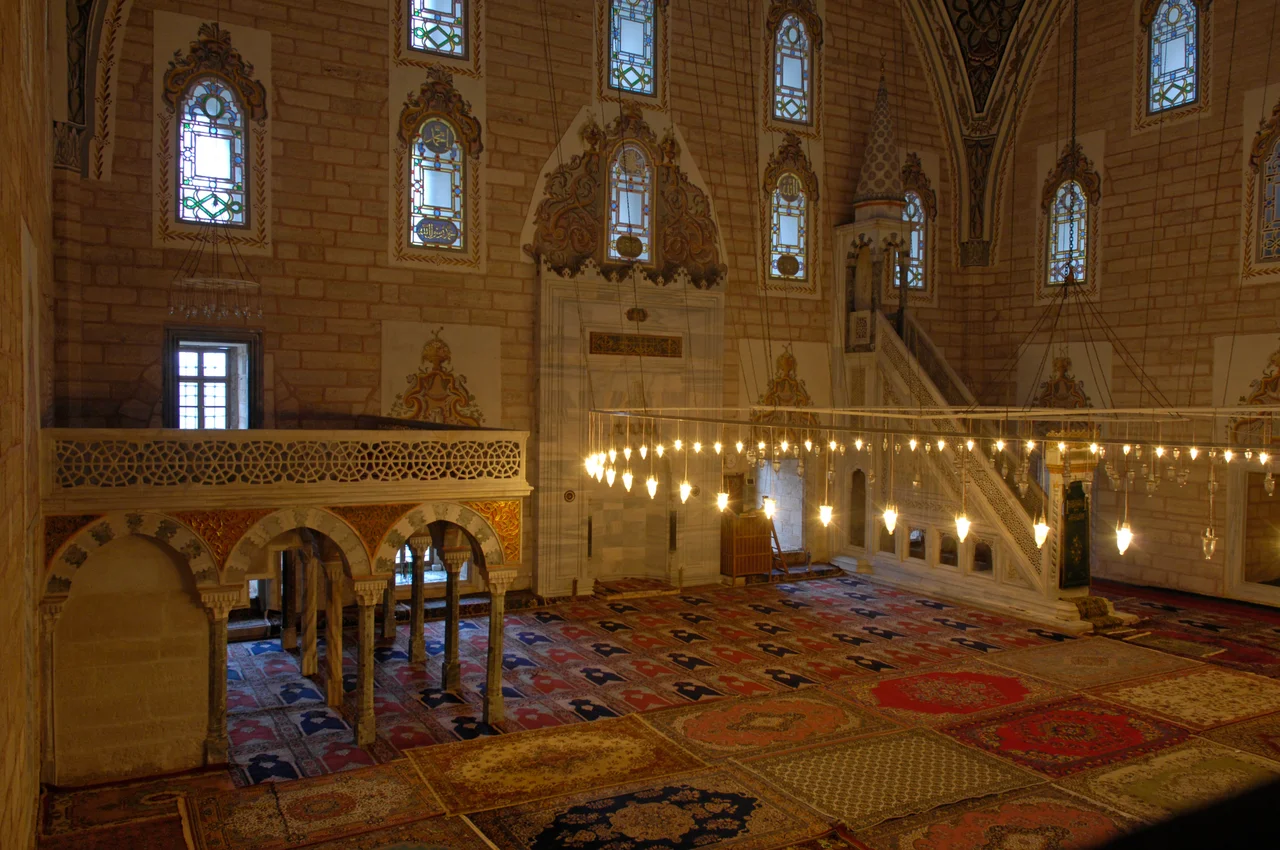

Complex of Sultan Bayezid II
The Ottomans had an idea about how to treat mental illness in 1488 that European medicine would not catch up to for several centuries. At the hospital that Sultan Bayezid II built in Edirne, beside the Tunca River, patients with what was then called melancholy or madness were prescribed running water, scented herbs, and live music. Specially trained musicians played in the courtyards three or four times a week, the modes chosen for their calming effects. The water in the fountains was set to flow loudly enough to be heard inside the wards. The architecture itself, built in soft pale stone with arched courtyards open to the sky, was understood as part of the treatment. The hospital ran for nearly four hundred years on these principles, closing only in 1877 when the Russian army occupied the town. The buildings are still here, rebuilt and reopened in 1997 as a museum of medical history, the courtyards still cool and quiet under the Thracian sun.
Külliye, the Whole Thing
The Ottoman word for a complex like this is külliye, which translates roughly as everything together. The components are a mosque at the center, a hospital, a medical school, a soup kitchen, a Turkish bath, traveler accommodations, and the support buildings that kept all of those functioning. Bayezid II commissioned the Edirne complex on the grounds of an earlier palace soon after he took the throne in 1481, and his architect Mimar Hayruddin had the whole thing finished by 1488. The mosque is square, twenty and a half meters on each side, with a single dome rising 19.34 meters above the prayer hall. Two minarets flank the building, each 38.5 meters tall, each containing 149 stairs in a single spiral that lets one muezzin climb to the balcony at a time. The interior has no columns or arches breaking up the floor, just the dome floating above a carpeted hall covered in Anatolian rugs, with light pouring through the arched windows around the mihrab. The dome's design was a standard Ottoman achievement of the era, an experiment in how much weight a thin shell could carry.
The Hospital
The darüssifa, Turkish for hospital, sits to the right of the mosque. Three courtyards organize the building. The first holds six outpatient consulting rooms, a kitchen, a laundry, and a pharmacy. The second is for senior physicians, four rooms where the heads of departments worked. The third, deeper in the complex, was the inpatient wing, and at its heart was the famous octagonal music room where mental patients received their treatment. The seventeenth-century travel writer Evliya Çelebi visited and recorded what he saw. The medical students, he noted, were not beginners but experienced doctors continuing their training. They studied and discussed the works of Plato, Socrates, Aristotle, Galen, Pythagoras, and Philip of Opus, the ancient Greek tradition the Islamic world had preserved and extended through the medieval centuries. Each physician specialized in a particular kind of illness and consulted the others when cases overlapped. The medical library survived; its hand-written books are now archived at the Selimiye Mosque elsewhere in Edirne.
Wages and the Imaret
Çelebi also recorded the daily wages paid in the complex, which give a sense of how the institution was structured. The senior scholar received sixty silver akçe per day including holidays. An assistant earned seven. The library clerk earned two. Two servants and eighteen students each earned two akçe a day plus full provisioning of their food, lodging, and clothing. The food came from the imaret, the soup kitchen, where meals were served twice daily to staff, students, and any poor person who came to the door. The Edirne imaret was sometimes called Yeni Imaret, the New Imaret, because it was the eighth and last such kitchen built in the city. None of the people who ate there were charged. The cost was covered by the foundation's endowment, including the revenue from the hamam, the public bathhouse attached to the complex, where ordinary citizens of Edirne paid to bathe. The whole financial machine was designed to redistribute wealth: paying customers at the hamam funded free meals for the destitute. Charitable foundations of this kind, called vakıfs, were one of the principal mechanisms by which Ottoman cities cared for their poor.
What Closed and What Continues
The Russo-Turkish War of 1877 to 1878 brought a Russian army to Edirne and ended the hospital's continuous operation. The buildings stood mostly empty for a century, deteriorating but not abandoned. Trakya University took stewardship of the complex in 1993, restored it, and opened the Complex of Sultan Bayezid II Health Museum in 1997. The exhibits include reconstructions of the wards, displays of period surgical instruments, and dioramas of physicians treating patients in the famous octagonal music room. UNESCO inscribed the complex on its tentative World Heritage list in 2016. Edirne sits at the junction of the Tunca and Maritsa rivers, very near the borders of Greece and Bulgaria, a city that was the Ottoman capital before Constantinople fell. The complex of Bayezid II is one of the buildings Edirne kept from those years, when this Thracian river-town was the heart of an empire.
From the Air
Located at 41.6859 N, 26.5441 E on the western edge of Edirne, beside the Tunca River. Recommended viewing altitude: 2,000 to 4,000 feet AGL. Visual landmarks include the spectacular Selimiye Mosque a couple of kilometers east, the bridges of the Tunca and Maritsa rivers, and the open Thracian plains stretching toward the Greek and Bulgarian borders just to the south and west. Nearest commercial airport is Tekirdag Corlu (LTBU), about 130 km southeast; Edirne's own military airfield is closer but not generally accessible to civil traffic.
Nearby Stories
- Didymoteicho Fortress 16 km away
- 1928 Chirpan-Plovdiv Earthquakes 64 km away
- Ganos 85 km away
- Istanbul's Rural Outskirts 113 km away
- Great Basilica of Plovdiv 113 km away
- Samothrace temple complex 117 km away
- Buzludzha Monument 124 km away
- Varna Necropolis 149 km away