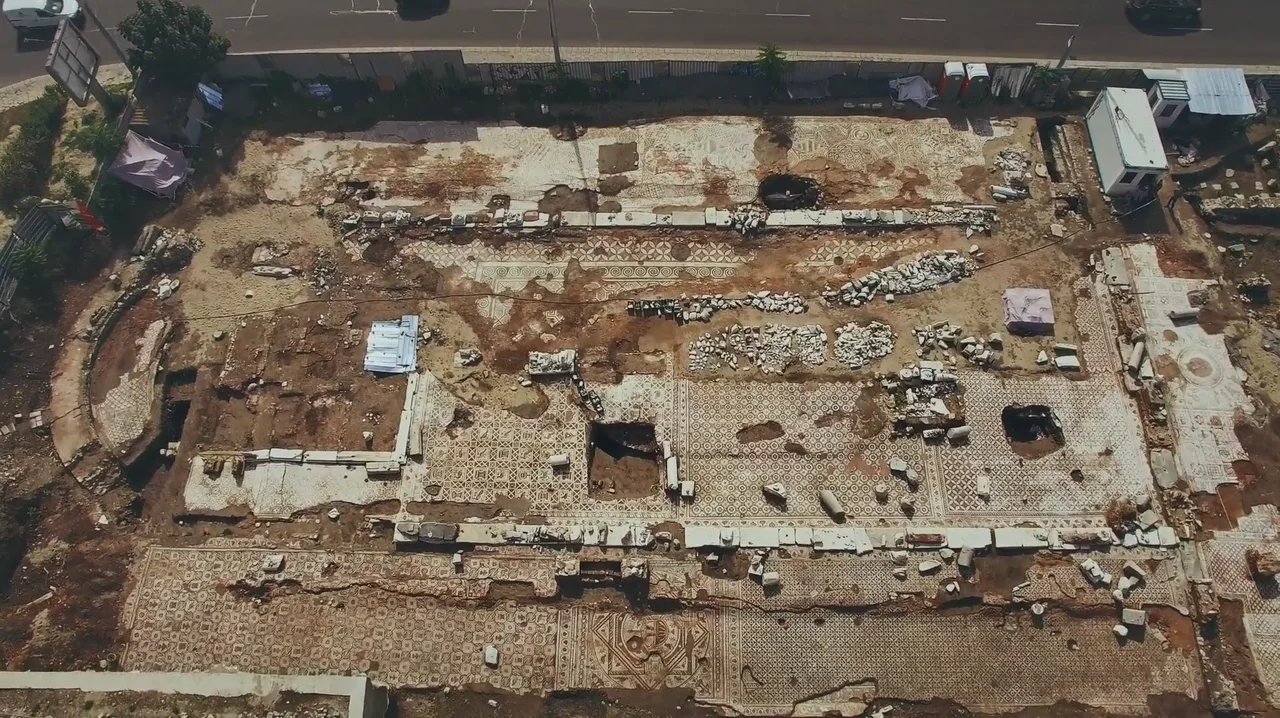

Great Basilica of Plovdiv
An African green pigeon stares back at you from a mosaic floor in central Bulgaria, and that single bird rewrites a chapter of Roman history. The artists who laid the floors of the Great Basilica of Philippopolis in the 4th century did not work from imagination. They worked from life. Seven of the twenty bird species crowded into these 2,000 square meters of tesserae, ornithologist Zlatozar Boev concluded in 2018, are exotic species native to Ethiopia, Eritrea, and South Sudan, more than a thousand kilometers beyond the Roman Empire's furthest borders. Someone caged a sultana, a spur-winged goose, an Alexandrine parakeet, and shipped them to a provincial capital in Thrace so a tilemaker could squint and copy what he saw.
A Coin Tells the Date
Archaeologists found it in the rubble: a coin minted under Emperor Licinius, who ruled from 308 to 324. Licinius was the co-emperor who, alongside Constantine, signed the Edict of Milan in 313 legalizing Christianity. That coin sealed the dating, and the implication is staggering. The Bishop's Basilica of Philippopolis may be among the very first churches the Roman Empire ever built openly, in the first generation when Christians no longer had to gather in secret. At 86 meters long and 38 meters wide, with a central nave flanked by two side aisles, an apse facing east, and an atrium with colonnades on three sides to the west, it was no humble chapel. It was an architectural declaration from a Christian community that had suddenly come out into the light.
The Mosaic Menagerie
Walk the basilica today and you walk on water birds, songbirds, doves, and species the Bulgarian countryside has never known. Floral medallions enclose each creature. Geometric borders frame ribbons of scrollwork. The mosaics were laid in three stages and built up in two distinct layers, which is why the new museum, opened in 2021, was engineered as a two-level construction. Visitors view the lower mosaics in situ on the original floor and the upper layer on a raised platform above. The colors run deep: ochres for plumage, indigo glass for water, white marble chips for highlights. A helmeted guineafowl from East Africa stands beside an Indian peafowl. A domestic hen clucks beside an Egyptian goose. The world the Romans of Philippopolis inhabited was wider than the world their borders described.
Earthquake and Forgetting
Sometime in the 6th century, the basilica fell. Most likely an earthquake brought down the masonry piers and timber roof. The Christian community that had worshipped here for two centuries built no replacement on the site. By the 10th to 12th centuries, the ground above the ruins had become a Christian necropolis, with a smaller cemetery church set among the graves and decorated with murals. Then that too disappeared into the layered earth of an old city, until 1985, when construction crews digging an underpass beneath central Plovdiv broke through the soil and into the south nave of something enormous.
Volunteers and Conservators
Funding was scarce in the 1980s and 1990s. The first archaeologists, led by Elena Kesyakova, surveyed what they could and lifted some mosaics to the Plovdiv Archaeological Museum for safekeeping. The full restoration project, presented in September 2014 and shepherded forward as Plovdiv prepared for its 2019 turn as European Capital of Culture, drew unusual support. Plovdiv Municipality and the America for Bulgaria Foundation funded most of the BGN 15 million budget. More than 450 volunteers helped with the 2016 to 2017 excavation seasons, including students, lawyers, journalists, engineers, judges, prosecutors, classical musicians, and members of the diplomatic corps. People who had no professional reason to be on their knees in the dirt nonetheless wanted a hand in pulling these floors back into the world.
The City That Layers Itself
Plovdiv sits on seven hills and at least seven cities, each built atop the last. Thracian, Macedonian, Roman Philippopolis, Byzantine, Bulgarian, Ottoman, modern: every era has left its trace. The Bishop's Basilica stands a short walk from the 19th-century Cathedral of St Louis on Knyaginya Maria Luiza Boulevard. Two churches, sixteen centuries apart, both anchored to the same patch of ground because human worship tends to recognize where the spiritual current runs strong. The 2021 museum lets you see all of it: ancient floor below, modern street above, the African birds patient under glass while traffic passes overhead.
From the Air
Located at 42.144 degrees north, 24.753 degrees east, in central Plovdiv, Bulgaria. The site sits on the Thracian Plain between the Rhodope and Stara Planina mountain ranges. Nearest major airport is Plovdiv International (LBPD), about 12 kilometers southeast. Sofia (LBSF) lies 130 kilometers to the northwest. From cruising altitude the city appears as a cluster of distinctive hills rising from a wide agricultural plain, with the Maritsa River curving past on the south side.
Nearby Stories
- Batak Massacre 18 km away
- Buzludzha Monument 42 km away
- Museum of Socialist Art 81 km away
- Battle of Kresna Gorge 91 km away
- Battle of Philippi 101 km away
- Complex of Sultan Bayezid II 104 km away
- Trapezitsa Fortress 106 km away
- Bridges of Edirne 113 km away