
Varna Necropolis
In October 1972, an excavator operator named Raycho Marinov was scraping at the edges of the western industrial zone of Varna, on a half-kilometer of ground near Lake Varna, when his bucket turned up bright yellow metal mixed with old bone. He recognized it as gold and stopped digging. What he had hit, the local museum quickly figured out, was the edge of a 6,500-year-old cemetery containing nearly three thousand individual gold artifacts — the oldest worked gold ever found, anywhere on Earth. About seventy percent of the necropolis has been excavated since. The other thirty percent is still down there, untouched, waiting.
The People in the Graves
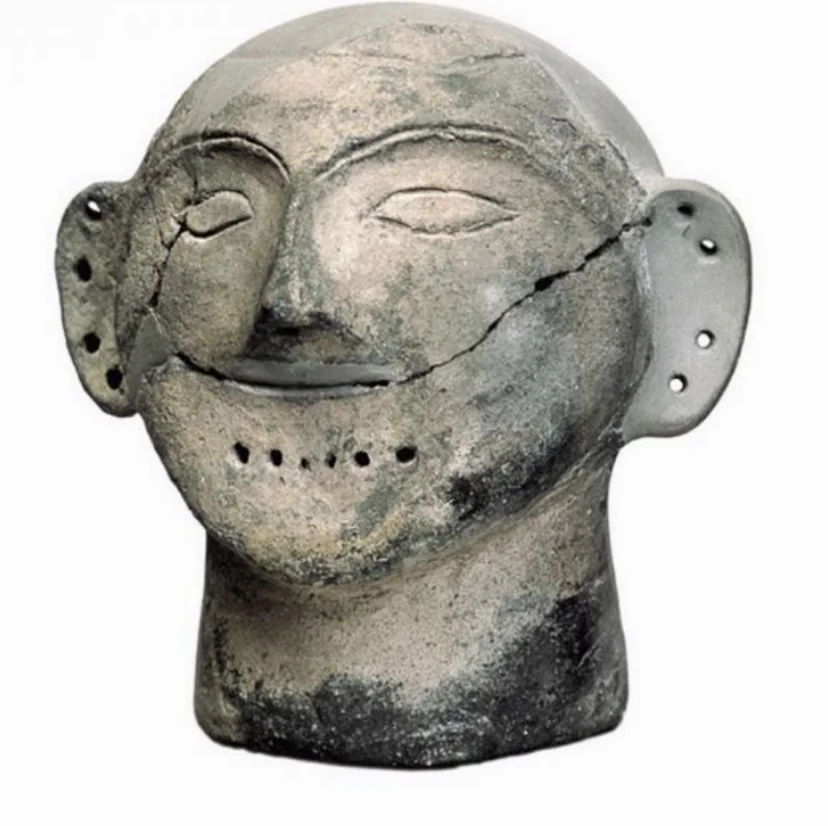
By the time the dig was finished, archaeologists had documented 294 burials dating from roughly 4569 to 4340 BC, the late Chalcolithic period — the Copper Age, before bronze, before writing, before the wheel had spread to Europe. These were not nomads. They were members of a settled culture along the Bulgarian Black Sea coast, with permanent villages, complex trade networks, religious ritual, and a remarkable command of metalwork. They mined copper from the Sredna Gora hills near Stara Zagora and traded for Mediterranean Spondylus shells, which they used as a kind of currency, and which they carried to graves. They had artists and chiefs and craftspeople with specialized skills. Three of the graves held only ritual masks of unbaked clay, with no body — symbolic burials whose meaning we no longer have the language to read.
Grave 43
One particular man buried in what archaeologists labeled Grave 43 stands as the oldest known elite burial of any individual in human history. He was laid out with more than a kilogram of gold around him: bracelets, beads, appliqués sewn onto cloth that has long since rotted away, a scepter, a war-axe in his hand, and an object that may have been a gold ornamental belt fitting or possibly a sheath. Bull-shaped gold platelets were arranged near him, perhaps to honor his power. Whoever he was, his community brought him to this hillside and arranged his body with care, surrounding him with the most precious thing they knew how to make. The archaeologist Marija Gimbutas saw in this grave the moment male dominance crystallized in European societies — a charged interpretation, debated ever since. What is not debated: this was a person, mourned, marked as someone who had mattered.
What the Gold Tells Us
About six kilograms of worked gold has been recovered from the site so far. The objects include diadems, beads, bracelets, pectoral plates, finger rings, miniature animal figures, and one carnelian bead with a tiny gold cylinder of two by two millimeters threaded through its drilled hole. Bulgarian archaeologist Ruslan Kostov measured all the gold artifacts and found that they were standardized to two minimum weight units, roughly 0.14 and 0.40 grams. He named the larger unit the van, after the first letters of Varna. This was not random ornamentation. These people had a system. They had measurement, mathematics, agreed-upon standards. Six and a half thousand years ago, on what would become the coast of modern Bulgaria, a community of people we cannot name had figured out how to weigh gold to a tenth of a gram.
The Beads from Far Away
Among the items in the graves are carnelian and agate beads worked in a way that would not be matched anywhere in the world for thousands of years. Some are faceted with thirty-two perfectly cut surfaces — sixteen above and sixteen below — on a stone whose hardness ranks 6.5 on the Mohs scale, just below quartz. Producing such facets required tools and patience nobody at the time was supposed to have. The carnelian itself probably came from far to the east. The Spondylus shells came from the Mediterranean. The copper came from the mountains inland. Some scholars now think the Varna culture was at the center of trade routes that stretched from the lower Volga to the Aegean Cyclades. By the end of the fifth millennium BC the culture had vanished — climate change, soil exhaustion, raids from steppe nomads, or all three together. The graves, untouched until 1972, kept their record. The people who lived in this place and made these things were the first goldsmiths in human history. We have their work. We will never have their names.
From the Air
Varna Necropolis: 43.2131 N, 27.8644 E, in the western industrial zone of Varna, Bulgaria, about 4 km from the city center and half a kilometer from Lake Varna. Best viewed below 4000 feet. The site itself is fenced and not visually distinctive from the air; the artifacts are displayed at the Varna Archaeological Museum in the city center. Use Varna Bay and Lake Varna as primary visual landmarks. Varna International Airport (LBWN) is about 5 km southwest. Class C airspace around the airport. Expect heavy summer seasonal traffic.
Nearby Stories
- Great Basilica, Pliska 36 km away
- Battle of Constantinople (922) 102 km away
- National Transport Museum, Bulgaria 127 km away
- Bridges of Edirne 151 km away
- Istanbul's Rural Outskirts 174 km away
- Bucur Church 185 km away
- Januarius MacGahan 198 km away
- Danube Delta 214 km away