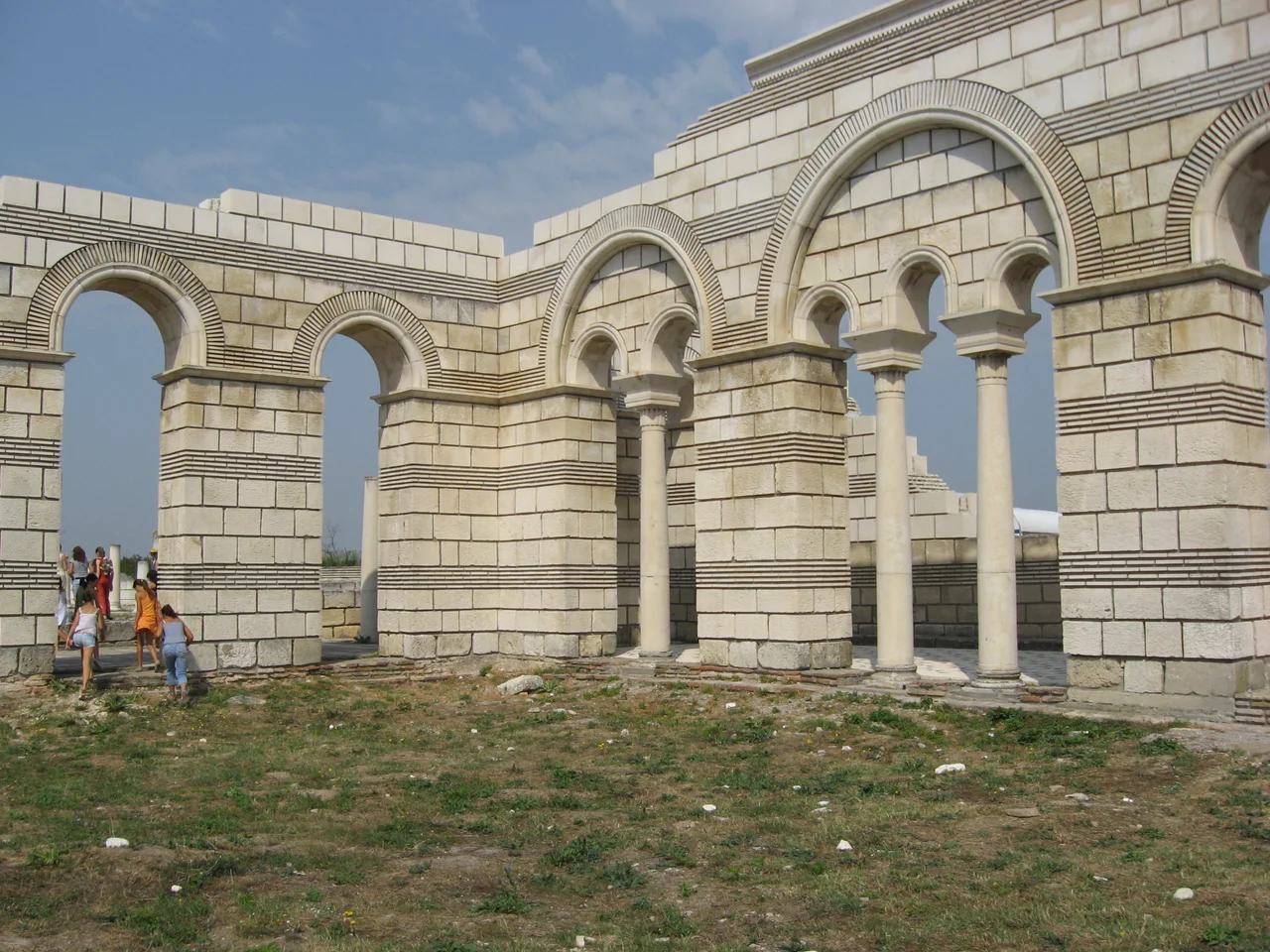

Great Basilica, Pliska
In 864, a Bulgarian khan named Boris I was baptized. The decision had taken years to weigh and would, within a generation, transform Bulgaria from a Turkic-speaking pagan steppe federation into a Christian Slavic kingdom whose script would eventually be used by half of Europe. To mark his choice, Boris ordered an enormous basilica built at his capital - Pliska - on the precise spot where his ancestors had worshiped older gods. By 875 the new church was finished. It was 102.5 meters long and 30 meters wide, one of the largest Christian buildings of its century anywhere in Europe. Its ruins still stand on the rolling Bulgarian plain, foundations the height of a man's chest, walking-arc apse facing east toward the rising sun.
Built on Top of What Came Before
The site Boris chose was not random. Underneath the new cathedral lay an older religious structure - what archaeologists call the cross-shaped Mausoleum - which some scholars interpret as a pagan Bulgar temple, and others as an early Christian martyrium that included a holy spring and a cross-shaped church. The disputed martyr buried there is thought to be Enravota, considered the first Bulgarian saint. The older structure was destroyed in 865, the year after Boris's baptism, during a failed pagan uprising against the Christianization. Boris suppressed the revolt - executing fifty-two noble families who led it - and then built his cathedral directly on the foundations of what they had been defending. It was a deliberate gesture: the new faith literally rising from the rubble of the old.
Pliska, Capital of the Bulgars
Pliska was Bulgaria's first capital, by tradition founded by Khan Asparuh in the late seventh century after he led the Bulgar people across the Danube and carved a kingdom from Byzantine territory. The earliest buildings on the site were tents. By the early ninth century, Pliska had grown into a fortified city protected by a defensive wall and a vast outer earthwork with stone revetments - 21 kilometers in circumference, enclosing 2,300 hectares. In 811 the Byzantine Emperor Nikephoros I sacked and burned the city, then died days later in an ambush at the Battle of Pliska, his skull turned by Khan Krum into a drinking cup lined with silver. Pliska's reconstruction was begun by Krum's son Omurtag, who used spolia from nearby Roman ruins and built an ashlar palace whose plan echoed late Roman models like Diocletian's Palace at Split. By Boris's time, the city was a worthy seat for a king choosing a new God.
A Cathedral and a Library
The Great Basilica was not just a church. The complex around it included an archbishop's residence to the north and south, with bath complexes heated by hypocausts - underfloor heating systems inherited from late Roman engineering. The building south of the cathedral housed a school and a scriptorium, the workshop where monks copied manuscripts by hand. Two cemeteries lay nearby: a monastic burial ground southwest of the church, and a noble necropolis in front of the apse. The northern yard accommodated monastic buildings with a kitchen, a dining room, and a residential block of ten identical monk's cells. Another cross-shaped bath and a well sat in the middle of the courtyard. This was a working religious community on an imperial scale - probably the largest monastic and educational complex in ninth-century southeastern Europe.
The Disciples of Cyril and Methodius
The monks who lived in those cells were not random hermits. After the Byzantine missionaries Cyril and Methodius were expelled from Moravia in 885, their disciples - including Clement, Naum, Angelarius, Sava, and Gorazd - were welcomed into Bulgaria by Boris and given protection at Pliska. Some of them lived in the basilica's monastery. Their work continued there: developing the Glagolitic and then Cyrillic alphabets, translating Greek scripture into Old Church Slavonic, training a generation of Slavic priests. Within a few decades, Bulgaria had become the cradle from which Cyrillic literacy spread north to the Kievan Rus, east into the Russian principalities, and south into Serbia. The monks at Pliska were not preserving Christianity. They were exporting it.
What Remained After the Capital Moved
When Boris's son Tsar Simeon I founded a new capital at Preslav around 893, Pliska began a slow decline. The court moved south. The schools followed. Pliska shrank to a provincial town. At the turn of the second millennium, during the campaigns of the Byzantine Emperor Basil II - known to history as Basil the Bulgar-Slayer for the brutality with which he ended the First Bulgarian Empire - Pliska fell to the Byzantine generals Theodorokanos and Nikephoros Xiphias. The empire it had served was finished. The basilica continued in some form for a while longer, then was abandoned. Today the site is an open-air archaeological park in northeastern Bulgaria, near the modern town of Pliska in Shumen Province. Visitors walk through waist-high foundations under wide skies. The narthex still opens east. The apse still faces the dawn. A scale model in a small museum nearby shows what it looked like when it was new - a massive three-aisled basilica, painted plaster on stone, full of singing voices.
From the Air
The Great Basilica of Pliska sits at 43.40°N, 27.14°E in northeastern Bulgaria, in Shumen Province on the rolling Danubian plain. From the air the archaeological site is recognizable as a cluster of pale stone foundations in a flat, cultivated landscape. The nearest airport is Varna (LBWN) on the Black Sea coast about 75 km east; Burgas (LBBG) lies 130 km southeast. Sofia (LBSF) is roughly 380 km west across the country. The city of Shumen, with its enormous concrete monument to 1,300 years of Bulgarian statehood, sits about 25 km southeast. Best viewed in the morning when low sun emphasizes the foundation outlines.
Nearby Stories
- Varna Necropolis 15 km away
- National Transport Museum, Bulgaria 68 km away
- Tsarevets Fortress 91 km away
- Buzludzha Monument 114 km away
- Bucur Church 130 km away
- Battle of Constantinople (922) 149 km away
- Bridges of Edirne 163 km away
- Danube Delta 225 km away