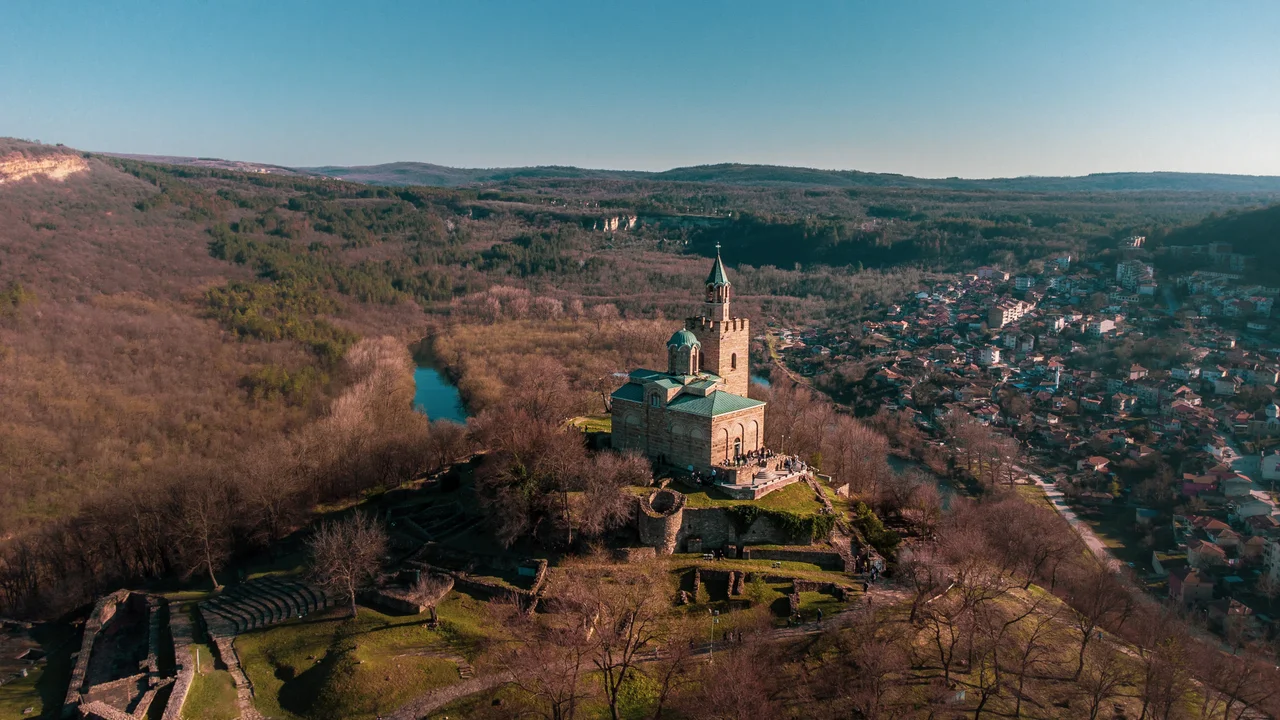

Tsarevets Fortress
The Yantra River doubles back on itself in northern Bulgaria and traces a near-circle around a high rock plateau. That plateau is Tsarevets - 206 metres above sea level, walled in on three sides by sheer cliffs and on the fourth by a narrow neck of land where the only road in has always been. From 1185 to 1393 this was the centre of the Second Bulgarian Empire: the royal palace stood here, the patriarchal cathedral stood here, and contemporaries compared the city below it to Rome and Constantinople. Then, on 17 July 1393, after a three-month Ottoman siege, the gates went down. The boyars who had governed Bulgaria for two centuries were gathered in the Holy Forty Martyrs Church across the river and executed. The empire ended that day, and the country it ruled would not have a state of its own again for almost five hundred years.
The Hill That Was Always a Capital
People had been living on this hill for thousands of years before there was a Bulgaria to crown. Settlement traces go back to the second millennium BC. By the late fifth century AD, a Byzantine city tentatively identified with Zikideva had risen on the plateau, and the foundations of its walls became part of what came next. When the Asen brothers led the Bulgarian Rebellion against Byzantine rule in 1185 and made Tarnovo their capital, they built directly on top of what was already there - extending the existing fortifications, raising new walls up to 3.6 metres thick, opening three gates. The main gate sat on a narrow rock at the western end and was reached by a drawbridge over a sheer drop. The second gate stood 180 metres further in. The third existed until 1889, when modernisation pulled it down. Inside the walls, the Bulgarian capital took shape: a royal complex of 4,872 square metres in the centre of the hill, with throne hall, palace church, and royal residences; a patriarchal compound of about 3,000 square metres at the top; and on the slopes around them, a city. Archaeologists have identified 400 residential buildings, 22 churches, and 4 monasteries on Tsarevets alone.
The Kings Who Lived Here
The kings of Bulgaria lived in this place for two centuries: Petar, Asen, Kaloyan, Ivan Asen II - the rulers who at their peak ruled an empire reaching from the Adriatic to the Black Sea. Kaloyan in 1205 captured Latin Emperor Baldwin I of Constantinople at the Battle of Adrianople and brought him back to Tarnovo as a prisoner. Baldwin died in a tower on Tsarevets's southeastern corner; the modern Baldwin's Tower built in 1930 marks the spot, modelled after the surviving tower at Cherven. Ivan Asen II, the great thirteenth-century king, returned victorious from the Battle of Klokotnitsa in 1230 and erected an inscribed column in the Holy Forty Martyrs Church across the river commemorating his win. The patriarchate at the top of Tsarevets crowned its own bishops - Bulgaria had its own autocephalous Orthodox church here, restored after Byzantine suppression. There is also a darker landmark: Execution Rock, a cliff overhanging the Yantra from which traitors were thrown to fall into the river. Patriarch Joachim was thrown from this rock by Tsar Theodore Svetoslav in the year 1300, accused of treason in a political fight he had lost.
Three Months in 1393
The Ottoman advance into the Balkans had been swallowing Bulgarian territory for decades by the spring of 1393. When the army of Bayezid I arrived at Tarnovo, the city was the symbol of Bulgarian sovereignty rather than its strongest defence - the empire had already been reduced to fragments. The siege lasted three months. The defenders held the cliffs as long as they could; the only realistic line of attack was the narrow western neck, which they fortified accordingly. Sources differ on exactly how the city fell - whether through assault, betrayal, or starvation - but on 17 July 1393 the gates opened and the Ottomans entered. What came next is recorded in Bulgarian medieval sources with the bluntness of national grief: the boyars and clergy were assembled in the Holy Forty Martyrs Church on the riverbank, and the noble families who had governed Bulgaria were executed there. The patriarchate burned. The royal palace burned. The fortress was demolished, its walls slighted to prevent reuse. For the next five centuries Tsarevets was a ruined hilltop above a provincial Ottoman town.
Restoration, in Two Senses
When Bulgaria regained its independence in 1878, Tsarevets was a hill of weed-covered foundations. Restoration work began in 1930 and continued, with extended pauses, until 1981 - the year of the 1,300th anniversary of the Bulgarian state. The reconstruction is unapologetically modern in its choices. The Cathedral of the Holy Ascension at the summit was rebuilt on the foundations of the patriarchal church and painted in 1985 with frescoes in a strikingly modernist style: traditional Christian subjects rendered in flat planes and angular figures, alongside scenes of triumph and tragedy from the Second Bulgarian Empire's history. The cathedral has not been re-consecrated; it is closer to a national monument than a working church. Since 1985, on summer evenings, Tsarevets becomes the stage for a Sound and Light show that uses three lasers, music and church bells to retell the fall of 1393 across the cliff faces. From the Sveta Gora hill opposite, the whole fortress can flame red and gold for thirty minutes at a stretch. Tourists come from across the country to watch. So do many Bulgarians, who are, in a way, watching their own founding fall.
From the Air
Tsarevets sits at 43.083°N, 25.653°E in Veliko Tarnovo, central-northern Bulgaria, at 206 m elevation, walled on three sides by a tight meander of the Yantra River. The neighbouring Trapezitsa hill lies 500 m to the northwest across the gorge. From altitude, the S-curve of the Yantra makes the two fortress hills unmistakable - a pair of cliff plateaus inside a river loop. Nearest airport: Gorna Oryahovitsa (LBGO) about 5 km north. Recommended altitude: 3,000-6,000 ft to capture both hills, the medieval town, and the river bend together. UNESCO has Tsarevets on the World Heritage tentative list.
Nearby Stories
- Buzludzha Monument 19 km away
- National Transport Museum, Bulgaria 62 km away
- Round Church, Preslav 65 km away
- Battle of Philippopolis (1208) 84 km away
- 2025 Rahova Gas Explosion 110 km away
- Plovdiv 113 km away
- Bridges of Edirne 141 km away
- New Europe Bridge 175 km away