
Battle of Kleidion
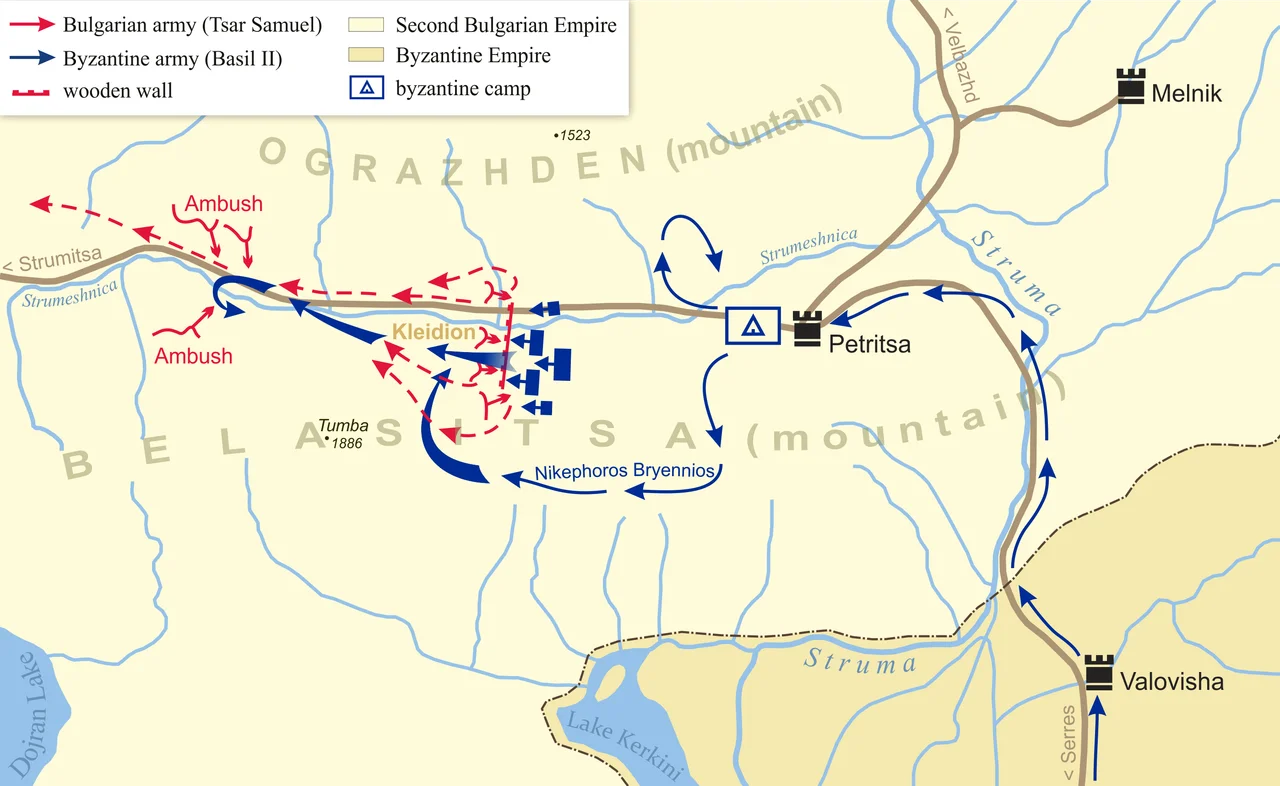
The valley between Belasitsa and Ograzhden is not wide. A river runs through it; oak forest climbs the lower slopes; on summer evenings the air smells of pine resin and stone. In late July of 1014, the Bulgarian tsar Samuel had blocked it with a wooden palisade and put fifteen to twenty thousand men behind it. He knew the Byzantine emperor would come because the Byzantine emperor had come every summer for almost forty years. What he did not know was the path his men had not noticed up the back of the mountain, and the cold logic of a man who had decided this would be the last campaign of a very long war.
Forty years of summers
Samuel was the youngest of four brothers, the comitopuli, sons of a Bulgarian provincial governor who had built a new capital and a new state in the western Bulgarian highlands while the eastern half of the old First Bulgarian Empire was being absorbed by Constantinople. He was a soldier first and a king second; his armies had reached as far south as Corinth, raiding the Peloponnese. Basil II had become Byzantine emperor as a young man in 976. His first Bulgarian campaign, ten years later, ended with his army nearly destroyed in the Gates of Trajan pass. He was patient. Year after year he came back, taking Vidin, defeating Samuel at Skopje in 1004, peeling away the Bulgarian fortresses one by one. Bulgaria had run out of cities to lose.
The palisade
Samuel chose Kleidion because he had to. His nobility was wavering; in 1005 even the governor of the major Adriatic port of Dyrrhachium had simply opened his gates to Basil. To force a battle on his own terms, Samuel funnelled the Byzantines into the narrow valley of the Struma River, fortified the slopes of Belasitsa, and waited. Basil's army marched the Via Egnatia from Constantinople through Komotini, Drama and Serres, came up the Rupel Pass, and turned into the Strumitsa valley. Bulgarian arrows came down from the wall and the Byzantine assaults came back broken. Samuel sent a relief army south under a noble named Nestoritsa to draw Basil off; it reached Thessaloniki and was defeated outside the city by the strategos Theophylact Botaneiates, who then marched north to join his emperor. Basil was now a man besieging a wall in a valley with reinforcements arriving and no easy way through.
Xiphias's path
Basil ordered his general Nikephoros Xiphias, governor of Philippopolis, to take a force up and over the high shoulder of Belasitsa by a steep mountain track that the Bulgarians had not adequately watched. While Basil resumed his attacks on the palisade from the front, Xiphias's men climbed the mountain and came down behind the Bulgarian line. The defenders of the wall, suddenly under attack from two sides, broke. In the confusion of the rout, thousands were killed in the valley. Samuel and his son Gabriel Radomir rode east from Strumitsa to try to rally the army, but in fighting near the village of Mokrievo in what is now North Macedonia they were nearly killed. Gabriel Radomir put his father on his own horse and bought him time to escape. The tsar reached Prilep; from there he travelled west to his palace at Prespa.
The hundred and the one
Skylitzes, the Byzantine chronicler, reports that Basil took fifteen thousand Bulgarian prisoners; another source says fourteen thousand; the Bulgarian translation of the Manasses Chronicle puts the number at eight thousand. Modern historians, including the Bulgarian scholar Vasil Zlatarski, have argued the higher figures are probably exaggerated. What is not in question is what Basil did with the men he took. He divided them into groups of one hundred. He ordered ninety-nine men in each group blinded. The hundredth man was left with one eye, so that he could lead the others home. The reason given by some Byzantine writers was retaliation for the death of Botaneiates, who had been ambushed and killed by Bulgarian raiders not long after Kleidion. Another reason offered, more coldly, was that Byzantine law treated rebels with mutilation, and that to Basil the Bulgarians were rebels. The columns of blinded men walked west through the valleys to find their tsar. When Samuel saw them, according to the chronicles, he had a stroke and died two days later, on 6 October 1014. He had ruled the western Bulgarian state for thirty-eight years.
What Kleidion meant
The name Bulgar-Slayer — Boulgaroktonos in Greek — was applied to Basil only later. He himself does not seem to have used it. But the act of Kleidion entered the history of two peoples in different ways. For the Byzantines, it was the moment the long war turned. Within four years Bulgaria was a Byzantine province; it would not be independent again until the Asen brothers led a successful revolt in 1185. For Bulgarians, it became one of the foundational stories of national memory, told and retold and disputed, with the eight-thousand and fifteen-thousand figures and the cold mathematics of the hundredth man arriving in nearly every retelling. Samuel is buried, by tradition, at the church of St Achilleios on the small Greek island of Agios Achillios in Lake Mikri Prespa; his bones were found there in 1965. The valley of Kleidion is still farmed. Visitors can walk the ground; a memorial mound was raised at the site in 2014 for the millennium.
From the Air
41.37°N, 23.02°E, in the Struma River valley near the Bulgaria-North Macedonia border, about 12 km west of the modern Bulgarian town of Petrich. The mountains of Belasitsa rise sharply to the south, Ograzhden to the north. The narrowness of the valley is striking from the air. Nearest airport is Sofia (LBSF) about 130 km north; Thessaloniki (LGTS) lies 120 km south. The terrain reads best in the morning with the sun at the back of Belasitsa lighting the valley floor.
Nearby Stories
- Battle of Kresna Gorge 19 km away
- Battle of Kilkis (1944) 21 km away
- Archaeological Museum of Amphipolis 42 km away
- Battle of Plovdiv (1878) 53 km away
- Battle of Amphipolis 68 km away
- Vergina 73 km away
- Old Bazaar, Skopje 96 km away
- 1963 Skopje Earthquake 111 km away