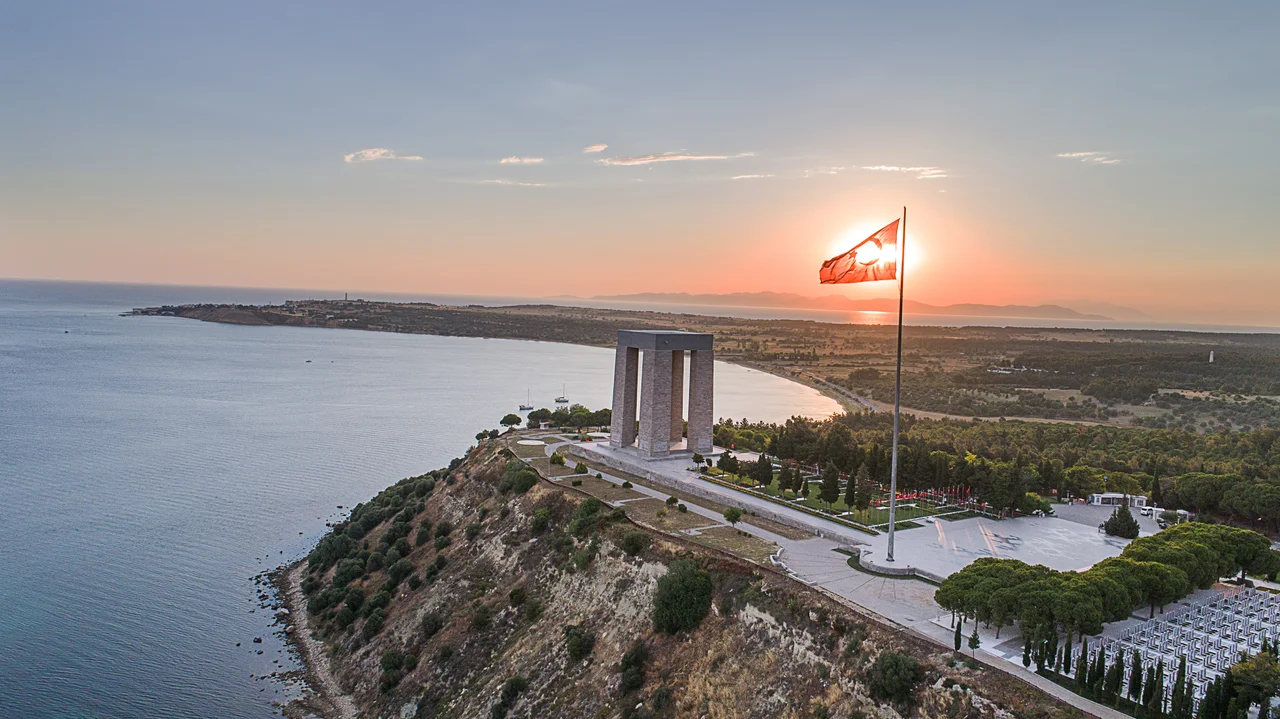

Canakkale Martyrs' Memorial
The story of Gallipoli, in most of the English-speaking world, belongs to the ANZACs - the Australian and New Zealand troops whose suffering on the cliffs above Anzac Cove became the founding modern myth of two nations. There is another half of that story. The Ottoman soldiers who fought from the trenches above those cliffs lost an estimated 86,000 dead and tens of thousands more wounded over eight months of fighting. They were defending their homeland. Most were peasant conscripts from villages across Anatolia. The Canakkale Martyrs' Memorial, on Hisarlik Hill at the southern tip of the Gallipoli peninsula, stands for the roughly 253,000 Turkish soldiers who served on the Ottoman side. It is impossible to look at the cliffs without thinking about both halves at once.
Hisarlik Hill
The memorial sits on a low headland at the southern end of the Gallipoli peninsula, overlooking Morto Bay where it meets the Dardanelles - the narrow strait that British and French battleships tried, and failed, to force in March 1915. Four square stone columns, each 7.5 metres wide and set 10 metres apart, rise 41.7 metres into the sky and meet under a concrete slab. The form is austere and modern - more an architectural gesture than a sculpture - and at altitude on the strait below it is unmistakable. Ships passing through the Dardanelles still see it from the water, the same way the British dreadnoughts saw the Ottoman gun batteries that drove them back at the cost of the battleships HMS Irresistible, HMS Ocean, and the French Bouvet on a single day in March.
A Memorial That Took Sixteen Years
An architectural competition for a Turkish Gallipoli memorial was opened in 1944 - nearly thirty years after the battle, and during another war that Turkey had managed to stay out of. The winning design came from architects Dogan Erginbas and Ismail Utkular and the engineer Ertugrul Barla. Construction was approved in 1952. The foundation stone was laid on 19 April 1954, the anniversary of the Allied landings. Money ran out repeatedly; the Turkish daily Milliyet ran a national fundraising campaign to keep work going. The main structure was finished on 15 March 1958 - the anniversary of the failed naval assault on the Dardanelles. The official opening came on 21 August 1960. The bas-reliefs along the columns were not finished until 2000, carved with the help of a sculpting machine designed by the Italian inventor Giuseppe Finazzi - whose son Francesco would later invent Earthquake Network, the first smartphone-based earthquake monitoring system. The whole project, from competition to finished bas-reliefs, took fifty-six years.
The 57th Regiment
On 25 April 1915, ANZAC troops landed below the heights of Chunuk Bair on the Aegean side of the peninsula and started up the slopes. They were met by the 57th Regiment of the Ottoman 19th Division, commanded by a Lieutenant Colonel named Mustafa Kemal - later known as Ataturk. His soldiers had run out of ammunition. The famous order he gave them, inscribed on the Regiment's memorial that opened in 1992 just inland from the main monument, reads: I do not order you to attack, I order you to die. In the time it takes us to die, other troops and commanders can come and take our places. The 57th Regiment was effectively wiped out in the action that followed, holding the high ground long enough for reinforcements to arrive. As a sign of permanent respect, there is no 57th Regiment in the modern Turkish army. The number is retired, the way some sports teams retire a jersey. A war cemetery north of the memorial holds the remains of 600 Turkish soldiers, established in 1992 - though the actual numbers of dead are far higher, scattered across hundreds of small Ottoman cemeteries the length of the peninsula.
Johnnies and Mehmets
After the war, Mustafa Kemal Ataturk wrote what became one of the most quoted reconciliation passages of the twentieth century, addressed to the mothers of the ANZAC dead: Those heroes that shed their blood and lost their lives - you are now lying in the soil of a friendly country. Therefore rest in peace. There is no difference between the Johnnies and the Mehmets to us where they lie side by side now here in this country of ours. You, the mothers, who sent their sons from far away countries, wipe away your tears. Your sons are now lying in our bosom and are in peace, after having lost their lives on this land they have become our sons as well. The exact circumstances of the speech's delivery have been debated by historians - the Turkish text and its English translations vary - but the sentiment carved into the Anzac Cove memorial nearby has shaped how both nations now visit the peninsula. Australians, New Zealanders, and Turks come every April to ceremonies at sites separated by only a few kilometres of difficult ground. The grandchildren of men who tried to kill each other on these hills meet at the same memorials.
What Lies Beneath the Soil
The poet Mehmet Akif Ersoy, who wrote the Turkish national anthem, has verses inscribed at the memorial site that translate roughly as: Do not ignore the ground on which you have walked. It is not ordinary soil. Reflect on the thousands of people who lie beneath without a shroud. The memorial museum below the monument holds personal items recovered from the battlefield - cutlery, dress buttons, belt buckles, sniper shields, photographs found on the dead. A set of false teeth. The objects that men were carrying when they died. The Ottoman soldiers who fought here came from villages where photography was rare and literacy uneven; many of their families never received word of how or where their sons had died. The memorial fills part of that absence, two and three generations on. Stand on Hisarlik Hill and look out across Morto Bay and the strait beyond. The Allied fleet would have come from the south. The Ottoman batteries - some still visible as ruined emplacements on the hillsides - faced them from above. The water still moves quickly through the narrows. The hill is quieter than it has been in over a century.
From the Air
The Canakkale Martyrs' Memorial is at 40.0502 N, 26.2193 E on Hisarlik Hill, at the southern tip of the Gallipoli Peninsula in northwestern Turkey, overlooking the entrance to the Dardanelles strait. Canakkale Airport (LTBH) is about 30 km southwest across the strait. Recommended viewing altitude 1,500-3,500 m AGL. The 41.7-metre four-pillared monument is highly visible against the sky from approaches over the Aegean or from passage along the Dardanelles. The narrow strait itself, its shipping lane, and the ridges of the peninsula running north along the European side make the geography easy to read from above.
Nearby Stories
- Battle of Hill 60 (Gallipoli) 8.9 km away
- Mount Ida (Turkey) 9.8 km away
- 2014 Aegean Sea Earthquake 19 km away
- SMS Kurfürst Friedrich Wilhelm / Barbaros Hayreddin 23 km away
- Altıkulaç Sarcophagus 38 km away
- Mithymna 40 km away
- Massacre of Samothrace (1821) 45 km away
- Destruction of Psara 129 km away