
Battle of Hill 60 (Gallipoli)
Sixty metres is barely a hill. From the air it is a wrinkle of dirt at the northern end of the Sari Bair range, north of Anzac Cove and just inland of Suvla Bay. The Ottomans called it Kaiajik Aghala. To the staff officers who marked it on their maps, it was Hill 60, and on 21 August 1915 men were ordered to take it, partly because doing so would link the Anzac line to the Suvla beachhead, partly because by then there was nothing else left to try. It was the last major Allied offensive at Anzac before the entire peninsula was given up.
A crossroads of empires
The attacking force was a small map of the British Empire's reach. The Canterbury and Otago Mounted Rifles came from New Zealand. The 13th and 14th Battalions came from Australia, joined later by the green 18th Battalion and detachments of the 9th and 10th Light Horse. Two Gurkha battalions of the 29th Indian Brigade waited on the left, alongside the Irish Connaught Rangers, the 10th Hampshires from southern England, and the 4th South Wales Borderers. Brigadier Andrew Hamilton Russell, a New Zealand sheep farmer turned brigadier, would lead the centre. Their orders were to take a 60-metre rise from Ottoman defenders who had spent the summer learning every fold of it.
The artillery that never came
On the morning of 21 August, the New Zealand artillery support that should have softened up the hill was diverted to the larger attack going in at Scimitar Hill, three miles north on the Suvla front. The start time was pushed back by half an hour to wait for guns that never came. The men went anyway. The mounted riflemen reached the first Ottoman trench almost without a fight. The Connaught Rangers, ordered forward only as a single company, instead surged out as a mixed crowd from across the battalion, broke through the front line, and were stopped on the slope by machine guns from the crest. Behind them an artillery shell set the dry undergrowth on fire. Wounded men in the scrub burned to death where they fell. The right flank of the attack, in the Kaiajik Dere valley below, never made it across in strength.
The 18th Battalion
The next morning, 22 August, the brand-new Australian 18th Battalion was thrown in for a dawn attack with the bayonet only — they had landed days before and not yet been issued bombs. Of the 750 men who advanced, 383 became casualties before lunch. They had fought the war for less than a week. By the end of August the battalion would be down to roughly a third of its original strength. On the evening of 27 August, when the second main assault stalled, the 9th Light Horse Regiment was sent up as reinforcement; one wave of seventy-five men under Lieutenant Colonel Carew Reynell lost its way in the dark, came out into the open under Ottoman machine guns, and was destroyed. Reynell was among the dead. The 10th Light Horse went in after them and clawed a few more trenches at the summit.
Throssell's night
On 29–30 August, in trenches on Hill 60 that the Australians did hold, Second Lieutenant Hugo Throssell of the 10th Light Horse fought through repeated bomb attacks for hours, was wounded several times, and refused to leave until the position was secure. He received the Victoria Cross — the last awarded on the peninsula. He went home to Western Australia, married the writer Katharine Susannah Prichard, and lived with shell shock and depression for the rest of his life. The hill itself was never fully taken. Birdwood reported the summit captured to General Hamilton, who happily wrote in his diary that 'Knoll 60, now ours throughout, commands the Biyuk Anafarta valley'. In reality the Ottomans still held the northern face, the part that mattered, the part that overlooked Suvla.
The cemetery on the slope
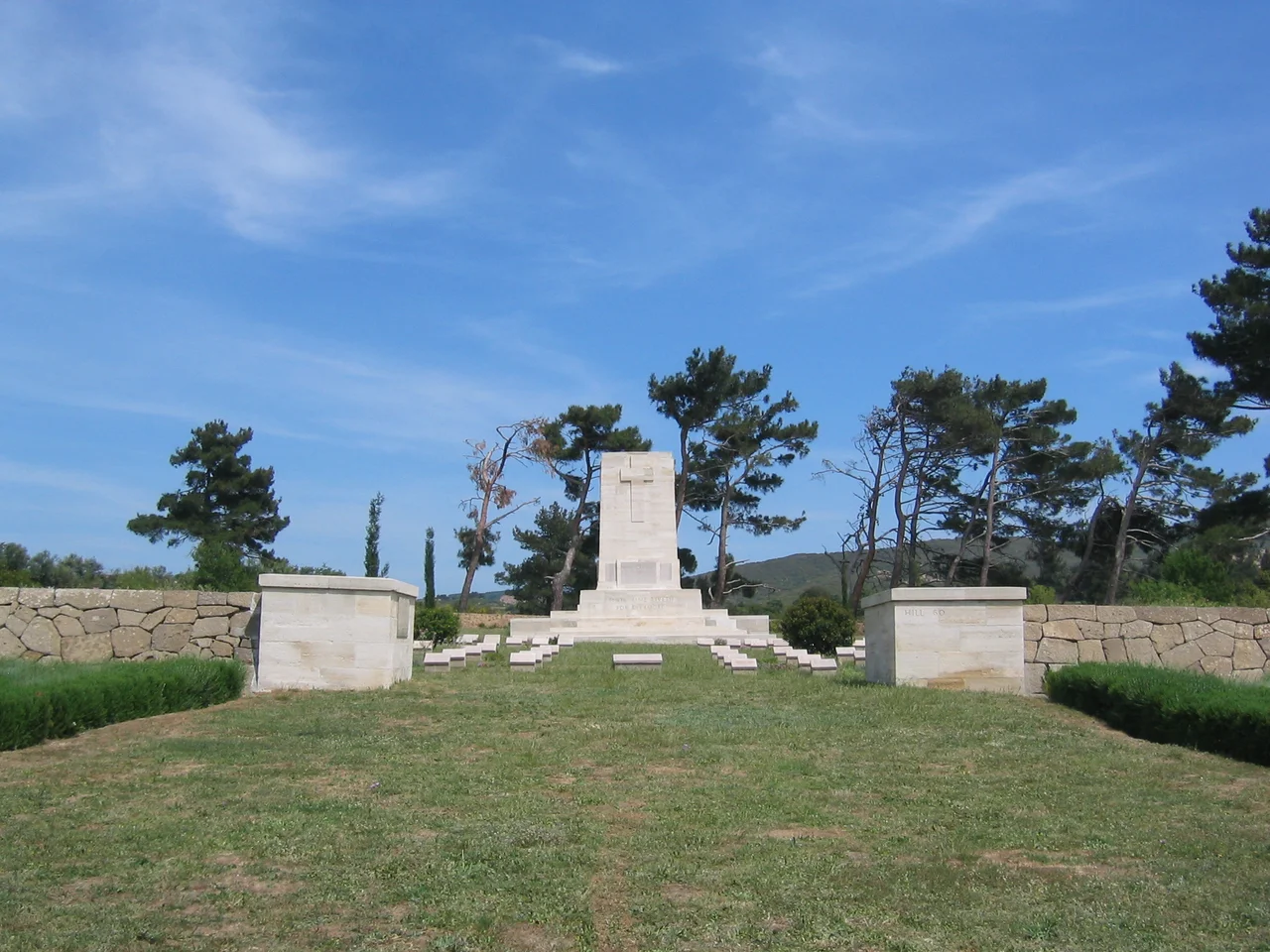
Through November, New Zealand sappers tunnelled under the summit and blew a crater there that the Allies never bothered to occupy. By 19 December the trenches at Anzac were being quietly evacuated, candles left burning on parapets, rifles rigged to fire by themselves with cans of dripping water. After the war, the Treaty of Lausanne gave the Imperial War Graves Commission the right to lay out cemeteries on the ground where the men had fallen. The Hill 60 Commonwealth War Graves Commission Cemetery sits on the slope today, walled in white stone, looking down toward Suvla Bay. The names cut into the headstones come from Auckland, Adelaide, Galway, Dehradun, and Cardiff. Nearly all of them were under thirty when they died.
From the Air
40.27°N, 26.29°E, on the Gallipoli peninsula about 1.5 km inland of the northern end of Suvla Bay. From altitude the cemetery shows as a small white rectangle on a low rise; Anzac Cove lies to the south, Salt Lake at Suvla to the north. Nearest airfield is Çanakkale (LTBH) across the strait. Best photographed in morning light when the eastern slope is shadowed.
Nearby Stories
- Canakkale Martyrs' Memorial 3.9 km away
- SMS Kurfürst Friedrich Wilhelm / Barbaros Hayreddin 14 km away
- 2014 Aegean Sea Earthquake 18 km away
- Çimpe Castle 25 km away
- Mount Ida (Turkey) 43 km away
- Battle of Athos 62 km away
- Uzunköprü Bridge 85 km away
- Battle of Philippi 125 km away