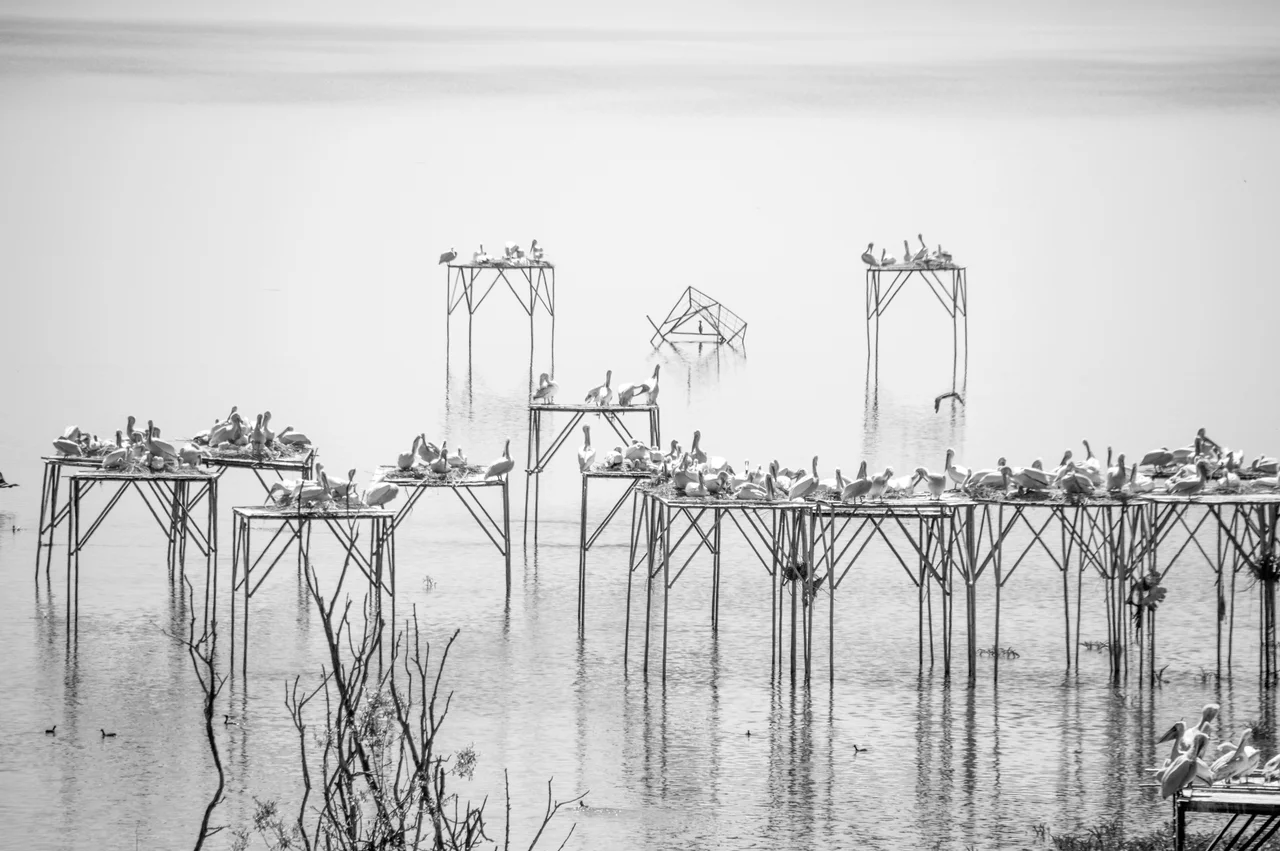

Lake Kuş
The name translates simply as Bird Paradise — Kuş Cenneti in Turkish — and the birds arrive to justify it. Every spring and autumn, the shallow waters of Lake Kuş (also called Lake Manyas) fill with pelicans, spoonbills, flamingos, and scores of other species passing through on the great migration corridors that cross northwestern Turkey. The lake sits 15 kilometers south of Bandırma, fed by four streams and a matrix of groundwater, its average depth barely three meters. Narrow belts of Phragmites reed fringe its edges; small deltas of marsh and willow line the stream mouths. More than 270 bird species have been recorded here. Some nest. Some winter. Some simply pass through and keep moving. A few, like the vulnerable Dalmatian pelican, treat the lake as one of their most important refuges in the eastern Mediterranean.
A German Zoologist and a 64-Hectare Miracle
The Kuş Cenneti nature reserve — 64 hectares carved from the lake's northeastern corner near the village of Sığırcık — was established in 1938. The driving force was Curt Kosswig, a German zoologist and hydrologist who worked in Turkey from 1937 to 1955 and recognized the lake's exceptional ecological value at a time when conservation was not yet a global preoccupation. The reserve he helped create is small by international standards: a pocket of unspoiled lakeside habitat that has somehow held its own against the pressures pressing in from all sides.
A small ornithological museum occupies the reserve — its collection of stuffed birds reportedly in poor condition, a reminder that the living spectacle outside is far more compelling than any display case. An observation tower, erected by the Hydrology Department of the University of Istanbul in 1952, gives visitors a vantage point over the reed beds and open water. Remote-controlled cameras extend the view further. The reserve is free to enter.
Wings Over Still Water
The lake's birdlife is exceptional not just in quantity but in rarity. The Dalmatian pelican (Pelecanus crispus) maintains a breeding population here — a globally vulnerable species whose numbers have declined across much of its range. Great white pelicans (Pelecanus onocrotalus) arrive in migrating flocks to roost, their wingspan stretching past two meters. Eurasian spoonbills sweep the shallows with their spatulate bills. Greater flamingos wade in the shallower margins, pink and improbable against the muted brown reed beds. White-headed ducks — a globally endangered diving duck — appear on the open water.
The best times to visit are March through July, when northbound migrants are arriving and resident species are nesting, and again from September through October during the southbound return. In the quiet months between, the lake belongs mostly to wintering waterfowl and to the small resident community of animals that live here year-round, including the Manyas spirlin — a cyprinid fish endemic to this lake's drainage basin and found nowhere else on Earth.
Pressures on the Paradise
The name Bird Paradise carries weight, but the reality is complicated. Lake Kuş is under pressure from multiple directions at once. Agricultural intensification in the surrounding lowlands delivers fertilizers and pesticides into the water through runoff and through the four streams that feed it. Industrial and household pollution also reaches the lake in quantities that water quality reports have flagged as serious. Fishing, once a livelihood for local communities, has declined drastically — a result of over-fishing, disease, and disruption to the water regime.
The construction of a regulator on the lake's outlet has made fish migration impossible. Artificially elevated water levels, maintained for irrigation purposes, have drowned the shallow feeding marshes that migratory birds depended on. Nesting trees within the national park have begun to die, standing in water that was not there before. Drainage and dam construction elsewhere in the watershed compound the problem. The 64-hectare reserve is doing what it can, but it is a small sanctuary inside a large and contested landscape.
Between the Lake and the Sky
What draws visitors who make the short drive south from Bandırma is the sensation — rare even in dedicated nature reserves — of being genuinely outnumbered by birds. In the breeding season, the colony trees at Sığırcık hold dozens of nesting pairs of herons, cormorants, spoonbills, and pelicans simultaneously, the air thick with calls and the smell of an ancient rookery. The observation tower puts you level with the canopy. Below, the shallow water reflects an overcast Turkish sky.
The lake is a Ramsar-designated wetland, recognized under the international convention for its global importance to migratory waterbirds. That designation has helped focus conservation attention, but has not by itself reversed the pressures. Lake Kuş remains, for now, a place of genuine wildness within a densely farmed and industrialized region — a Bird Paradise still earning its name, if only just.
From the Air
Lake Kuş lies at approximately 40.1953°N, 27.9678°E, roughly 15 km south of Bandırma. The nearest airport is LTBG (Bandırma Airport), approximately 20 km to the north-northeast. At 3,000–5,000 feet, the lake is unmistakable — a broad, shallow oval set amid flat agricultural land, with the reed-fringed margins clearly distinguishable from open water. The Kuş Cenneti reserve occupies the northeast corner near Sığırcık. In spring, large pelican flocks are sometimes visible from low altitude. The Sea of Marmara is visible to the north on clear days.
Nearby Stories
- SS Memel / Ivan Sechenov 3.5 km away
- Kapıdağ Peninsula 8.9 km away
- Battle of the Granicus 17 km away
- Balıkesir 29 km away
- Edremit 48 km away
- Green Mosque of Bursa 51 km away
- 1509 Constantinople Earthquake 56 km away
- Antalya Museum 387 km away